Published:
Estimated reading time:
8–9 minutes

Ask an AI assistant how Amazon S3 works and it can probably give you a useful answer.
Ask it which of your production S3 buckets are currently exposed to the internet and the problem changes completely.
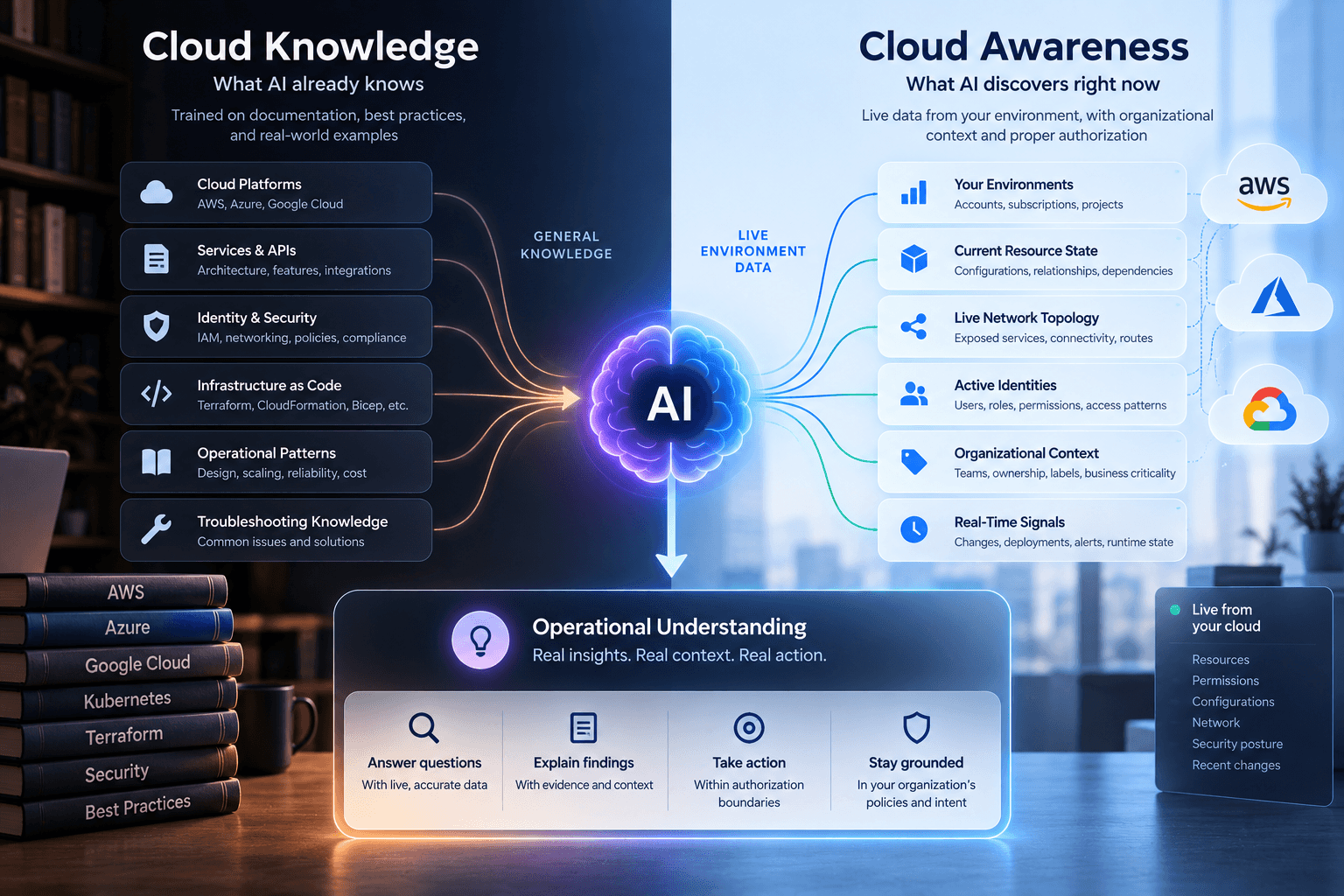
The first question requires cloud knowledge.
The second requires cloud awareness.
Modern AI models know an enormous amount about AWS, Microsoft Azure, Google Cloud, Kubernetes, Terraform, networking, identity, security, and other infrastructure technologies. But knowing how cloud infrastructure works is very different from knowing what is happening inside a particular organization's cloud right now.
For AI to become genuinely useful in cloud operations, it needs more than knowledge.
It needs a secure way to observe live cloud state, understand organizational context, investigate relationships, preserve authorization boundaries, and reason over what it discovers.
That is what turns a cloud-aware AI from a chatbot into an operational tool.
Cloud Knowledge Is Not Cloud Awareness
Large language models are trained on enormous amounts of technical information.
They can explain how IAM policies work. They can write Terraform. They can describe why an Application Load Balancer might return a 502 error. They can explain how Azure networking or Google Cloud IAM works.
That knowledge is valuable.
But an AI model does not inherently know that your production application is currently behind a particular load balancer, which security groups are attached to it, what changed this morning, or which databases those workloads can reach.
Those answers depend on the current state of your environment.
Consider two questions:
How do AWS security groups work?
and
Which internet-facing workloads in our production environments can currently reach a database on port 5432?
The first can be answered from technical knowledge.
The second requires investigation.
The AI must identify the relevant environments, query current infrastructure, understand relationships between resources, and reason across the results.
That is cloud awareness.
The Cloud Is Continuously Changing
Cloud infrastructure is not a static dataset.
Resources are created and destroyed. Deployments change configurations. Engineers modify permissions. Autoscaling creates new instances. Serverless workloads appear and disappear. Security controls change. Temporary credentials expire. Network relationships evolve.
Even a highly detailed representation of the environment describes the cloud at a particular moment.
That creates an important challenge for AI systems.
If an AI is reasoning from information synchronized ten minutes ago, one hour ago, or yesterday, it may be reasoning about an environment that no longer exists in that form.
For some questions, that delay is acceptable.
Historical reporting, trend analysis, cost analytics, and compliance evidence often benefit from stored datasets.
Operational investigation is different.
When someone asks:
What is exposing this service to the internet right now?
the word right now matters.
Real-Time Cloud Understanding Starts With Tools
An AI model cannot simply think harder and discover the state of an AWS account.
It needs tools.
Those tools might expose cloud-provider APIs, internal systems, identity platforms, observability data, ticketing systems, security platforms, or other operational sources.
For cloud infrastructure, provider APIs are particularly important because they represent the systems that actually control the environment.
If AI needs to know which load balancers currently exist, it can query the relevant AWS, Azure, or Google Cloud APIs.
If it needs to understand what is behind one of those load balancers, it can query the next relevant service.
If the answer reveals another relationship, it can continue investigating.
The model provides reasoning.
The tools provide awareness.
Together, they allow AI to move from answering generic cloud questions to investigating a specific environment.
Real Time Does Not Mean One Giant API Call
Cloud providers do not expose an API called:
Tell me everything happening in my cloud.
Cloud state is distributed across hundreds of services and thousands of API operations.
Understanding an environment therefore requires orchestration.
Suppose an engineer asks:
What is publicly exposed in production?
An AI system might first need to determine which cloud environments represent production.
It can then query relevant networking, compute, load-balancing, storage, or other services.
If it discovers an internet-facing load balancer, the next step might be to identify its listeners and targets.
The targets could lead to workloads.
Those workloads could lead to security groups, identities, databases, queues, or storage.
Each answer changes what the AI needs to investigate next.
Real-time cloud understanding is therefore less like running one search query and more like conducting an investigation.
Conversation Is Useful Because Investigations Branch
This is one reason conversational interfaces work particularly well for cloud operations.
Traditional dashboards assume the questions in advance.
A dashboard designer decides which metrics, resources, findings, or relationships should appear on the screen.
An investigation is less predictable.
An operator might begin with:
Which production environments have internet-facing resources?
Then ask:
What is behind those load balancers?
Then:
Which databases can those workloads reach?
Then:
Who owns that environment?
Each question depends on what was discovered previously.
A conversational AI can preserve that investigation context and continue reasoning from the accumulated evidence.
The conversation is not valuable merely because typing English is easier than writing an API call.
It is valuable because the AI can maintain the thread of an evolving investigation.
Live Cloud State Is Only Half the Problem
Imagine an AI discovers an EC2 instance in AWS account 123456789012.
Technically, it has discovered live cloud state.
Operationally, the information may still be almost meaningless.
What does that account represent?
Is it production or development?
Which application does it support?
Who owns it?
How critical is it?
Does it contain regulated workloads?
Should an incident involving that account wake someone up at 3:00 AM?
Cloud APIs are excellent at describing infrastructure.
They do not necessarily describe what that infrastructure means to the business.
AI therefore needs another type of information:
organizational context.
Organizational Context Gives Infrastructure Meaning
Organizations usually think about infrastructure differently from cloud providers.
AWS sees accounts and resources.
Azure sees subscriptions and resources.
Google Cloud sees projects and resources.
The business sees products, teams, environments, customers, critical systems, and ownership.
A cloud-aware AI needs to connect those perspectives.
Suppose an alert identifies an untagged EC2 instance.
The resource itself might provide limited context.
But if the AI knows the AWS account belongs to the production cybersecurity environment, is owned by the security platform team, and is classified as business critical, the finding has a very different meaning than the same resource in a development environment owned by an internal experimentation team.
The resource state came from the cloud.
Its operational meaning came from organizational context.
Both are necessary for useful reasoning.
You Do Not Need to Copy the Entire Cloud to Understand It
One common approach to cloud visibility is to continuously ingest resources into a centralized inventory.
The platform creates a stored representation of AWS, Azure, and Google Cloud resources and then allows applications to query that representation.
This architecture has legitimate uses.
Historical analysis, cross-resource indexing, trend reporting, and large-scale analytics can benefit from synchronized datasets.
But a synchronized resource inventory is not the only way to give AI cloud awareness.
A system can maintain the organizational information that changes less frequently, such as environments, accounts, subscriptions, projects, identities, namespaces, ownership, and labels.
When current infrastructure state is needed, the AI can query the cloud provider directly.
This creates a useful separation:
Persistent organizational context
plus
Live operational state
The AI knows where to look and what the environment means, while provider APIs describe what exists there now.
Live Queries Avoid a Difficult Question: How Stale Is Too Stale?
Every synchronized inventory introduces some delay between reality and representation.
That delay might be seconds or minutes.
The important question is not whether the inventory is technically "real time."
It is whether the information is current enough for the decision being made.
For a monthly cost report, an hour of delay may be irrelevant.
For an active security investigation, it could matter considerably.
Querying the authoritative provider API at investigation time changes the model.
Instead of asking:
What did our inventory last observe?
the system can ask:
What does the cloud report now?
That does not eliminate every consistency problem. Cloud-provider APIs themselves have different behaviors, and distributed systems always contain timing considerations.
But it moves the source of operational truth closer to the system actually running the infrastructure.
Multi-Cloud Makes Awareness Harder
Cloud awareness becomes more complicated when an organization operates AWS, Azure, and Google Cloud.
The same operational question may require completely different APIs and resource relationships in each provider.
Consider:
Which production environments expose storage publicly?
In AWS, the investigation may involve S3 configuration and policy mechanisms.
In Azure, it may involve storage account and container configuration.
In Google Cloud, it may involve Cloud Storage IAM and public access controls.
The user should not necessarily need to translate the question into three provider-specific investigations.
AI can provide the reasoning layer that determines which tools and APIs are required for each environment.
The clouds remain different.
The operational intent remains common.
This is where a unified cloud control plane becomes particularly useful.
It can provide common organizational context and authorization while allowing AI to interact with provider-specific APIs underneath.
AI Needs Authorization, Not Just Connectivity
Giving AI access to cloud APIs creates another problem.
Whose access is it using?
The simplest architecture is to create a powerful cloud identity for the AI platform.
Every user asks questions through the AI, and the AI performs the corresponding cloud operations using that shared identity.
That provides connectivity.
It weakens the security model.
Suppose Alice is authorized to investigate development but not production. Bob is authorized for both.
If both users send requests through an AI identity that can read everything, the AI platform must recreate every authorization boundary perfectly before every tool call.
Cloud-provider logs also see the AI identity interacting with the environment rather than naturally preserving the authority of the person who initiated the investigation.
A cloud-aware AI should not become a shortcut around existing access controls.
The AI Should Operate Under the Requester's Authority
A stronger model begins with the requesting identity.
When a user asks the AI to investigate an environment, the system can determine whether that person is authorized to access the target.
If authorization succeeds, Secure Execution can obtain temporary, appropriately scoped credentials on behalf of the user.
The AI then interacts with cloud APIs under that authorization context.
The trust chain becomes:
User → AI Investigation → Authorization → Temporary Credentials → Cloud APIs
This preserves an important principle:
AI should not gain authority simply because a user asked it a question.
The user's authorization determines what the AI can investigate.
This becomes even more important as AI systems move from reading cloud state to modifying it.
Read-Only Awareness and Cloud Modification Are Different Trust Decisions
An AI that can investigate infrastructure is not automatically an AI that should be allowed to change infrastructure.
These capabilities should be separated.
Read-only cloud investigation can answer questions, trace relationships, explain configurations, identify likely problems, and propose solutions.
Modification introduces a different level of risk.
An organization may allow AI to investigate production while requiring proposed infrastructure changes to be generated as Infrastructure as Code, validated, committed to Git, reviewed through a pull request, and deployed through an existing pipeline.
The same AI can participate in both workflows.
The authorization model does not have to be the same.
That distinction allows organizations to adopt cloud-aware AI incrementally instead of making an all-or-nothing decision about autonomous cloud operations.
Awareness Also Needs Explainability
When AI answers a cloud question, operators should be able to understand how it reached the answer.
Consider:
Why do you think this application is publicly accessible?
A useful answer should be grounded in evidence discovered from the environment.
The AI might explain that it found an internet-facing load balancer, traced its listener to a target group, identified the associated workloads, and observed the relevant network configuration.
This is much more useful than simply returning:
Yes, the application appears to be public.
Operational AI should distinguish between what it knows generally, what it observed from the environment, and what it inferred from those observations.
That distinction improves both trust and troubleshooting.
Cloud Awareness Can Extend Beyond Cloud APIs
Cloud infrastructure does not operate in isolation.
A complete operational decision might also depend on:
identity-provider information
endpoint or device posture
vulnerability data
monitoring and observability
incident-management systems
on-call schedules
deployment history
source-control activity
business ownership
These systems provide context that cloud APIs cannot.
For example, an AI might determine that a user technically has permission to request production access.
An endpoint-management system might indicate that the user's device no longer satisfies organizational security requirements.
An incident-management system might indicate that the person is currently responding to an active production incident.
Those signals can change the appropriate decision.
The future of cloud-aware AI is therefore not simply connecting an LLM to AWS, Azure, and Google Cloud.
It is giving AI controlled access to the context necessary to understand an operational situation.
From Cloud Awareness to Cloud Operations
Once AI can securely understand live cloud state, several capabilities become possible.
It can investigate incidents conversationally.
It can explain why a resource appears exposed.
It can correlate infrastructure with organizational ownership.
It can evaluate cloud environments against governance requirements.
It can identify remediation options.
It can generate proposed Infrastructure as Code changes.
It can help operators understand the impact of those changes before they are deployed.
The important progression is not:
Chatbot → Autonomous Cloud Administrator
It is:
Knowledge → Awareness → Reasoning → Governed Action
Each stage requires additional context and stronger controls.
That is a more practical path toward AI-driven cloud operations.
How StratoCloud Gives AI Live Cloud Awareness
StratoCloud's approach to AI cloud operations is built around the distinction between stored organizational context and live infrastructure state.
StratoCloud maintains context about AWS accounts, Azure subscriptions, Google Cloud projects, namespaces, synchronized cloud identities, and cloud-agnostic labels.
Those structures help describe how cloud environments relate to the organization.
StratoCloud does not need to maintain a synchronized inventory of every individual cloud resource in order for AI to investigate the environment.
When a user asks an operational question, StratoCloud's AI can query relevant provider APIs to understand current cloud state.
The result combines two sources of understanding:
What does the organization know about this environment?
and
What does the cloud say is happening right now?
Talk to Your Cloud
Talk to Your Cloud provides the conversational interface to this model.
A user can begin with an operational question rather than selecting a provider, service, API, or dashboard.
The AI can determine which environments and tools are relevant, query live cloud state, reason about the results, and preserve context as the investigation continues.
Follow-up questions build on what has already been discovered rather than starting a new search from scratch.
Organizational Context
Namespaces and cloud-agnostic labels provide business context above provider hierarchy.
AWS accounts, Azure subscriptions, and Google Cloud projects can be associated with concepts such as environment, ownership, business function, and criticality.
This allows the AI to reason about infrastructure as part of the organization rather than as isolated provider resources.
Identity-Preserving Secure Execution
Cloud awareness also respects access boundaries.
Before investigating a target environment, StratoCloud can verify that the requesting user is authorized.
Secure Execution can then obtain temporary just-in-time read-only credentials on behalf of that user.
The AI interacts with cloud APIs within the user's authorization context rather than relying on one shared, permanently privileged AI identity.
From Understanding to Governed Action
Live awareness can then connect to the rest of the cloud lifecycle.
Continuous Governance can evaluate cloud environments against organizational requirements.
Intelligent Remediation can turn findings into proposed solutions, including validated Infrastructure as Code delivered through pull requests.
Secure Execution can govern how humans, workloads, and AI interact with cloud environments.
The AI therefore becomes part of a broader control plane rather than an isolated chatbot attached to cloud APIs.
Real-Time Cloud AI Is an Architecture, Not a Model Feature
The intelligence of AI models will continue improving.
They will become better at reasoning about infrastructure, writing code, understanding security relationships, and planning operational tasks.
But no model, regardless of how capable it becomes, can know the current state of a private cloud environment without access to that environment.
Real-time cloud understanding therefore depends on architecture.
The AI needs tools.
It needs live data.
It needs organizational context.
It needs identity.
It needs authorization.
It needs secure execution.
And when understanding turns into action, it needs governance.
The future of AI cloud operations will not be defined only by how much the AI knows.
It will be defined by how safely and accurately the AI can discover what is true right now.
Frequently Asked Questions
Can AI monitor cloud infrastructure in real time?
AI can use cloud-provider APIs and other operational tools to retrieve current state and reason about what it discovers. The freshness of that understanding depends on the underlying data sources and when they are queried.
Does an AI model already know what is in my AWS account?
No. A model may understand AWS concepts and services, but it cannot inherently know the current state of a private AWS environment. It needs authorized access to tools or APIs that expose that information.
What is the difference between cloud knowledge and cloud awareness?
Cloud knowledge is general understanding of cloud technologies, APIs, architecture, and operational patterns. Cloud awareness is knowledge of the current state and organizational meaning of a specific cloud environment.
Does real-time cloud AI require a resource inventory?
Not necessarily. AI can query cloud-provider APIs when current resource state is required while using persistent organizational context to understand which environments matter and what they represent.
Why is organizational context important for cloud AI?
Cloud APIs describe infrastructure but often cannot explain its business meaning. Organizational context can tell AI who owns an environment, whether it is production, what business function it supports, and how critical it is.
How does AI work across multiple cloud providers?
AI can interpret a common operational question and determine which provider-specific APIs are required across AWS, Azure, and Google Cloud. A unified control plane can provide common context and authorization while preserving provider-specific implementation.
Should AI use a shared cloud identity?
A shared identity can simplify integration but weakens attribution and can create broad privilege. An identity-preserving model can authorize the requesting user and obtain temporary credentials appropriate to that person's access.
Is read-only AI cloud access safe?
Read-only access substantially limits risk compared with modification, but it still exposes potentially sensitive infrastructure information. It should remain authorized, scoped, temporary where practical, and auditable.
Should AI be allowed to modify cloud infrastructure?
Modification should be treated as a separate trust decision from investigation. For many infrastructure changes, AI can generate and validate Infrastructure as Code while existing Git review and deployment workflows retain control over production execution.
Is conversational cloud operations just a chatbot?
Not when the AI can securely use operational tools. A chatbot primarily answers from existing knowledge or supplied information. A cloud-aware operational AI can query live environments, reason about the results, preserve investigation context, and operate within authorization boundaries.