Published:
Estimated reading time:
9–10 minutes

Running infrastructure across multiple clouds creates an unusual problem.
AWS, Microsoft Azure, and Google Cloud each provide powerful tools for operating their own environments. They have their own APIs, identity systems, organizational hierarchies, policy frameworks, security controls, and operational models.
The challenge begins when an organization needs to operate across all of them.
A security team may want one policy to apply to production environments regardless of cloud provider. A platform team may need to understand which cloud environments belong to a particular product. An engineer may need temporary access to infrastructure spread across multiple clouds. An incident responder may need to investigate a problem without first determining which provider console contains the answer.
Organizations often try to solve this by centralizing cloud data into dashboards.
But a unified dashboard is not necessarily a unified cloud control plane.
A true cloud control plane creates a common operational layer above the cloud providers while allowing each provider to remain different underneath.
What Is a Unified Cloud Control Plane?
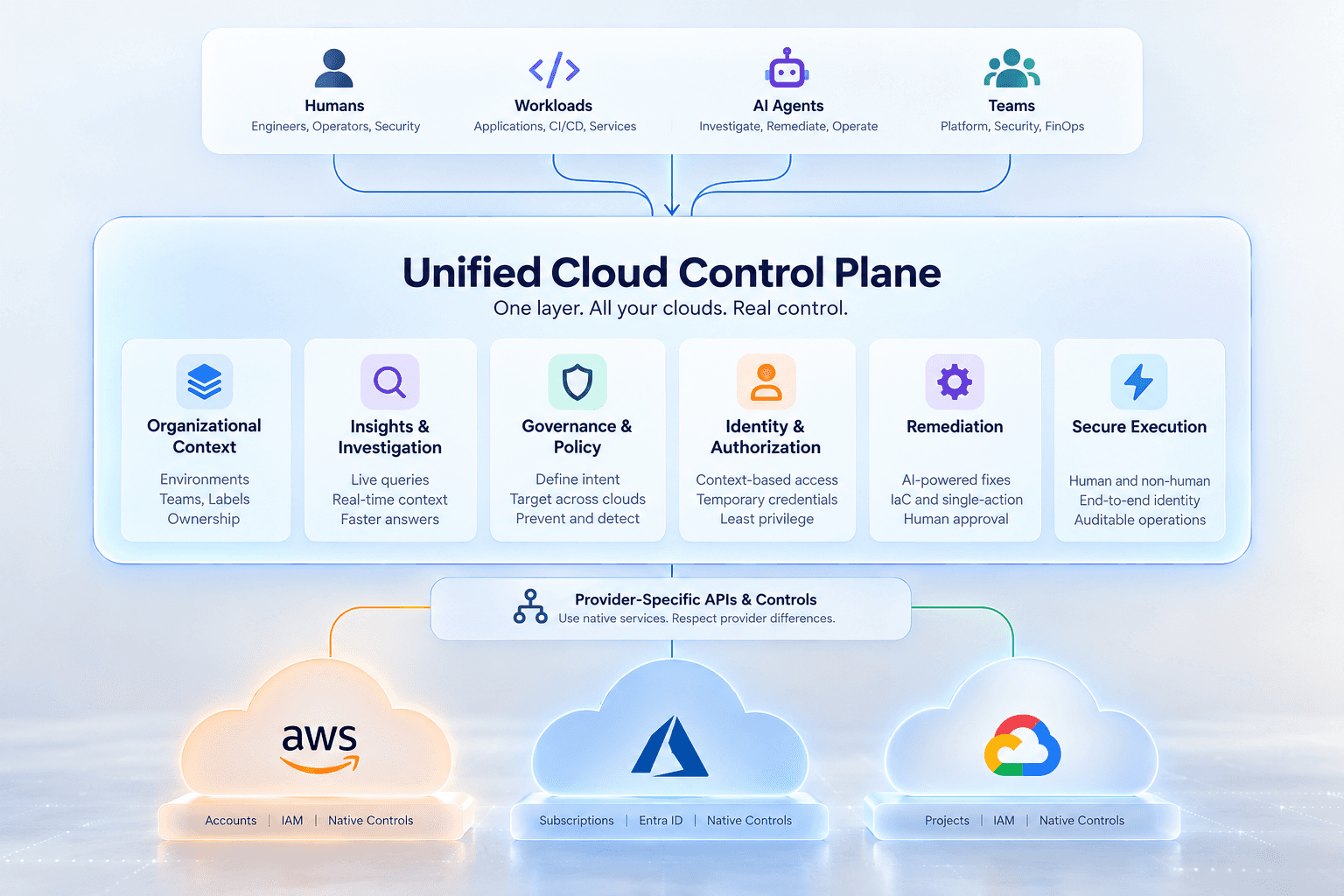
A unified cloud control plane is a layer through which an organization can understand, govern, authorize, and operate cloud environments across multiple providers.
It does not replace AWS, Azure, or Google Cloud.
It sits above them.
The cloud providers remain responsible for their infrastructure, APIs, identity primitives, policy mechanisms, and native services. The control plane provides a common organizational and operational layer that determines how those capabilities should be used.
Conceptually, the architecture looks like this:
The Goal Is Not to Make Every Cloud the Same
Multi-cloud platforms frequently make an appealing promise:
Write once and operate every cloud the same way.
That idea works for some abstractions, but it breaks down quickly in real cloud environments.
An AWS account is not an Azure subscription. AWS IAM is not Azure RBAC. Amazon S3 is not identical to Azure Blob Storage or Google Cloud Storage. Each provider has different APIs, resource models, security controls, networking constructs, and operational capabilities.
Those differences are not merely inconvenient implementation details.
Sometimes they represent useful capabilities that organizations intentionally chose a provider to obtain.
A unified cloud control plane should therefore avoid reducing every provider to the lowest common denominator.
The goal is not:
AWS = Azure = GCP
The goal is:
One organizational intent → appropriate provider-specific implementation
That is a much more useful abstraction.
Unify Intent, Not Infrastructure
Suppose an organization establishes a requirement:
Production object storage must not be publicly accessible.
The organizational intent is common.
How that requirement is evaluated or enforced can differ between AWS, Azure, and Google Cloud.
A control plane can understand that the same governance requirement applies across all production environments while translating the requirement into the appropriate provider-specific controls.
This separates two concepts that are often mixed together:
What the organization wants
and
How each cloud implements it
That separation becomes increasingly important as organizations add cloud providers.
Security and platform teams should not have to define their organizational intent from scratch for every provider. At the same time, they should not lose access to the provider-specific mechanisms required to implement that intent correctly.

Organizational Context Has to Exist Above the Providers
Cloud providers organize infrastructure differently.
AWS commonly uses organizations, organizational units, and accounts. Azure uses tenants, management groups, subscriptions, and resource groups. Google Cloud uses organizations, folders, projects, and other resource hierarchy constructs.
Those structures are useful for administering each provider.
They do not necessarily represent how the business thinks about its infrastructure.
Imagine a product called Payments.
Its production environment might include two AWS accounts, an Azure subscription, and a Google Cloud project.
From the business perspective, those environments belong together.
From the cloud providers' perspectives, they have no relationship at all.
A unified control plane can provide an organizational layer above provider hierarchy.
Instead of forcing the business to organize itself around AWS Organizations, Azure management groups, or Google Cloud folders, cloud environments can be associated with concepts such as:
product
team
business unit
environment
geography
data sensitivity
criticality
This context becomes useful across almost every cloud operation.
A finding in a random account number means little to an executive or incident responder. Knowing that the account belongs to the production Payments environment, is owned by the Payments platform team, and is classified as business critical immediately changes how the finding is understood.
Cloud-Agnostic Context Does Not Require Cloud-Agnostic Resources
There is an important distinction here.
A control plane can maintain cloud-agnostic organizational context without maintaining a cloud-agnostic representation of every individual cloud resource.
Those are different architectural decisions.
Many cloud management platforms build a synchronized inventory containing representations of resources from each provider. Applications then query that database instead of querying the cloud itself.
That model can be useful for certain workloads, but it introduces synchronization challenges. The platform must continually ingest changes, normalize provider-specific resource models, and determine how stale the resulting representation is allowed to become.
Another model is possible.
A control plane can understand high-level organizational structure such as AWS accounts, Azure subscriptions, Google Cloud projects, namespaces, labels, and identities while querying the providers directly when current resource state is required.
That means organizational context can remain persistent while operational state can remain live.
The distinction becomes particularly valuable during investigation.
The control plane knows where the environment belongs in the organization while the provider APIs answer what is happening inside that environment right now.
A Unified Control Plane Should Understand Live Cloud State
Traditional dashboards are usually built around predetermined questions.
How many resources exist? How many findings are open? What is our compliance percentage? Which accounts have the highest cost?
Those are useful questions, and dashboards remain valuable for recurring monitoring.
Operational investigation is different.
An engineer might begin with:
Which production environments currently expose services to the internet?
The answer creates the next question:
What is behind those load balancers?
That answer might lead to:
Which databases can those workloads reach?
The investigation cannot always be modeled as a predetermined dashboard because the next question depends on the previous answer.
A control plane that can query live cloud APIs gives AI and operators another interface for working with cloud infrastructure.
Instead of navigating provider structure first, they can begin with operational intent.
The control plane can determine which environments are relevant, which provider APIs can answer the question, and how the resulting information relates to organizational context.
This is where conversational cloud operations become part of the control-plane architecture rather than simply another chatbot interface.
Governance Needs a Common Targeting Model
Defining a policy is only part of cloud governance.
The organization also needs to determine where that policy applies.
A rule might apply to:
every production environment
environments owned by a particular business unit
cloud environments containing regulated workloads
development environments except approved sandboxes
critical production environments across every provider
Provider hierarchy alone cannot always express those relationships cleanly.
If targeting depends only on AWS organizational units, Azure management groups, and Google Cloud folders, teams must recreate organizational structure independently inside every provider.
A higher-level control plane can instead determine scope from organizational context and then apply the appropriate provider-specific governance mechanism.
This makes governance portable at the level where portability actually matters: organizational intent and scope.
The underlying enforcement can remain cloud specific.
Identity Is Part of the Control Plane
Cloud operations ultimately happen under an identity.
A human opens a console. A workload calls an API. A CI/CD pipeline deploys infrastructure. An AI agent investigates an incident.
A unified control plane therefore cannot focus only on resources and policies.
It also needs to understand who or what is attempting to act.
A tempting multi-cloud architecture is to give the control plane broad identities in AWS, Azure, and Google Cloud and execute every operation through those shared identities.
That simplifies integration.
It also collapses attribution.
Cloud-provider audit logs may show that the platform identity performed an operation without clearly preserving which human, workload, or AI process initiated it.
A stronger control-plane architecture preserves the initiating identity and authorization context.
When an authorized user needs access, the control plane can evaluate the request and obtain temporary credentials appropriate to the target provider and requested operation.
The control plane becomes an authorization and execution layer without turning into one permanent, universally privileged cloud identity.
Context Can Make Authorization Dynamic
Identity alone does not always provide enough information to make an access decision.
Consider an engineer who is normally permitted to access production.
Whether that access should be granted right now might depend on additional context:
which environment is being requested
what role is needed
whether approval exists
whether the user is currently on call
device security posture
vulnerability or endpoint risk
incident or change context
requested duration
A unified control plane can combine these signals with identity before issuing access.
This creates a common authorization model above AWS, Azure, and Google Cloud even though the resulting temporary credentials remain provider specific.
The control plane does not need to pretend the providers use the same identity system.
It provides a common place to answer a higher-level question:
Should this identity receive this access under these circumstances right now?
Remediation Belongs in the Same Lifecycle
Detection without remediation leaves the operational loop incomplete.
A governance system may discover that an environment violates policy. An operator then needs to understand the problem, determine the correct solution, implement it, and verify that the environment now satisfies the requirement.
A unified control plane can connect those stages.
Consider a governance finding in an AWS production environment.
The control plane already knows the organizational context surrounding the account. It understands the policy that produced the finding. AI can help investigate the live environment and reason about an appropriate solution.
If the infrastructure is managed as code, the remediation can be proposed as an Infrastructure as Code change.
That change can be validated and delivered through a pull request rather than allowing an AI agent to directly modify production.
After the organization's existing pipeline deploys the change, governance can evaluate the environment again.
The lifecycle becomes:
Understand → Govern → Remediate → Execute → Verify
Each capability reinforces the others.
AI Makes a Control Plane More Useful, Not Less Necessary
Generative AI has created a new interface for cloud operations.
Instead of learning every API or navigating dozens of provider consoles, engineers can increasingly express what they want in natural language.
But AI does not eliminate the need for a control plane.
It increases it.
An AI agent needs tools that can access cloud APIs. It needs organizational context so it understands what environments mean. It needs authorization so it cannot simply act everywhere. It needs temporary credentials or another secure execution mechanism. It needs governance boundaries around what actions are permitted.
Without those capabilities, conversational cloud operations risk becoming a powerful AI interface attached to excessively broad cloud credentials.
The control plane provides the structure around the intelligence.
AI can reason about what should happen.
The control plane determines where, under whose authority, within what policy, and through which execution path it may happen.
Why a “Single Pane of Glass” Is Not Enough
For years, cloud management products have promised a single pane of glass.
The idea is appealing.
Instead of opening AWS, Azure, and Google Cloud consoles separately, teams get another dashboard containing information from all three.
That can improve visibility, but it does not necessarily create operational unification.
If an engineer still needs separate processes for governance, identity, access, remediation, and execution, the organization has consolidated its dashboards without consolidating its operating model.
A unified cloud control plane should provide more than aggregated visibility.
It should give the organization a common way to express:
What environment are we talking about?
What do we want to know?
What policies should apply?
Who is allowed to act?
What should change?
How should that change be executed safely?
Those are control-plane questions.
Displaying three clouds on one screen is not.
The Control Plane Should Connect Humans, Workloads, and AI
Cloud infrastructure is no longer operated only by people.
Applications access cloud services. CI/CD pipelines deploy infrastructure. automation systems respond to events. AI agents increasingly investigate environments and propose or perform operational tasks.
These actors should not require completely separate governance models.
A unified control plane can provide common principles across them:
identifiable actor
explicit authorization
organizational context
least privilege
temporary access where possible
policy evaluation
auditable execution
The implementation may differ.
A human might authenticate through an identity provider. A workload might exchange an identity token for temporary cloud access. An AI agent might operate on behalf of an authorized human.
But the underlying security question remains consistent:
Who or what is acting, what are they allowed to do, and under what context?
What Should a Unified Cloud Control Plane Actually Unify?
A useful control plane should unify the things the organization itself considers common.
That includes organizational context, governance intent, access decisions, operational investigation, remediation workflows, and execution controls.
It should not artificially normalize every provider-specific feature.
This produces a useful architectural boundary.
Above the boundary: organizational intent.
Below the boundary: provider implementation.
The organization can therefore operate consistently without requiring its clouds to become identical.
How StratoCloud Approaches the Unified Control Plane
StratoCloud is built around this distinction.
AWS accounts, Azure subscriptions, and Google Cloud projects can be organized into StratoCloud namespaces that reflect how the business understands its environments rather than being limited by each provider's hierarchy.
Cloud-agnostic labels can add context such as ownership, environment, business function, or criticality to namespaces, accounts, subscriptions, projects, and synchronized cloud identities.
That organizational context can then be used across four connected capabilities.
Insights
StratoCloud can query live cloud environments to answer operational questions without requiring a synchronized inventory of every individual cloud resource.
Users and AI can investigate current state through provider APIs while StratoCloud supplies the organizational context surrounding those environments.
Continuous Governance
Organizations can define governance intent and target environments using higher-level organizational context.
StratoCloud can then evaluate or enforce that intent using mechanisms appropriate to AWS, Azure, and Google Cloud.
The policy remains organizational.
The implementation remains provider specific.
Intelligent Remediation
When governance identifies a problem, StratoCloud can help reason about the finding and generate a proposed remediation.
For infrastructure configuration changes, AI-generated Infrastructure as Code can be created inside an isolated execution environment, validated, committed to an authorized GitHub repository, and delivered through a pull request.
The customer's existing review and deployment process remains responsible for deciding whether the proposed change reaches production.
Secure Execution
When humans, workloads, or AI need to interact with cloud environments, StratoCloud can evaluate authorization and context before providing temporary access.
Instead of forcing every operation through one shared cloud identity, Secure Execution can preserve the identity and authority behind the request while obtaining short-lived credentials appropriate to the target environment.
Together, these capabilities form a lifecycle:
Understand → Govern → Remediate → Execute → Verify
The goal is not to build another abstraction that hides the clouds.
It is to provide a common control layer for operating them.
The Future of Multi-Cloud Is Common Control, Not Identical Clouds
Multi-cloud complexity is unlikely to disappear.
AWS, Azure, and Google Cloud will continue developing different services, identity systems, APIs, security capabilities, and operational models.
Trying to eliminate those differences entirely creates another abstraction that teams eventually need to break through.
A better approach is to decide which concepts genuinely belong at the organizational level.
Ownership belongs there.
Governance intent belongs there.
Authorization belongs there.
Operational intent belongs there.
Remediation workflows belong there.
Auditability belongs there.
The provider-specific implementation can remain underneath.
That is the role of a unified cloud control plane: not to make every cloud identical, but to let an organization operate multiple clouds as one coherent system.
Frequently Asked Questions
What is a unified cloud control plane?
A unified cloud control plane is an organizational and operational layer above multiple cloud providers. It provides common capabilities for understanding, governing, authorizing, remediating, and operating cloud environments while using each provider's native APIs and controls underneath.
Is a cloud control plane the same as a single pane of glass?
No. A single pane of glass usually focuses on aggregating visibility into one interface. A control plane participates in operational decisions such as policy targeting, authorization, remediation, and secure execution.
Does a unified control plane replace AWS, Azure, or Google Cloud?
No. The cloud providers continue to provide the infrastructure, APIs, identity primitives, policy mechanisms, and native services. The control plane provides a common organizational layer above them.
Should a multi-cloud platform normalize every cloud resource?
Not necessarily. Excessive normalization can hide useful provider-specific capabilities and reduce everything to a lowest common denominator. Organizational intent and context can be unified without pretending every provider resource is identical.
Does a cloud control plane need a resource inventory?
Not always. A platform can maintain persistent organizational context about environments and identities while querying cloud-provider APIs when current resource state is required.
How does a control plane help with multi-cloud governance?
It separates organizational governance intent and targeting from provider-specific implementation. One requirement can apply across multiple clouds while each provider uses the appropriate native mechanisms to evaluate or enforce it.
How does identity fit into a cloud control plane?
Every cloud operation occurs under an identity. A control plane can evaluate authorization and context, preserve the initiating identity, and provide temporary provider-specific credentials rather than relying on one permanently privileged intermediary identity.
What role does AI play in a cloud control plane?
AI can provide reasoning and a natural-language interface for investigation, governance, and remediation. The control plane provides the context, authorization, tools, policy boundaries, and secure execution mechanisms that allow AI to interact with cloud infrastructure safely.
Can a unified cloud control plane manage both humans and workloads?
Yes. Humans, workloads, automation, and AI agents have different identity mechanisms, but they share fundamental requirements around identity, authorization, least privilege, context, and auditability.
Why is organizational context important in multi-cloud?
Provider hierarchies describe how infrastructure is organized within each cloud. Organizational context describes what those environments mean to the business, including ownership, product, environment, criticality, and business function. A unified control plane can connect the two.