Published:
Estimated reading time:
9–10 minutes

Artificial intelligence is changing how engineers interact with cloud infrastructure.
The first generation of AI assistants primarily answered questions. Engineers could ask for an explanation of a Terraform error, generate a command, summarize documentation, or get help troubleshooting an application.
AI agents go further.
Instead of only producing an answer, an agent can use tools, gather information, reason about what it discovers, and perform multiple steps toward a goal.
Applied to cloud operations, this creates a new category of system: the AI cloud agent.
An AI cloud agent is an AI system that can interact with cloud environments and operational tools to investigate problems, make decisions, and potentially perform actions on behalf of users or automated processes.
That capability can dramatically reduce operational work. It also creates an important security question:
How do you give AI enough access to be useful without giving it unrestricted control over your cloud?
What Is an AI Cloud Agent?
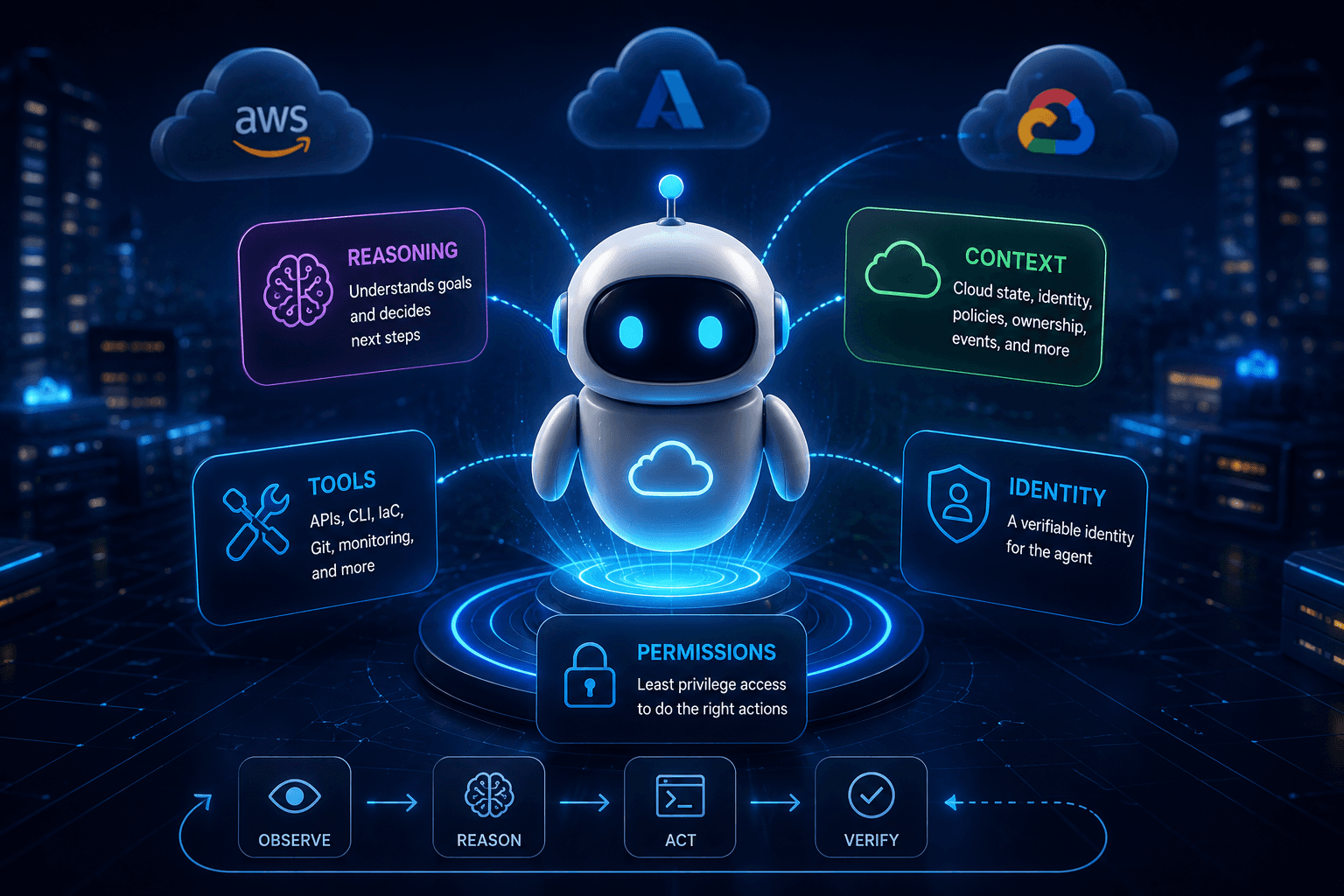
An AI cloud agent combines an AI model with the context, tools, identity, and permissions necessary to interact with cloud infrastructure.
A traditional AI chatbot primarily follows a simple pattern:
Question → Model → Answer
An agent can operate in a loop:
Goal → Gather Context → Reason → Use Tool → Observe Result → Reason Again → Continue
Imagine asking:
Which production systems are affected by this security finding?
A basic AI assistant might explain how you could investigate the problem.
An AI cloud agent could potentially query the cloud environment, identify the affected accounts or projects, inspect relevant configurations, correlate organizational context, and return a specific answer based on the current environment.
The difference is significant.
The AI is no longer only discussing the cloud. It is interacting with it.
What Makes an AI System an Agent?
Not every AI application is an agent.
An agent typically has several capabilities working together.
Reasoning
The AI interprets a goal and determines what information or actions are required.
Tools
The agent can invoke APIs, command-line utilities, code execution environments, search systems, repositories, cloud services, or other approved tools.
Context
The agent receives information about the environment in which it is operating.
That might include cloud configuration, identity information, organizational metadata, policies, security findings, application ownership, or operational events.
Memory or State
Some agents maintain information about what they have already discovered or done during a task.
This allows multi-step workflows rather than isolated requests.
Identity
If the agent interacts with protected systems, those systems need to know who or what is making the request.
An AI agent therefore becomes another identity that organizations must authenticate and govern.
Permissions
The agent should only be able to perform actions it has been authorized to perform.
This becomes one of the most important controls in AI-powered cloud operations.
AI Assistants vs. AI Agents
The distinction between assistants and agents is largely about agency.
An assistant helps a human decide what to do.
An agent can perform steps toward the objective.
For example, consider an engineer investigating unexpected cloud spending.
An AI assistant might provide a list of commands the engineer can run.
An AI cloud agent could query the relevant cloud environments, identify resources contributing to the increase, determine which environments and teams own them, and summarize the likely causes.
If the organization allows it, the agent could then prepare remediation actions.
The human still defines the objective and the organization defines the boundaries, but the AI performs more of the intermediate work.
Why Cloud Operations Are Well Suited to AI Agents
Cloud environments contain enormous amounts of information.
Engineers routinely move between cloud consoles, APIs, monitoring systems, security tools, Git repositories, ticketing systems, documentation, and internal platforms to understand what is happening.
Many operational tasks therefore involve gathering information from several places and reasoning across it.
AI agents are well suited to this type of work.
A cloud agent could help answer questions such as:
Which production environments are affected by this vulnerability?
Who owns the account where this resource is running?
Which cloud identities have not been used recently?
What changed before this incident started?
Which environments violate this security policy?
What Infrastructure as Code would remediate this finding?
Which cloud environments are associated with this application?
What is likely causing this unexpected increase in cloud spending?
The important shift is from navigating tools manually to expressing an operational goal.
From Cloud Dashboards to Cloud Conversations
Traditional cloud operations depend heavily on dashboards.
Dashboards remain useful, but they require users to know where information lives, which filters to apply, which provider console to open, and how different pieces of data relate to each other.
AI creates another interaction model.
Instead of navigating through multiple interfaces, engineers can increasingly ask questions in natural language.
For example:
Show me production environments affected by this finding and tell me who owns them.
The system can determine which information it needs, query the appropriate sources, and assemble an answer.
This moves cloud operations from navigation toward conversation.
The value is not simply that natural language is easier than clicking through a console. The larger opportunity is that an agent can reason across multiple pieces of information and perform the investigation itself.
AI Cloud Agents Need Current Cloud Context
An agent is only as useful as the information available to it.
Cloud environments change continuously.
Resources are created and deleted. Permissions change. Deployments occur. Incidents begin and end. Security findings appear. Ownership changes.
An agent answering operational questions therefore benefits from access to current cloud state rather than relying entirely on a stale representation of the environment.
For some questions, historical or indexed information is useful.
For others, the agent needs to investigate what exists right now.
That distinction becomes especially important when AI moves from general advice into operational decision-making.
AI Agents Become Cloud Identities
Once an AI agent can interact with cloud systems, identity becomes unavoidable.
The cloud needs some way to authenticate the agent.
This creates a new class of non-human identity.
Organizations already manage many types of machine identities, including service accounts, workload identities, CI/CD pipelines, automation systems, and applications.
AI agents add another category.
But agents introduce an additional challenge.
Traditional automation usually executes predefined logic.
An AI agent may dynamically decide which tool to use and which step to take next.
That means organizations need to think carefully about the identity and authorization model behind agent actions.
Why Giving AI Permanent Credentials Is Dangerous
The easiest way to connect an AI agent to cloud infrastructure would be to give it a long-lived credential with broad permissions.
It is also one of the most dangerous approaches.
If the credential is exposed, the attacker may inherit the same access.
If the agent behaves unexpectedly, its permissions remain available.
If the agent only needs access occasionally, the credential still exists continuously.
And if many agents are created, organizations can quickly accumulate another category of standing machine privileges.
AI agents therefore strengthen the argument for temporary credentials and ephemeral access.
The agent should receive the access it needs when it needs it, rather than permanently possessing powerful cloud credentials.
Least Privilege for AI Agents
Least privilege becomes more complex when applied to agents.
Traditional least privilege asks:
What permissions does this identity need?
For AI agents, organizations should ask additional questions:
What task is the agent performing?
Which environment is involved?
Which tools does the agent need?
Which cloud operations should be allowed?
How long should access exist?
Is the target production or development?
Does the action require human approval?
What is the potential blast radius?
Can the action be performed indirectly through Git rather than directly against production?
The goal is not simply to create a role called "AI Agent" and assign it broad permissions.
Authorization should reflect what the agent is trying to accomplish.
Context-Based Access for AI Agents
Context can make agent authorization significantly more precise.
Suppose an AI agent requests permission to investigate a production security finding.
The decision might consider the agent's identity, requested operation, target environment, finding severity, organizational policy, current task, and whether a human approved the workflow.
The same agent requesting a different action could receive a different decision.
This is where Context-Based Access Control becomes particularly relevant.
Instead of asking only:
What role does this agent have?
The authorization system can ask:
Should this agent be allowed to perform this operation, against this environment, under these circumstances, right now?
That is a much stronger model for AI-driven infrastructure operations.
AI Agents Need Controlled Tools
Permissions are only one boundary.
The tools available to the agent also define what it can do.
An agent used for investigation might have read-only cloud APIs.
An agent used for remediation might have access to a secure code execution environment, Terraform tooling, and an authorized Git repository.
An agent used for incident response might have a different set of capabilities.
Tool access should therefore be deliberate.
Giving an agent every available tool because it might someday need one undermines least privilege.
A safer approach is to expose the tools appropriate to the task.
Secure Execution Environments for AI
Some AI workflows require more than API access.
An agent may need to create files, modify code, run commands, inspect tool output, and iterate based on the results.
Those operations should occur inside controlled execution environments.
For example, an AI remediation agent might work inside a secure sandbox where it can generate Terraform, run terraform validate, invoke tflint, inspect errors, and modify the code.
The sandbox gives the AI useful capabilities without requiring unrestricted access to the system hosting the agent.
Secure execution therefore becomes an important building block for agentic cloud operations.
AI Agents Should Not Automatically Mean Direct Production Access
There is an important architectural distinction between an AI agent being able to prepare an infrastructure change and being able to execute that change directly in production.
Those capabilities should not automatically be combined.
Consider intelligent remediation.
An AI agent can analyze a governance finding, generate the appropriate Infrastructure as Code, validate it inside a secure sandbox, and create a pull request.
The organization's existing Git workflow can then determine whether the change reaches production.
This gives the agent significant operational capability without giving it unrestricted deployment authority.
Git effectively becomes a trust boundary between AI-generated work and production infrastructure.
Human Approval Still Matters
AI agents can reduce manual work without removing humans from every decision.
Human involvement can be based on risk.
An agent might be allowed to perform read-only investigations autonomously.
It might generate remediation code without approval.
Creating a pull request may also be permitted automatically.
Deploying a sensitive production IAM change could require explicit human authorization.
This creates a spectrum rather than a binary choice between manual operations and full autonomy.
Organizations can gradually expand agent authority as they gain confidence in the controls around it.
AI Agents and Intelligent Remediation
Intelligent remediation is a strong example of agentic cloud operations.
A governance system identifies a policy or compliance gap.
The agent investigates the finding and relevant context.
It determines the appropriate remediation.
Inside a secure sandbox, it generates or modifies Infrastructure as Code and runs validation tooling.
The proposed remediation is committed to an authorized Git repository.
A pull request is opened for review.
The organization's normal engineering process determines whether the change is deployed.
The agent performs much of the repetitive engineering work while existing controls remain intact.
AI Agents Across AWS, Azure, and Google Cloud
Multi-cloud environments make agentic operations particularly valuable.
Each provider has different APIs, IAM systems, terminology, resource models, and management interfaces.
Humans often need specialized knowledge to move between them.
An AI cloud agent can provide a more consistent interaction layer.
The engineer can express the operational intent while the agent determines how to gather the required information from AWS, Azure, Google Cloud, or multiple providers.
This does not eliminate the underlying differences between cloud platforms.
It reduces how much of that complexity the user must navigate manually.
Auditability Becomes Essential
When humans perform cloud actions manually, organizations already need logs showing who did what.
AI agents require the same accountability, and often more.
Organizations should be able to determine:
Which agent performed the operation?
Who or what initiated the task?
What information did the agent access?
Which tools did it use?
What permissions were granted?
What actions did it perform?
What code did it generate?
What approvals occurred?
What ultimately changed?
Agent actions should not become an opaque layer of automation.
They should create a verifiable chain from request to outcome.
The Path Toward Autonomous Cloud Operations
AI cloud agents are an important step toward more autonomous cloud operations.
Today, many agents will focus on investigation, recommendations, code generation, and controlled workflows.
Over time, organizations may allow trusted agents to perform more actions autonomously.
But autonomy should increase alongside the controls surrounding it.
Identity, temporary credentials, contextual authorization, secure execution, policy enforcement, auditability, and human approval provide the foundation.
The future of cloud operations is unlikely to be an all-powerful AI administrator with permanent credentials.
A more practical model is a collection of specialized agents operating inside carefully defined boundaries.
How Strato Cloud Approaches AI Cloud Agents
Strato Cloud is designed around the idea that AI should be able to interact with cloud environments without bypassing the security and governance controls enterprises depend on.
Through Strato Cloud, users can interact with their cloud environments using natural language and investigate current cloud state across AWS, Azure, and Google Cloud.
AI can also participate in operational workflows such as Intelligent Remediation, where governance findings can be analyzed and converted into proposed Infrastructure as Code changes.
Those workflows can combine secure execution environments, temporary access, contextual authorization, validation tooling, authorized repositories, and human-reviewed pull requests.
The objective is not to give AI unrestricted cloud administrator access.
It is to make AI useful enough to perform meaningful cloud work while keeping its identity, tools, permissions, and actions controlled and auditable.
Frequently Asked Questions
What is an AI cloud agent?
An AI cloud agent is an AI system that can use cloud context and approved tools to investigate environments, reason about operational tasks, and potentially perform actions.
How is an AI agent different from an AI assistant?
An assistant primarily provides information or recommendations. An agent can use tools and perform multiple steps toward completing a goal.
Do AI agents need their own identities?
Agents interacting with protected cloud systems need an authenticated identity or another verifiable mechanism that allows their actions and permissions to be controlled and audited.
Should AI agents have permanent cloud credentials?
Broad, long-lived credentials create unnecessary risk. Temporary credentials and task-specific access can reduce standing privilege and limit the impact of compromised or unexpected agent behavior.
Can AI agents modify production infrastructure?
They can technically be given that capability, but direct production access is not required for agents to provide significant value. An agent can instead generate and validate Infrastructure as Code and submit changes through existing Git and deployment workflows.
What is secure execution for AI agents?
Secure execution gives an agent a controlled environment in which it can perform tasks such as writing files, executing approved development tools, validating Infrastructure as Code, or interacting with authorized systems.
How do AI cloud agents work in multi-cloud environments?
Agents can interact with provider-specific APIs and tools while giving users a more consistent way to investigate and operate across AWS, Azure, and Google Cloud.
Are AI cloud agents fully autonomous?
Not necessarily. Agent autonomy can range from read-only investigation to controlled remediation or approved automated actions. Organizations can determine how much authority an agent receives based on the task and risk.