Published:
Estimated reading time:
9–10 minutes
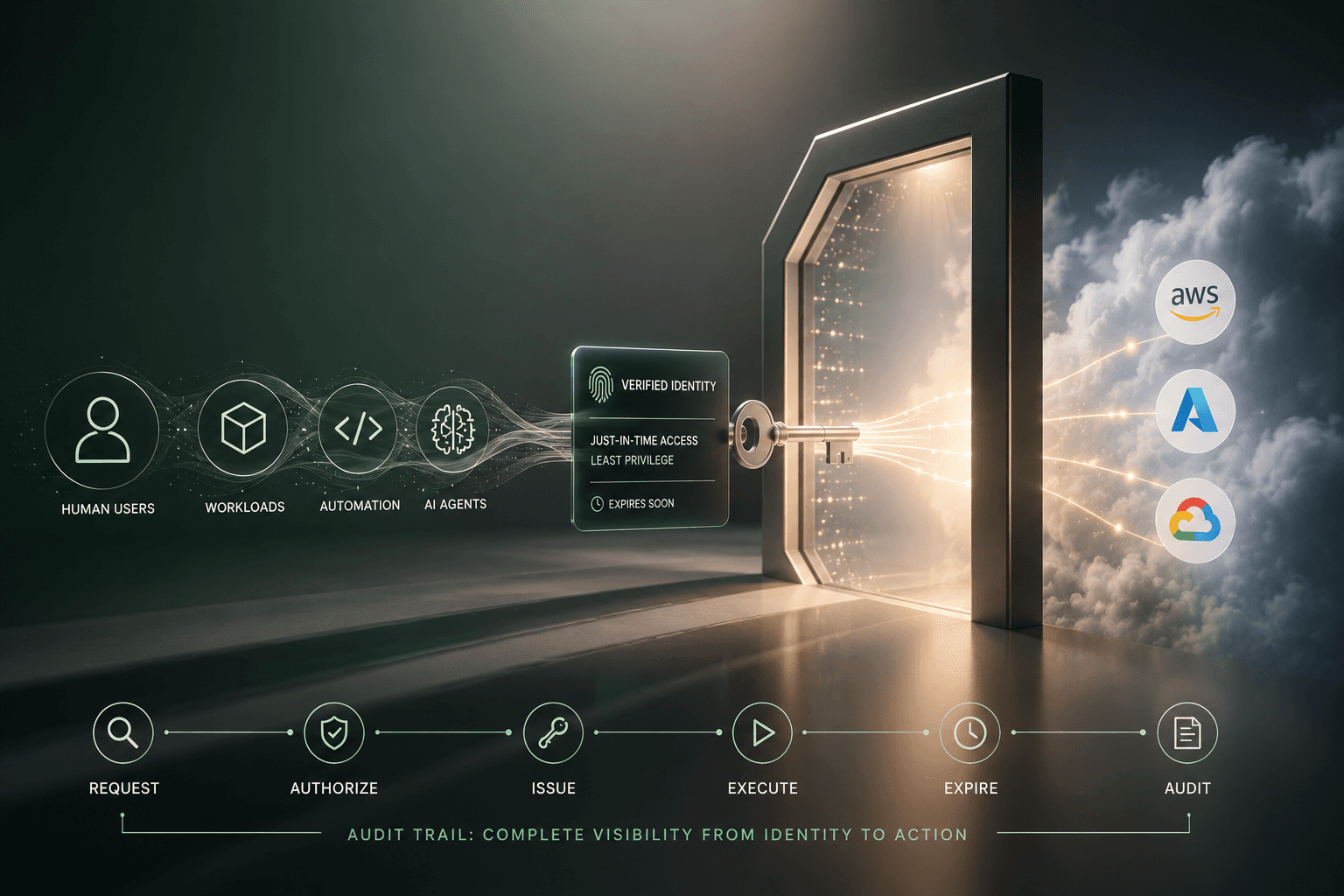
Cloud security has traditionally focused heavily on controlling access to infrastructure. Organizations create IAM roles, assign permissions, manage credentials, enforce MFA, and attempt to follow least-privilege principles. These controls remain essential, but the way organizations interact with cloud infrastructure is changing.
Humans are no longer the only actors operating cloud environments. Applications, CI/CD pipelines, automation systems, workloads, and increasingly AI agents all need to perform actions across cloud infrastructure. As a result, the security question is becoming broader than simply asking who has access to the cloud.
Organizations increasingly need to understand who or what is attempting an action, whether that action should be allowed under the current circumstances, what permissions are actually required, and how those permissions can be exercised without creating permanent security exposure. This broader problem is what Secure Execution addresses.
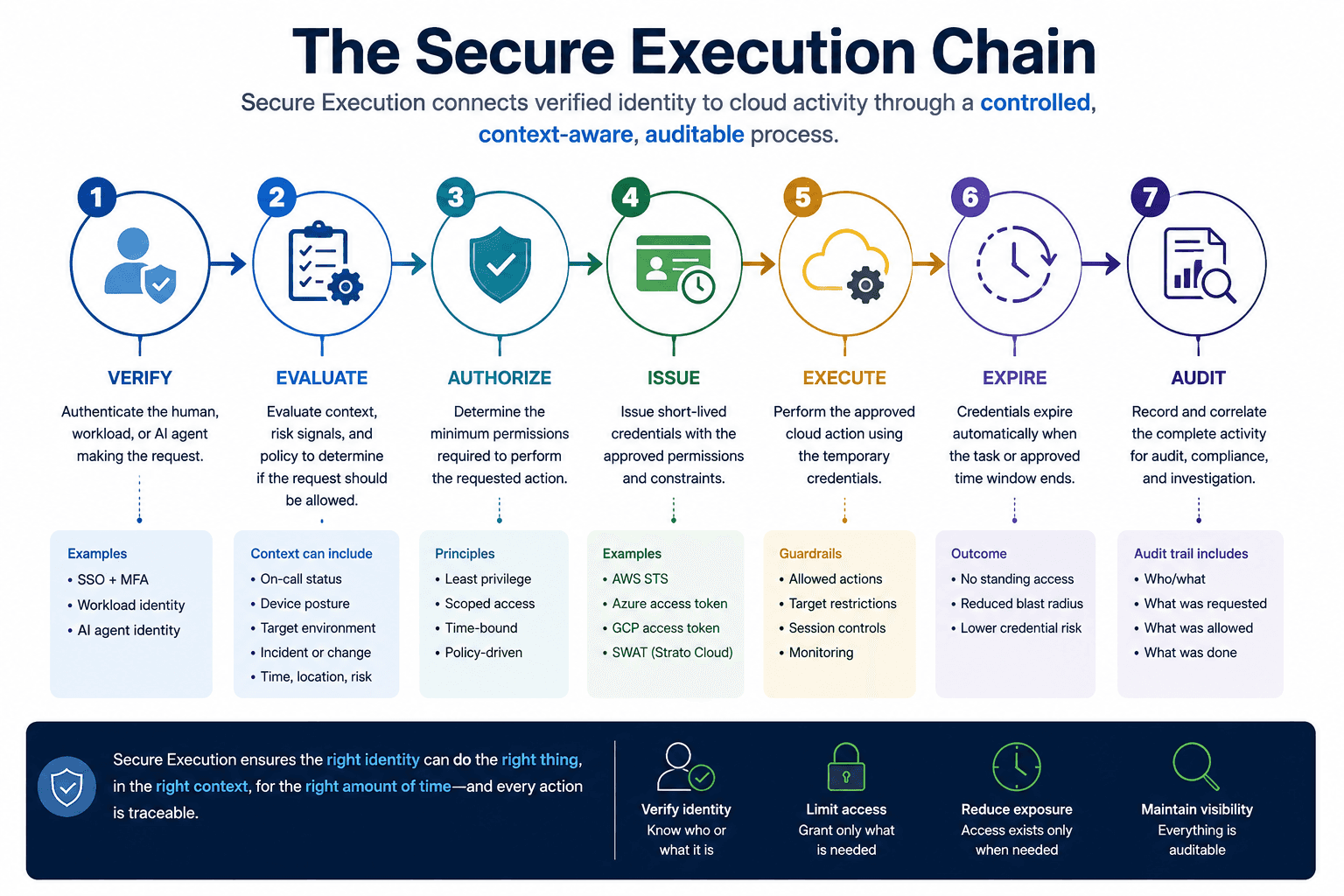
Secure Execution is an approach to cloud operations that verifies identity, evaluates context, grants only the access required for a particular task, uses temporary credentials whenever possible, and creates an auditable chain between the requester and the resulting cloud activity. Rather than focusing only on controlling access, Secure Execution focuses on making the execution of cloud actions secure by design.
What Is Secure Execution?
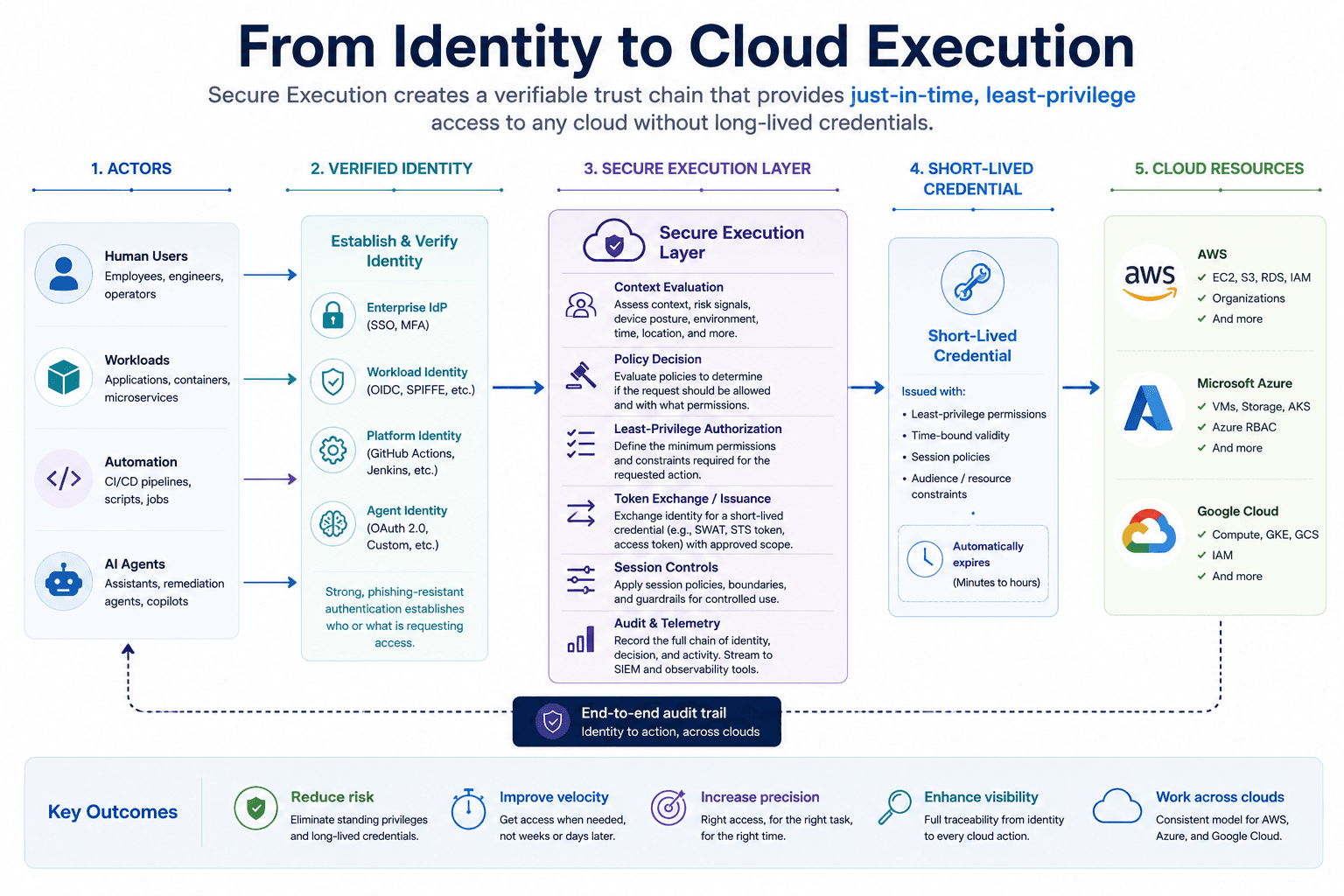
Secure Execution is a security model for allowing humans, workloads, automation systems, and AI agents to perform authorized cloud actions without relying on unnecessary standing privileges or long-lived credentials.
A Secure Execution architecture typically combines several controls:
Verified identity
Context-aware authorization
Just-in-time access
Least privilege
Temporary or ephemeral credentials
Controlled execution
Auditability
Instead of permanently assigning broad cloud access because an identity may need it in the future, Secure Execution evaluates what access is required when an action actually needs to occur. The resulting process can be summarized as:
Verify → Evaluate → Authorize → Issue → Execute → Expire → Audit
Identity establishes who or what is making the request, while context helps determine whether the request should be allowed. Authorization defines the appropriate permissions, temporary credentials provide a secure way to exercise those permissions, and the resulting action is recorded for auditing. When the task or approved period ends, the credentials expire rather than remaining available indefinitely.
Why Traditional Cloud Access Creates Risk
Cloud IAM systems are extremely powerful, but many organizations still use them in ways that create unnecessary exposure. An engineer might receive a role because they occasionally need production access, while a service account might receive permissions because an application requires them. A CI/CD system may be given credentials that remain valid indefinitely because managing their lifecycle is operationally difficult.
Over time, these permissions accumulate as people change roles, applications evolve, projects end, and automation changes. The access often survives long after the original reason for granting it has disappeared.
This creates standing privilege, where access exists continuously even when nobody is actively using it. If an identity with powerful standing permissions is compromised, an attacker may immediately inherit those permissions without needing to overcome another authorization boundary.
Secure Execution changes the question from "What should this identity always be able to do?" to "What does this identity need to do right now?" That difference allows organizations to reduce the amount of privileged access continuously exposed across their cloud environments.
Secure Execution vs. Traditional IAM
Secure Execution does not replace cloud IAM. AWS IAM, Azure RBAC, Google Cloud IAM, and other authorization systems still determine which operations identities can perform within their respective platforms.
Instead, Secure Execution changes how organizations use those capabilities. Traditional access models often create relatively persistent relationships:
Identity → Role → Permissions
Secure Execution introduces additional decision points:
Identity + Request + Context + Policy → Temporary Authorization → Execution
An engineer may therefore have no permanent production privileges but receive temporary access during an approved incident. A workload might receive credentials only while it is running, while an AI agent could receive permission for a specific operational task without possessing a permanent administrator credential.
The cloud provider still enforces the underlying permissions. Secure Execution determines when those permissions should become available, to whom, under what circumstances, and for how long.
Identity Comes Before Credentials
Secure Execution begins with identity because a system needs confidence about who or what is requesting an action before deciding whether to authorize it.
For humans, identity may originate from an enterprise identity provider and include authentication signals such as MFA. For workloads, identity might originate from a runtime environment, workload identity system, CI/CD platform, or federation mechanism. AI agents introduce another type of non-human identity that organizations need to distinguish and govern.
The important principle is that the cloud credential should not become the identity itself. A static access key proves possession of the key, but it does not necessarily provide a strong or current chain back to the person, workload, or process responsible for the activity.
Secure Execution instead establishes identity first and issues the necessary cloud authorization afterward. This creates a stronger connection between the original identity and the actions ultimately performed in the cloud.
Human and Machine Identities Need Different Treatment
Humans and machines both need cloud access, but their access patterns are fundamentally different. A human engineer might require temporary production access during an incident, while a CI/CD pipeline may need access for only several minutes during a deployment.
A containerized workload may continuously obtain short-lived credentials while it is running. An AI agent may require access only while investigating a particular cloud problem or performing an approved task.
Treating all of these actors as permanent IAM users or long-lived service accounts ignores those differences and creates unnecessary exposure. Secure Execution allows the access lifecycle to reflect the identity performing the work and the task being performed.
Context Changes the Access Decision
Identity alone does not tell the entire story. Consider an engineer requesting administrative production access. The request might be entirely appropriate if that engineer is currently on call and responding to a production incident, but the same request could be inappropriate from an unmanaged device during normal operations.
Context-Based Access Control adds these circumstances to the authorization decision. Relevant context can include on-call status, device security posture, vulnerability information, endpoint security signals, incident status, change approvals, target environment, business criticality, requested action, time, location, and organizational ownership.
This allows the same identity and role to produce different authorization decisions depending on the situation. Secure Execution can use that context to determine whether execution should proceed and what level of access should be provided.
Just-in-Time Access Reduces Standing Privilege
Just-in-time access changes when authorization becomes available. Instead of assigning permanent access because someone may need it someday, the organization grants access when a legitimate need actually exists.
A user requests access, relevant policy and context are evaluated, and the appropriate permissions become available for a limited period. When the task is complete or the approved period expires, the access disappears.
For organizations with hundreds or thousands of engineers, this can dramatically reduce standing privilege. Production access no longer needs to exist twenty-four hours a day simply because an engineer might eventually need it.
Temporary Credentials Reduce Credential Risk
Just-in-time authorization addresses when access should exist, but organizations also need to consider the credentials used to exercise that access.
Long-lived cloud credentials create risk because they remain useful until someone rotates or revokes them. If they are leaked, copied, forgotten, or exposed through another system, they may remain exploitable for an extended period.
Temporary credentials reduce that exposure because expiration is built into their lifecycle. AWS STS credentials, Azure access tokens, and equivalent mechanisms can provide time-limited access without requiring permanent cloud secrets.
Secure Execution therefore combines temporary authorization with temporary credentials whenever possible. The credential exists because an authorized action needs to occur, and it disappears when that access is no longer required.
JIT Access and Ephemeral Credentials Are Different
Just-in-time access and ephemeral credentials are closely related, but they solve different parts of the problem. JIT access determines when authorization should exist, while ephemeral credentials determine how that authorization should be exercised securely.
An organization could grant access just in time but still issue credentials that remain valid longer than necessary. Conversely, it could use temporary credentials for an identity that permanently retains broad authorization.
Secure Execution brings these concepts together so that authorization appears when required and the credentials used to exercise it are temporary as well.
From Identity to Short-Lived Workload Access
Workloads represent an especially important Secure Execution use case because applications, CI/CD systems, containers, automation, and AI agents frequently need cloud access without a human directly involved.
Historically, organizations have often solved this problem by storing cloud credentials in environment variables, CI/CD secrets, vaults, configuration files, or secret-management systems. Secret management can improve how credentials are stored, but the underlying credential may still be long-lived.
Federation provides a stronger model. A workload can first prove an identity it already possesses, then use that verified identity as the basis for obtaining temporary cloud authorization.
The resulting chain looks like:
Workload Identity → Authorization → Temporary Cloud Credential → Cloud Action
This allows the workload to perform its task without requiring a permanent cloud secret.
OAuth Token Exchange and Secure Execution
Modern applications and workloads frequently already possess OAuth 2.0 identity tokens that represent authenticated users, applications, or other principals. Rather than providing those workloads with static AWS, Azure, or Google Cloud credentials, a Secure Execution system can use the existing identity as the starting point for temporary cloud access.
In Strato Cloud's Secure Execution model, an OAuth 2.0 token can be exchanged for a Short-Lived Workload Access Token, or SWAT. SWAT provides a short-lived authorization mechanism that can participate in the process of obtaining temporary access to the target cloud environment.
The broader architectural principle is more important than any individual token format. Organizations should be able to establish a verifiable chain from the original authenticated identity, through authorization and credential issuance, to the cloud action that ultimately occurs.
Secure Execution for AI Agents
AI agents make Secure Execution increasingly important because they may need to query cloud environments, inspect configurations, investigate security findings, generate remediation, or invoke operational tools.
Giving an AI agent a permanent administrator credential would make integration simple, but it would also create an enormous security boundary around the AI system. Any compromise or unexpected behavior could immediately inherit the full authority of that credential.
A safer approach treats the agent like another governed identity. Its identity is verified, the requested operation is evaluated, relevant context is considered, and only the necessary permissions are granted. Temporary credentials can then allow the agent to perform the approved action before automatically expiring.
This model allows AI to become operationally useful without turning every agent into a permanent privileged administrator.
Secure Execution Is More Than Credential Brokering
Temporary credential issuance is an important component of Secure Execution, but it does not define the entire architecture.
A credential broker primarily answers the question, "How do I obtain a credential?" Secure Execution addresses the broader problem of whether an identity should be allowed to perform an action under the current circumstances, what permissions it should receive, how those permissions should be exercised, and how the organization preserves a trustworthy record of the result.
Answering those questions requires identity, policy, context, authorization, credential issuance, execution, expiration, and auditing to work together as one security lifecycle.
Secure Execution and Intelligent Remediation
Secure Execution also provides an important foundation for AI-driven remediation. An intelligent remediation system may need to investigate a cloud finding, access code, run development tools, or interact with repositories, but those capabilities should not require unrestricted access to production.
Different parts of the remediation workflow can operate inside different security boundaries. AI can work inside a controlled sandbox to generate and validate Infrastructure as Code, while repository access can be limited to explicitly authorized repositories. Cloud access can use temporary credentials, and human approval can remain between the AI-generated proposal and production deployment.
Secure Execution therefore helps define both where AI can act and under what authority it can act.
Secure Execution Across Multiple Clouds
Multi-cloud environments make consistent access particularly difficult because AWS, Azure, and Google Cloud each have their own IAM systems, credential mechanisms, APIs, role models, and terminology.
Without a common access model, organizations often build separate processes for each provider. This creates operational complexity and can result in inconsistent security controls across clouds.
Secure Execution provides a higher-level operating model. Organizations can establish common principles around identity, contextual authorization, JIT access, temporary credentials, and auditing while continuing to use each provider's native security mechanisms underneath.
The technical implementation may differ from one provider to another, but the security model can remain consistent.
Auditability and the Identity Chain
Temporary access should never mean anonymous access. When implemented correctly, short-lived access can actually improve auditability by establishing a clear chain between the original identity and the resulting cloud activity.
Organizations should be able to determine who or what initiated a request, which identity was authenticated, what access was requested, which context influenced the decision, what policy authorized it, which permissions and credentials were issued, when those credentials expired, and what actions were performed.
Secure Execution events can also be streamed into SIEM platforms so they can be correlated with broader security monitoring and incident-response workflows. This gives security teams a consistent record of access decisions and execution activity.
A Practical Example
Imagine an engineer receives a production alert at 2:00 AM. The engineer normally has no standing administrative access to the affected production cloud account, but they need elevated permissions to investigate the incident.
The Secure Execution system verifies the engineer's enterprise identity and evaluates context such as whether the engineer is currently on call, the target environment, the requested role, security posture, and organizational policy. If the request is authorized, temporary cloud credentials are issued with the permissions necessary for the investigation.
The engineer can then perform the required actions without carrying permanent production privileges during normal operations. After the approved period, the credentials expire automatically, while the identity, authorization decision, credential issuance, and resulting cloud activity remain available for audit.
This allows the organization to provide powerful access when it is legitimately required without maintaining that same exposure every other hour of the year.
What Good Secure Execution Looks Like
A mature Secure Execution architecture follows several important principles:
Identity before credentials. Establish who or what is requesting access before issuing cloud authorization.
Temporary by default. Prefer short-lived authorization and credentials over permanent access.
Context-aware. Evaluate current circumstances instead of relying entirely on static roles.
Least privilege. Grant only the permissions required for the task.
Human and machine aware. Support employees, workloads, automation, and AI agents without forcing them into identical identity models.
Cloud-native underneath. Use provider-native security mechanisms rather than bypassing them.
Auditable end to end. Preserve the chain from original identity through authorization to cloud activity.
Multi-cloud consistent. Apply common security principles across AWS, Azure, and Google Cloud.
Together, these principles shift cloud access away from a static entitlement model and toward a controlled execution model.
How Strato Cloud Approaches Secure Execution
Secure Execution is one of the core pillars of Strato Cloud. It provides a cloud-agnostic execution layer designed to help humans, workloads, automation systems, and AI agents securely interact with AWS, Azure, and Google Cloud.
For human access, organizations can use just-in-time authorization and ephemeral credentials instead of maintaining unnecessary standing privileges. For non-human identities, Strato Cloud can establish a verifiable identity chain and exchange existing identity mechanisms such as OAuth 2.0 tokens for short-lived authorization through SWAT, the Short-Lived Workload Access Token.
Context can be incorporated into authorization decisions so that access reflects current conditions rather than only static roles. Secure Execution activity can also be streamed into security monitoring systems, allowing access decisions and cloud actions to become part of the organization's broader audit and incident-response workflows.
The objective is to give humans and machines the access they need to perform legitimate cloud work while minimizing permanent privilege and credential exposure when that access is not actively required.
Frequently Asked Questions
What is Secure Execution?
Secure Execution is an approach to cloud operations that combines verified identity, contextual authorization, least privilege, temporary credentials, controlled execution, and auditability.
Is Secure Execution the same as just-in-time access?
No. JIT access controls when authorization becomes available. Secure Execution is broader and also includes identity, context, credential issuance, execution, expiration, and auditing.
Is Secure Execution the same as privileged access management?
There is overlap, particularly around temporary privileged access. Secure Execution extends the model to workloads, automation, and AI agents and focuses on securely executing cloud actions across human and non-human identities.
What are ephemeral cloud credentials?
Ephemeral credentials are temporary credentials designed to expire automatically rather than remain valid indefinitely.
Can Secure Execution eliminate static cloud credentials?
It can significantly reduce the need for them. Federation, workload identity, token exchange, and provider-native temporary credential mechanisms allow many workloads to operate without storing long-lived cloud secrets.
What is SWAT?
SWAT stands for Short-Lived Workload Access Token. In Strato Cloud's Secure Execution architecture, it provides a short-lived authorization mechanism for workloads and other non-human identities.
How does Secure Execution apply to AI agents?
AI agents can be treated as governed identities. Their identity, requested action, context, permissions, credentials, and resulting activity can be controlled rather than giving the agent permanent broad cloud access.
Does Secure Execution replace AWS IAM, Azure RBAC, or Google Cloud IAM?
No. Those systems remain responsible for enforcing permissions within their respective clouds. Secure Execution provides a consistent model for determining when and how identities receive access to those native permissions.