Published:
Estimated reading time:
8–9 minutes
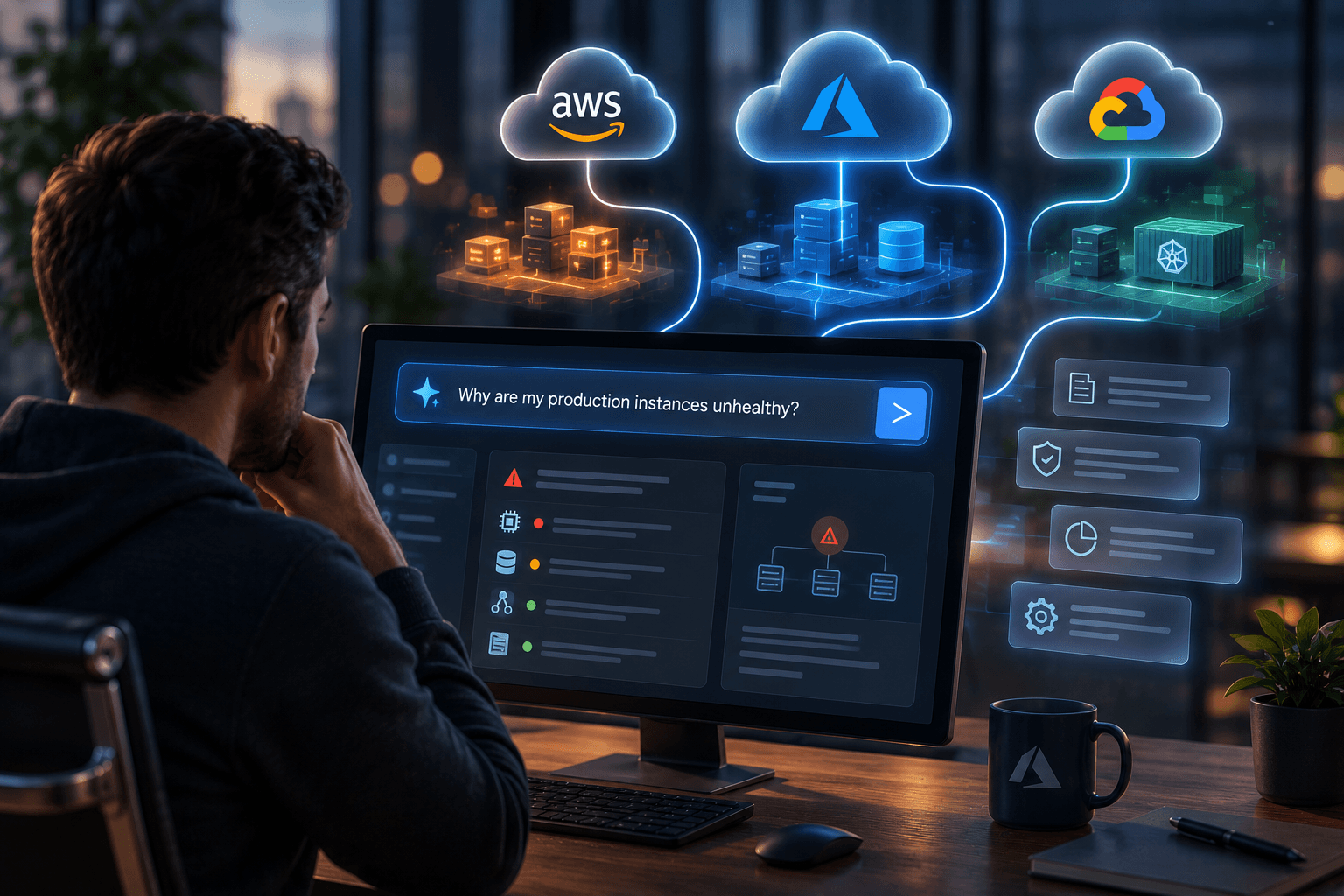
Cloud troubleshooting often begins with a simple question.
Why is this application failing? Which resources changed? What is exposed to the internet? Who owns the affected environment? Are there unhealthy instances behind this load balancer? What infrastructure could be contributing to this alert?
Answering those questions is rarely as simple as asking them.
Engineers may need to move between cloud consoles, monitoring platforms, security tools, command-line interfaces, documentation, account hierarchies, and internal systems. In multi-cloud environments, the process becomes even more fragmented because AWS, Azure, and Google Cloud expose different APIs, terminology, resource models, and interfaces.
Natural language cloud queries introduce a different interaction model. Instead of beginning with the tool or API an engineer needs to use, troubleshooting can begin with the question the engineer needs answered.
That sounds like a small interface change. It has the potential to significantly change how teams investigate cloud environments.
What Are Natural Language Cloud Queries?
Natural language cloud queries allow engineers to ask operational questions using ordinary language rather than manually constructing provider-specific API calls, command-line commands, filters, or dashboard queries.
An engineer might ask:
Which EC2 instances in our production accounts are publicly accessible?
Another might ask:
Show me unattached storage volumes in development environments that appear to be abandoned.
In a multi-cloud environment, the question could become broader:
Which internet-facing workloads across AWS, Azure, and GCP belong to our payments environments?
The system must translate the engineer's intent into the appropriate cloud operations, gather the necessary information, interpret the results, and return an answer that is useful in the context of the investigation.
This makes natural language more than a search box. It becomes an interface between human operational intent and cloud APIs.
Troubleshooting Today Starts With Knowing Where to Look
Traditional cloud troubleshooting assumes the engineer already knows a surprising amount before the investigation begins.
They need to know which provider contains the workload, which account, subscription, or project to inspect, which service owns the relevant information, which console page exposes it, which API to call, or which command-line syntax will produce the right result.
Experienced cloud engineers become good at this because they develop mental maps of their environments and the platforms they use. They know that one question requires an EC2 API, another requires CloudTrail, another requires IAM, and another requires querying a load balancer or monitoring system.
That expertise is valuable, but navigating interfaces is not the same thing as solving the underlying problem.
When an engineer asks, "What changed in this environment before the outage?", the real task is understanding the change. The mechanics of locating the correct APIs and constructing the queries are necessary overhead.
Natural language cloud interaction has the potential to reduce that overhead.
Start With the Question, Not the Cloud Service
A conversational troubleshooting model reverses the normal workflow.
Instead of starting with:
Which AWS service or API do I need?
the engineer starts with:
What do I need to know?
The system can then determine which cloud APIs, services, regions, and environments need to be queried to answer the question.
This becomes especially useful when the investigation crosses service boundaries. A single operational question may require information from compute, networking, identity, logging, storage, and organizational metadata.
For example, consider the question:
Why can't this application reach its database?
Investigating that problem might involve examining the application's compute environment, security groups or firewall rules, network routes, database configuration, DNS, identity permissions, and recent changes.
The engineer cares about the relationship between those systems. They do not necessarily care that retrieving the information requires six different APIs.
Natural language creates an opportunity to make the operational question the primary interface while cloud APIs become implementation details underneath.
Natural Language Is Not the Same as Searching Documentation
There is an important distinction between asking an AI system a cloud question and asking an AI system about your cloud.
A general-purpose AI model can explain how AWS security groups work, describe how to find unattached Azure managed disks, or provide a command that lists GCP projects.
Those answers come from knowledge about cloud platforms.
Operational troubleshooting requires something different. The system needs access to information about the organization's actual environment.
If an engineer asks:
Which production instances are currently unhealthy?
the answer cannot come from documentation or general model knowledge. The system needs to inspect the relevant cloud environment and determine what is true now.
This distinction separates cloud knowledge from cloud awareness.
Both are useful, but only the latter can directly answer operational questions about a running environment.
Current Cloud State Matters
Cloud environments change continuously. Instances start and stop, deployments replace infrastructure, permissions change, network configurations evolve, and temporary resources appear and disappear.
Troubleshooting therefore depends heavily on current state.
A resource inventory collected several hours ago may still be useful for reporting or historical analysis, but it may not accurately represent what an engineer is investigating during an active incident.
Natural language cloud queries become considerably more powerful when they can interact with live provider APIs and retrieve current information as part of the conversation.
An engineer can ask whether a load balancer currently has healthy targets, whether an IP address is still attached, which instances are running now, or what permissions an identity currently has.
The conversation becomes an interface for investigating the cloud rather than merely searching a stored representation of it.
Conversation Changes the Investigation Process
Traditional dashboards are generally designed around predefined views. Someone decides which metrics, resources, filters, or visualizations belong on the screen before the incident occurs.
That works well when the questions are predictable.
Troubleshooting is often unpredictable.
One answer leads to another question. An engineer discovers that a service is unhealthy and asks which instances are affected. They discover those instances share a security group and ask what changed in that group. They discover a recent change and ask which identity made it.
The investigation branches according to what the engineer discovers.
Conversation naturally supports this pattern because each answer can become context for the next question.
Instead of constructing a new dashboard or query for every step, the engineer can progressively narrow the investigation.
For example:
Which production web servers are currently unhealthy?
Then:
Do those instances have anything in common?
Then:
Show me recent configuration changes affecting that security group.
Then:
Who made the most recent change?
The value is not simply that the engineer typed sentences instead of commands. The conversation preserves the investigative thread.
Context Makes Cloud Answers More Useful
Raw cloud information often lacks the business context engineers and security teams need.
A cloud API might return an account ID, instance identifier, subscription, project, security group, or resource name. Those values describe infrastructure but may say little about why the infrastructure matters.
Organizational context can make the same answer significantly more useful.
Knowing that an affected AWS account belongs to the payments team, represents a production environment, and supports a critical customer-facing application immediately changes how an engineer interprets an alert.
This becomes especially important when native resource tags are missing or inconsistent.
The individual resource may not have useful metadata, but its surrounding account, subscription, project, or organizational grouping may still provide ownership, environment, business function, or criticality.
Natural language cloud investigation becomes more valuable when technical cloud state and organizational context can be considered together.
Multi-Cloud Makes Natural Language More Valuable
The operational overhead of cloud interfaces becomes much more visible in multi-cloud environments.
AWS, Azure, and Google Cloud provide different resource models, APIs, command-line tools, identity systems, and terminology. Engineers working across them need to constantly translate between provider-specific concepts.
A natural-language interface can provide a common interaction layer without pretending the underlying clouds are identical.
An engineer might ask:
Show me publicly exposed compute resources across our production environments.
The implementation may require different queries against AWS, Azure, and Google Cloud. The user should not necessarily need to formulate three separate provider-specific requests.
This is an important distinction. A conversational layer does not eliminate provider differences. It can translate human intent into provider-specific operations while preserving those differences underneath.
That makes natural language particularly interesting as an interface for a multi-cloud control plane.
Troubleshooting Becomes More Accessible
Cloud platforms reward specialization.
An experienced AWS engineer may know exactly which CLI commands and APIs to use during an incident. The same engineer may be less familiar with Azure or Google Cloud. Security analysts, application developers, support engineers, and engineering managers may have even less provider-specific expertise.
Natural language can lower the interface barrier without removing the need for technical judgment.
A developer investigating an application problem may be able to ask a useful infrastructure question without knowing the exact provider command required to retrieve the answer. A security analyst may investigate cloud exposure without navigating unfamiliar service consoles.
This does not make cloud expertise unnecessary. Understanding whether an answer makes sense, recognizing architectural relationships, evaluating risk, and deciding what to do next still require judgment.
Natural language can reduce the amount of platform syntax someone needs to memorize before that judgment becomes useful.
Natural Language Can Also Accelerate Experts
The benefit is not limited to less experienced users.
Experts frequently know exactly what they want to investigate but still spend time constructing commands, switching accounts, selecting regions, filtering results, combining API responses, and formatting output.
For them, natural language can function as a compression layer for operational intent.
An engineer who could manually construct five API queries may instead express the desired outcome once and allow the system to handle the mechanics.
This can make experienced engineers faster while allowing them to focus on interpreting the result rather than assembling it.
The most valuable interface is therefore not one that replaces expertise. It is one that allows expertise to operate at a higher level.
The System Needs Guardrails
Allowing AI to investigate cloud environments introduces an important security question: whose authority is the AI actually using?
A straightforward architecture might give the AI agent its own cloud identity with read-only permissions. Every time a user asks a question, the agent uses those credentials to query the environment on the user's behalf.
That approach can limit what the AI is allowed to change, but it introduces two significant problems.
First, the AI's access may be broader than the access of the person asking the question. Unless another authorization layer explicitly checks the user, someone could potentially ask the agent about a cloud environment they would not normally be permitted to inspect.
Second, the architecture can break the audit trail between the human and the resulting cloud activity. If 50 engineers ask questions and every investigation is performed using the same AI identity, cloud-provider logs will primarily show that identity making the API calls. The AI effectively becomes a middleman that obscures which human initiated each investigation.
A stronger model preserves the requesting user's identity all the way through the interaction.
When a user asks a question about a cloud environment, the system should first determine whether that user is authorized to access the environment. If access is permitted, Secure Execution can obtain temporary, just-in-time, read-only credentials on behalf of that user and use those credentials to perform the required cloud queries.
The resulting chain becomes:
User → AI → Authorization → JIT Read-Only Credentials on Behalf of User → Cloud APIs
This accomplishes two things simultaneously. Authorization remains tied to the user, so the AI cannot become a shortcut around existing access boundaries. Auditability also remains tied to the user, so cloud activity can be traced back to the person whose question caused it rather than appearing only as activity from a shared AI service identity.
This becomes increasingly important as conversational cloud systems grow more capable. Organizations should not have to choose between the convenience of an AI intermediary and knowing who actually initiated activity in their cloud environments.
The AI can perform the investigation, but the human identity and authorization chain should remain intact from question to cloud API call.
From Questions to Actions
Natural language troubleshooting is likely only the first stage of a broader shift in cloud operations.
Once a system can understand a question, query the environment, and interpret the result, the next logical step is helping the engineer act on what it discovers.
An engineer might begin with:
Which storage volumes appear to be orphaned?
After reviewing the results, the next request could be:
Prepare the remediation for these three.
That transition changes the security boundary. Answering a question and changing infrastructure are fundamentally different operations.
A safe architecture should therefore separate investigation from execution and introduce stronger controls as the requested action becomes more consequential.
For example, AI might generate Infrastructure as Code representing the proposed remediation, validate it in an isolated execution environment, and open a pull request rather than directly deleting resources.
Conversation can remain the interface while governance, Secure Execution, Git workflows, and human review determine what the system is actually allowed to do.
Natural Language Changes the Role of Dashboards
Dashboards are not going away.
They remain extremely useful for monitoring known metrics, tracking trends, displaying health indicators, and providing shared operational views.
Natural language solves a different problem.
Dashboards are strongest when teams know in advance what they want to observe. Conversation is strongest when teams are exploring an unknown problem.
During an investigation, engineers frequently do not know the fifth question they will need to ask when they begin with the first. A conversational interface can adapt as the investigation develops.
The future of cloud operations is therefore unlikely to be dashboards or conversations. It is more likely to involve dashboards for continuous awareness and conversational interfaces for dynamic investigation.
What Good Natural Language Cloud Interaction Looks Like
A useful conversational cloud interface needs more than a language model connected to an API. Several capabilities determine whether it can support real operational work:
Current cloud information. Answers should reflect the environment being investigated rather than relying solely on general cloud knowledge.
Multi-step reasoning. The system should be able to gather information from multiple services when a question crosses resource boundaries.
Conversation context. Follow-up questions should build naturally on previous findings.
Organizational context. Ownership, environment, criticality, and business purpose can make technical answers more actionable.
Multi-cloud awareness. Human questions should not always require provider-specific phrasing.
Clear authorization. The system should operate only within environments and permissions it is allowed to access.
Auditability. Organizations should be able to understand what the system queried and what actions it performed.
Separation of investigation and execution. Asking a question should not silently become permission to modify infrastructure.
Together, these capabilities turn natural language from a convenience feature into a practical operational interface.
How Strato Cloud Approaches Conversational Cloud Operations
Strato Cloud's Talk to Your Cloud capability is designed around the idea that engineers should be able to ask operational questions about their AWS, Azure, and Google Cloud environments without first navigating provider-specific interfaces.
Rather than depending on a traditional inventory containing a synchronized copy of every individual cloud resource, Strato Cloud can query live cloud environments to investigate current state.
This allows the conversation to begin with questions such as which resources are exposed, what is running in a particular environment, whether infrastructure appears abandoned, or what might be contributing to an operational problem.
Strato Cloud also maintains organizational context around AWS accounts, Azure subscriptions, GCP projects, namespaces, and synchronized cloud identities. Cloud-agnostic labels can represent ownership, environment, business function, criticality, and other information that helps interpret the cloud data returned during an investigation.
This combines two kinds of context: what the cloud says is happening now and what the organization knows about the environment in which it is happening.
Preserving the User's Identity Through the Investigation
There is another important part of the architecture: the AI should not become an identity-obscuring middleman between the user and the cloud.
A common approach to AI-powered cloud investigation is to give an AI agent its own service identity and cloud credentials. Users ask questions, and the agent performs the necessary API calls using that shared identity.
Even if those credentials are read-only, this creates an important distinction between the person requesting an operation and the identity actually performing it.
If dozens of engineers use the same agent, cloud audit logs can show the agent making those API calls rather than clearly attributing each investigation to the human who initiated it. The agent can also become a new authorization boundary. The system must separately ensure that a user asking the AI about an environment is actually permitted to access that environment.
Strato Cloud takes a different approach.
When a user asks Talk to Your Cloud a question about a cloud environment, Strato Cloud first verifies that the requesting user is authorized to access that environment. The AI does not receive blanket authority simply because it is capable of querying the cloud.
Once the request is authorized, Strato Cloud uses its Secure Execution framework to obtain temporary, just-in-time, read-only cloud credentials on behalf of that user. The AI performs the investigation using the user's identity and authorization context rather than relying on a shared AI identity.
The resulting trust chain looks conceptually like this:
User → Talk to Your Cloud → Authorization → Secure Execution → JIT Read-Only Credentials on Behalf of User → Cloud APIs
This architecture serves two important purposes.
First, the user's existing access boundaries remain meaningful. Asking the AI a question does not become a shortcut for seeing an AWS account, Azure subscription, or GCP project that the user would not otherwise be authorized to access.
Second, the identity chain remains intact for auditing. Cloud activity generated during the investigation remains attributable to the user whose question initiated it rather than collapsing activity from many users into a generic AI or service identity.
That distinction becomes increasingly important as AI becomes a more active participant in cloud operations. Organizations need to know more than what an AI system did. They need to know who asked it to do it, under whose authority it operated, and which identity ultimately interacted with the cloud.
From Investigation to Governed Action
The same architecture creates a foundation for moving safely from questions toward actions.
Talk to Your Cloud can help an engineer investigate the environment and understand what is happening. Continuous Governance can identify policy gaps and other findings. Intelligent Remediation can turn selected findings into proposed Infrastructure as Code changes. Secure Execution governs how humans, workloads, and AI systems receive access throughout those workflows.
The level of control can also increase with the risk of the operation. Investigating cloud state may require temporary read-only access on behalf of the user, while modifying infrastructure requires stronger authorization, validation, approval, and deployment controls.
For remediation, that does not mean handing an AI agent unrestricted production credentials. Strato Cloud can generate Infrastructure as Code in an isolated execution environment, validate the proposed changes, commit them to an authorized GitHub repository, and open a pull request for human review and deployment through the organization's normal workflow.
The long-term opportunity is therefore much larger than adding chat to a cloud dashboard. It is creating an operational interface where engineers can express intent directly while the control plane determines how to interact with the underlying clouds using live cloud state, organizational context, the requesting user's actual authority, temporary credentials, and an end-to-end identity chain that remains auditable.
Frequently Asked Questions
What is a natural language cloud query?
A natural language cloud query is an operational question expressed in ordinary language that a system translates into the cloud API calls or other operations required to retrieve an answer.
How is this different from asking ChatGPT a cloud question?
A general AI system can explain cloud technologies based on its knowledge. A cloud-aware operational system can inspect an organization's actual authorized cloud environment to answer questions about its current state.
Do natural language cloud queries require a cloud resource inventory?
Not necessarily. A system can query cloud provider APIs directly to retrieve current information rather than relying exclusively on a separately synchronized inventory of every resource.
Can natural language queries work across AWS, Azure, and Google Cloud?
Yes. A multi-cloud control plane can translate a common operational question into provider-specific queries while preserving the differences between the underlying platforms.
Will natural language replace cloud dashboards?
Probably not. Dashboards remain valuable for monitoring known metrics and trends, while conversational interfaces are particularly useful for exploratory investigation and troubleshooting.
Can AI safely query production cloud environments?
Yes, if the system has an appropriate identity, limited permissions, secure credential handling, and auditable access. Read access should still follow least-privilege principles.
Can the same interface make cloud changes?
It can, but execution requires a stronger security boundary than investigation. Sensitive changes should use appropriate authorization, temporary credentials, validation, approval, and deployment controls.
Why is conversational cloud interaction useful for experts?
Experts often know what they want to investigate but still spend time navigating provider interfaces and assembling queries. Natural language can compress those mechanics so experts can focus on interpreting results and solving the problem.