Published:
Estimated reading time:
8–10 minutes

When people think about identity and access management, they usually think about people. An employee signs in with a username, authenticates with multifactor authentication, receives access based on their role, and uses that access to perform work. For decades, this human-centered model shaped how organizations designed identity systems.
Modern cloud environments look very different. Applications call APIs, CI/CD pipelines deploy infrastructure, Kubernetes workloads communicate with cloud services, automation platforms make changes across environments, and SaaS integrations exchange data. Infrastructure tools create and modify resources, while AI agents are beginning to perform tasks that previously required a human operator.
Every one of these systems needs some way to establish who or what it is before another system can decide what it should be allowed to do. Identity is therefore no longer just a human problem. It is a human and machine identity problem.
What Is a Human Identity?
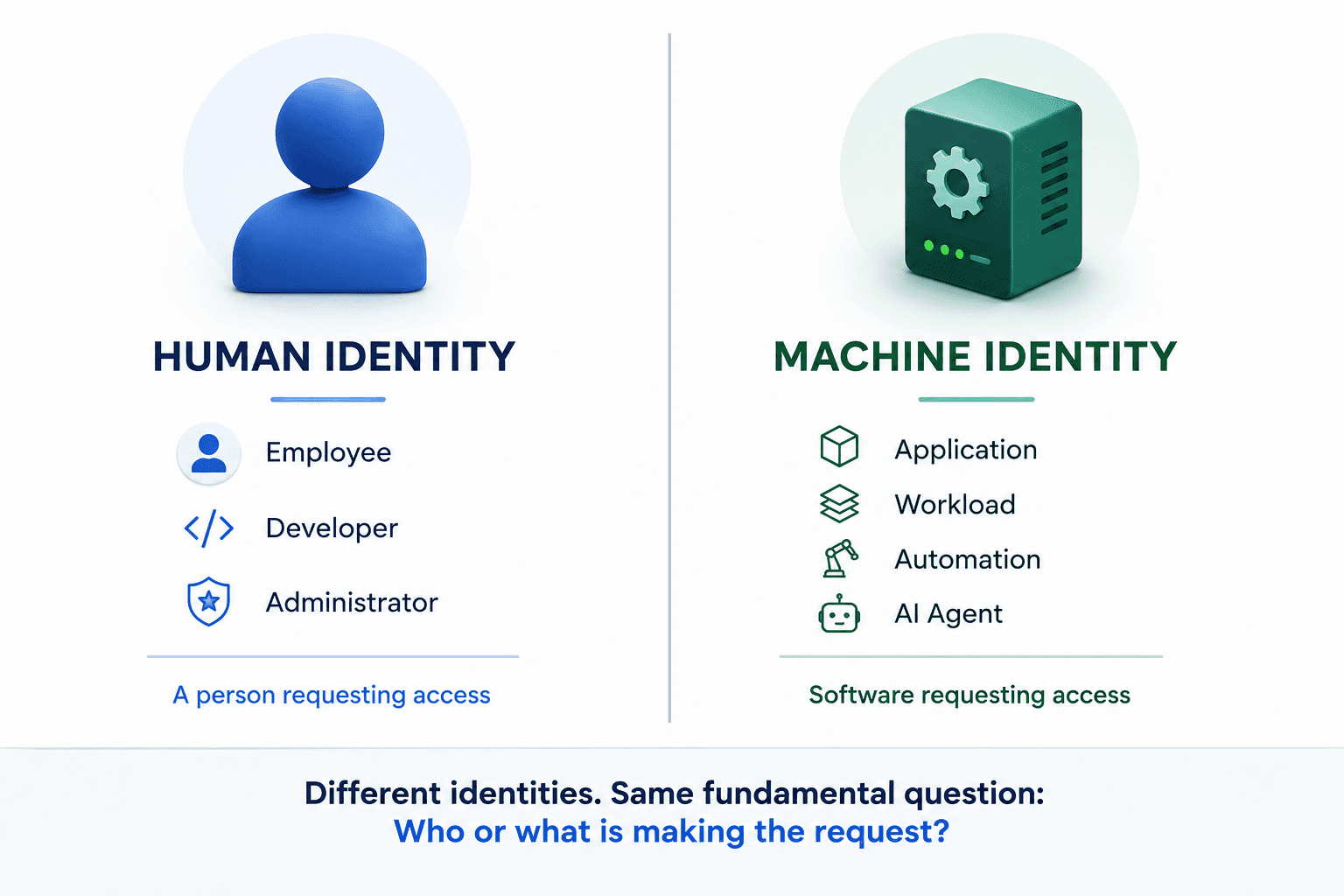
A human identity represents a person interacting with systems and resources. This could be an employee, contractor, administrator, developer, customer, or partner.
The identity usually originates in an identity provider or directory and is associated with information about the person such as their name, team, role, group membership, and employment status. Human identities typically authenticate through mechanisms designed for people, including passwords, passkeys, security keys, biometric authentication, and multifactor authentication.
Once authenticated, authorization systems determine what the person can access. For example, a platform engineer might authenticate through the company's identity provider and receive permission to access certain AWS accounts, Azure subscriptions, Google Cloud projects, internal applications, and development tools.
The identity represents the person even though that identity may ultimately be represented differently inside each system.
What Is a Machine Identity?
A machine identity represents a non-human entity that needs to authenticate or interact with another system. The word "machine" can be misleading because the identity does not necessarily represent a physical machine.
Machine identities can represent:
Applications and services
Containers and Kubernetes workloads
Virtual machines and serverless functions
CI/CD pipelines
Infrastructure automation
Service accounts
APIs and integration platforms
Scripts and bots
AI agents
A machine identity ultimately answers the same fundamental question as a human identity: Who or what is making this request?
The challenge is that machines cannot authenticate the same way humans do. A deployment pipeline cannot pull out a security key and touch it, a serverless function cannot enter an MFA code, and an application cannot ask a person to approve every API call. Machines therefore require authentication mechanisms designed for automated operation.
Human and Machine Identities Share the Same Basic Problem
At a high level, human and machine identity systems perform similar functions. First, an entity needs to establish its identity. Then another system decides what that identity is authorized to do.
For a human, the process might follow Employee → Identity Provider → Authentication → Authorization → Cloud Access. For a workload, it might follow Workload → Workload Identity → Authentication → Authorization → Cloud Access.
The mechanics can be very different, but both systems ultimately need to answer a common set of security questions:
Who or what is requesting access?
Can we verify that identity?
What should it be allowed to do?
Under what circumstances should the access be allowed?
How long should that access remain available?
What evidence should be recorded about the interaction?
Thinking about both humans and machines through this common identity model becomes increasingly important as software performs more actions autonomously.
Why Machine Identity Has Become So Important
Traditional enterprise environments often had many more human identities than machine identities. Cloud-native architectures can reverse that relationship.
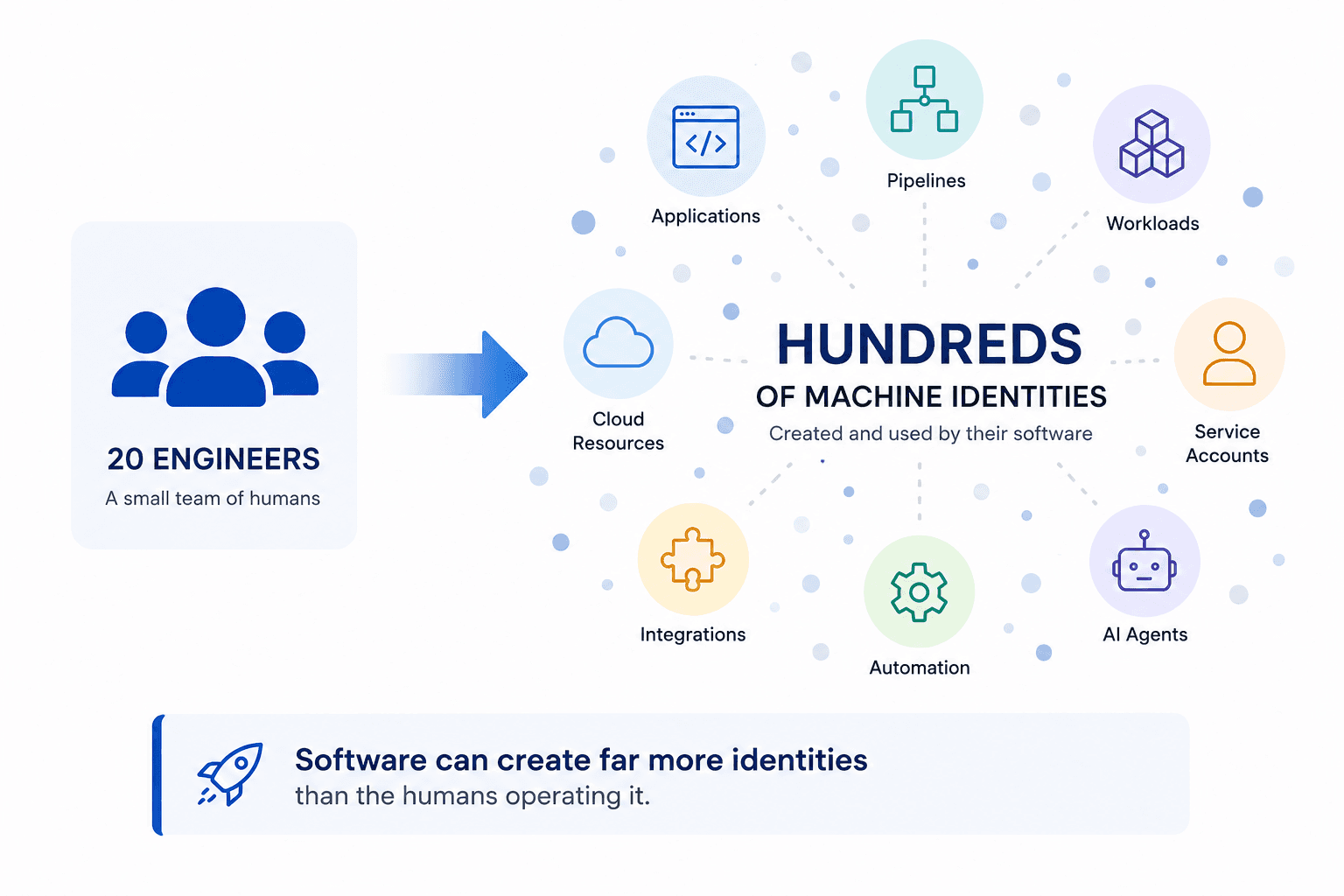
One developer might interact with dozens of applications and cloud services. Those systems may consist of hundreds of workloads, functions, pipelines, service accounts, integrations, and automation processes, with each component potentially requiring its own identity.
A company with 5,000 employees might therefore operate tens of thousands or even hundreds of thousands of non-human identities depending on its architecture. The exact ratio varies dramatically between organizations, but the broader trend is clear: software is becoming an increasingly significant consumer of identity and access.
This creates a different governance problem from managing employees in a directory.
Machine Identities Can Multiply Quickly
Imagine a development team with 20 engineers. Those 20 human identities might operate 40 microservices, 25 CI/CD pipelines, 15 serverless applications, 10 infrastructure automation workflows, 30 cloud service accounts, 20 third-party integrations, and several AI agents.
A relatively small number of humans can therefore be responsible for a much larger number of machine identities. As environments grow, the relationship becomes increasingly difficult to understand.
Teams eventually need to answer questions such as:
Who owns a particular service account?
Which application still uses it?
Why does it have access to production?
When was the permission last needed?
What would break if the identity were removed?
Does the workload still exist?
These questions resemble the challenges organizations have faced with human access governance, but machine identities can appear and disappear much faster.
The Credential Problem
One of the oldest ways to authenticate a machine is to give it a secret. That might be an API key, access key, client secret, password, certificate, or another credential stored somewhere the application can retrieve it.
This approach is simple, which is one reason it became so common. It also creates a major security challenge.
A secret stored in source code, a configuration file, a CI/CD platform, an environment variable, or a secret-management system may remain valid for months or years. If that credential is copied, leaked, exposed in logs, or obtained by an attacker, another system may have difficulty distinguishing the attacker from the legitimate workload. In practice, possession of the credential can become sufficient to impersonate the identity.
Organizations then need processes to create secrets, distribute them, store them, rotate them, monitor them, and eventually revoke them. At cloud scale, this can become an enormous operational burden.
Identity Is Better Than Possession of a Secret
Modern workload identity systems attempt to answer a more useful question than whether a process simply knows the correct secret. They try to establish whether the workload can prove what it actually is.
Instead of permanently giving an application a reusable cloud credential, the application can establish its identity using properties of the environment in which it is running. That identity can then be exchanged for temporary authorization or short-lived credentials.
The exact implementation differs between platforms, but the architectural shift is important. A credential no longer needs to function as the permanent identity of the workload. The workload establishes identity first, and credentials can become temporary artifacts created from that identity.
This is the foundation for technologies such as workload identity federation and other forms of credential exchange.
Human Identity Usually Has a Lifecycle
Human identity governance benefits from an important source of organizational truth because people have recognizable employment lifecycles. Someone joins the company, joins a team, changes roles, moves to another business unit, and eventually leaves.
HR systems and identity providers can use these events to drive access changes. This is the familiar joiner, mover, and leaver lifecycle.
Machine identities often have much less obvious lifecycles. A service account might be created by an engineer during a deployment and remain for years. A pipeline may be replaced while its old identity survives, or an integration may stop being used without anyone removing its credentials.
Machines do not have the same obvious organizational departure event that humans do. This makes ownership and lifecycle management especially important for non-human identities.
Every Machine Identity Needs an Owner
A machine identity should not exist without organizational context. At minimum, an organization should be able to determine which application, service, team, or business function is responsible for it.
Without ownership, even basic governance becomes difficult. A security team might discover a highly privileged service account but be unable to determine whether deleting it would interrupt a critical production process. The account remains because nobody is confident enough to remove it, and over time these unknown identities accumulate.
Ownership changes the conversation. Instead of knowing only that a service account exists, the organization can understand that the identity belongs to the Payments platform, is owned by the Payments Engineering team, operates in production, and supports a critical business service.
That context makes access decisions, incident response, and lifecycle management much more practical.
Cloud Providers Represent Machine Identity Differently
AWS, Azure, and Google Cloud all support machine identity, but they expose different concepts and mechanisms.
AWS environments commonly use IAM roles for workloads running on services such as EC2, Lambda, and EKS. Applications can assume roles and receive temporary credentials rather than relying on permanent IAM user access keys.
Azure uses concepts including managed identities, service principals, and Microsoft Entra identities. Azure resources can use managed identities to authenticate to supported services without requiring developers to manage credentials directly.
Google Cloud commonly uses service accounts and workload identity mechanisms to represent applications and workloads. Workloads can obtain access through their assigned identity rather than storing permanent service-account keys.
The providers differ in terminology and implementation, but the architectural goal is similar: allow software to establish identity and obtain the access it needs without depending on permanently embedded secrets.
Multi-Cloud Makes Machine Identity Harder to Understand
In a single cloud, teams can learn the provider's identity model and build governance around it. Multi-cloud environments introduce multiple identity models at once.
A workload may be represented by an AWS IAM role in one environment, an Azure managed identity or service principal in another, and a Google Cloud service account elsewhere. The same organization must then answer common governance questions across these different provider constructs:
Who owns this identity?
What can it access?
Which environment does it belong to?
Is it production?
Is the access still required?
Does it use static credentials?
How should its activity be audited?
The cloud-specific implementation matters, but the organization also needs a way to reason about identities at a level above individual provider terminology.
Humans and Machines Should Not Necessarily Receive Access the Same Way
Human and machine identities may ultimately need similar cloud permissions, but the way those permissions are granted can differ.
A human requesting privileged production access might be evaluated using information such as their identity, team, MFA status, managed-device posture, vulnerability status, on-call status, active incidents, requested duration, and the criticality of the target environment. Signals from identity providers, MDM platforms, EDR systems, vulnerability-management solutions, on-call platforms, and ITSM systems can all contribute useful context.
A workload cannot be evaluated using exactly the same signals. Instead, the system might consider which workload is requesting access, where it is running, which application owns it, its deployment environment, the pipeline or process that created it, the workload's security posture, and the operation it is attempting to perform.
The signals differ, but the underlying principle remains the same: access decisions should reflect the context surrounding the identity and the action it wants to perform.
This becomes especially important as organizations move from static role assignments toward more dynamic forms of access control, including context-based access control.
Machine Access Should Be Temporary When Possible
Machines are often granted standing privilege because automation needs to operate without waiting for human approval. Automation, however, does not inherently require permanent credentials or permanent privilege.
A deployment pipeline might establish its identity when a deployment begins, receive the permissions required to perform that deployment, obtain temporary credentials, complete the operation, and lose the elevated capability afterward. Similarly, an infrastructure automation process might receive permission to modify a specific environment only while an approved change is executing.
The same principle used for human ephemeral access therefore applies to machines: the ability to operate automatically does not require the ability to operate with permanent privilege.
AI Agents Blur the Boundary Between Human and Machine Access
AI agents are machine identities, but they introduce characteristics that make them different from traditional workloads. A traditional service generally performs a predictable function. A payment service processes payments, a deployment pipeline deploys software, and a monitoring system collects telemetry.
An AI agent may dynamically decide which actions are necessary to accomplish a goal. For example, a cloud operations agent might inspect an application, analyze logs, identify a configuration problem, determine a remediation, and request permission to execute a change.
This creates a more complex identity and authorization problem. The organization may need to understand:
Which agent is acting?
Who or what initiated the task?
What is the agent attempting to accomplish?
Which systems does it want to access?
What authority is required for this operation?
Which contextual signals support the decision?
How long should the authority exist?
Giving every AI agent a permanent administrator credential would undermine many of the security controls organizations have spent years building.
AI agents therefore make strong machine identity, temporary credentials, ephemeral authorization, contextual access decisions, and verifiable chains of identity increasingly important.
Identity Chains Matter
Machine activity often originates from another identity. A developer might start a deployment, the deployment platform launches a workflow, the workflow authenticates to a cloud environment, and the cloud environment authorizes infrastructure changes.
The resulting identity chain might be represented as Human → Platform → Workload → Cloud Action. For AI-driven operations, it might look like Human → AI Agent → Execution System → Cloud Action.
Looking only at the final credential can hide the origin of the action. A stronger model preserves enough of the identity chain to answer a much richer version of the question, "Who changed production?"
Instead of seeing only the technical identity that executed the API request, an organization can potentially understand the identities and authorization decisions that led to the action. That becomes valuable for security investigations, auditability, governance, and automated policy enforcement.
Human and Machine Identity Need a Common Governance Model
Human and machine identities should not be treated as identical, but they should not live in completely disconnected governance systems either.
Organizations increasingly need to answer common questions across both:
What is this identity?
Who owns it?
What environment does it belong to?
What access does it have?
Why does it have that access?
Is the access permanent or temporary?
What credentials does it use?
What organizational context applies to it?
What actions has it performed?
Should the identity or its access still exist?
The answers may come from different systems, but the governance problem is shared. This is particularly important in cloud environments where humans, workloads, automation, and AI agents can all make high-impact infrastructure changes.
Building a Better Identity Strategy
A modern cloud identity strategy should begin by recognizing that identity includes more than employees. Organizations should understand both their human and non-human identities, establish ownership, reduce unnecessary standing privilege, and move away from static credentials where stronger identity mechanisms are available.
A practical strategy can include:
Identify human and machine identities across cloud environments.
Establish ownership for non-human identities.
Understand which identities have privileged access.
Identify machine identities relying on long-lived secrets.
Prefer workload identity over embedded credentials where possible.
Use temporary credentials instead of static credentials.
Reduce unnecessary standing privileges.
Incorporate organizational, security, and operational context into access decisions.
Preserve identity chains for automated operations.
Apply the same governance principles to AI agents from the beginning.
The objective is not to force every identity into the same technical model. It is to ensure that every identity, human or machine, can be understood, authenticated, authorized, governed, and audited appropriately.
Frequently Asked Questions
What is a human identity?
A human identity represents a person interacting with systems, such as an employee, developer, administrator, contractor, customer, or partner.
What is a machine identity?
A machine identity represents software or another non-human entity that needs to authenticate and interact with systems. Examples include applications, workloads, service accounts, CI/CD pipelines, automation systems, and AI agents.
Is a service account a machine identity?
Yes. Service accounts are one common mechanism for representing non-human identities, although different cloud providers and platforms use different terminology and identity mechanisms.
Are machine identities the same as credentials?
No. Identity represents who or what an entity is, while credentials are mechanisms used to prove that identity. Treating a long-lived secret as both the credential and effective identity is one of the problems modern workload identity systems attempt to reduce.
Why are machine identities difficult to manage?
Machine identities can be created rapidly, may outnumber human identities, often lack clear ownership, and do not follow predictable employment lifecycles. They may also rely on long-lived credentials that are difficult to rotate and track.
What is workload identity?
Workload identity allows an application or workload to establish its identity based on the environment or platform where it runs rather than relying entirely on a permanently stored credential.
Can machine identities use temporary credentials?
Yes. Workload identities can often exchange proof of their identity for short-lived credentials or tokens, reducing dependence on permanent secrets.
Are AI agents machine identities?
Yes. AI agents are a form of non-human identity. Their ability to dynamically choose and perform actions makes identity, authorization, context, and auditability particularly important.
Should humans and machines use the same access policies?
They can share common governance principles, but the signals used to evaluate them may differ. Humans may be evaluated using factors such as device posture, MFA, vulnerability status, on-call status, and employment context, while workloads may use runtime environment, workload identity, application ownership, deployment context, and other machine-specific signals.
Key Takeaways
Identity in modern cloud environments is no longer only about people. Applications, workloads, pipelines, automation systems, service accounts, and AI agents also need identities that can be authenticated, authorized, governed, and audited.
Human identities usually have recognizable organizational lifecycles and can authenticate interactively. Machine identities operate automatically, can multiply rapidly, and often require different mechanisms for establishing identity.
Long-lived secrets have historically been used to solve machine authentication, but they create significant security and operational problems. Workload identity and temporary credentials provide a path toward systems where software can prove what it is without permanently possessing reusable secrets.
Ownership and context are also essential. Knowing that a service account exists is less useful than knowing which application owns it, which environment it operates in, how critical that environment is, and why the identity has its current permissions.
AI agents make these questions even more important because software is beginning to make and execute decisions that previously required humans. The future of cloud identity therefore requires a common governance model that can reason about humans, workloads, automation, and AI agents together while respecting the differences between them.
Related Reading
Workload Identity Federation Explained (coming soon)
Cross-Cloud Identity Management (coming soon)
What Is a Cloud Identity Graph? (coming soon)
Why AI Agents Need Temporary Credentials (coming soon)
AI Agent Identity: The Next Identity Challenge (coming soon)
Secure AI-to-Cloud Communication (coming soon)
How Strato Cloud Helps
Strato Cloud provides a cloud-agnostic control plane for managing access across AWS, Azure, and Google Cloud while recognizing that the identities interacting with cloud environments are increasingly both human and non-human.
Strato Cloud syncs cloud identities alongside AWS accounts, Azure subscriptions, and Google Cloud projects, allowing organizations to apply cloud-agnostic organizational context to those identities. Labels can help describe ownership, business function, environment, criticality, and other information that is difficult to express consistently across different provider identity models.
That organizational context can also contribute to access decisions. Human access can potentially incorporate signals from systems such as identity providers, device-management platforms, vulnerability-management tools, on-call systems, endpoint security platforms, and incident-management systems. Machine access can use different signals appropriate to workloads, automation, and execution environments.
For temporary access, Strato Cloud can help organizations move away from assuming that powerful permissions need to exist continuously. Humans and non-human identities can obtain the cloud capabilities required for legitimate work without turning every occasional need into permanent standing privilege.
Strato Cloud's Secure Execution model extends this idea to workloads and automated systems. Short-Lived Workload Access Tokens, or SWATs, are designed to support short-lived workload access while maintaining a verifiable identity chain between the initiating identity, the workload performing the operation, and the resulting cloud action.
This becomes increasingly important as AI agents begin interacting directly with cloud infrastructure. The objective is not simply to give an agent credentials. Organizations need to establish which identity is acting, why it is acting, what it should be allowed to do, under what context, and for how long that authority should exist.