Published:
Estimated reading time:
8–9 minutes

Cloud environments are easy to change. That flexibility is one of their greatest advantages, but it also creates a security challenge because a single configuration change can expose data, weaken network controls, disable logging, or create permissions that were never intended.
In a small environment, engineers may be able to review configurations manually. At enterprise scale, that becomes unrealistic. Organizations can operate hundreds of cloud environments containing thousands or millions of resources, with infrastructure changing continuously across AWS, Azure, and Google Cloud.
Cloud Security Posture Management, commonly shortened to CSPM, emerged to address this problem. CSPM continuously evaluates cloud environments for security risks and configuration weaknesses, giving security and platform teams a systematic way to identify problems that would otherwise be difficult to find manually.
What Is CSPM?
Cloud Security Posture Management is a category of cloud security technology designed to continuously identify security risks caused by cloud configuration and posture.
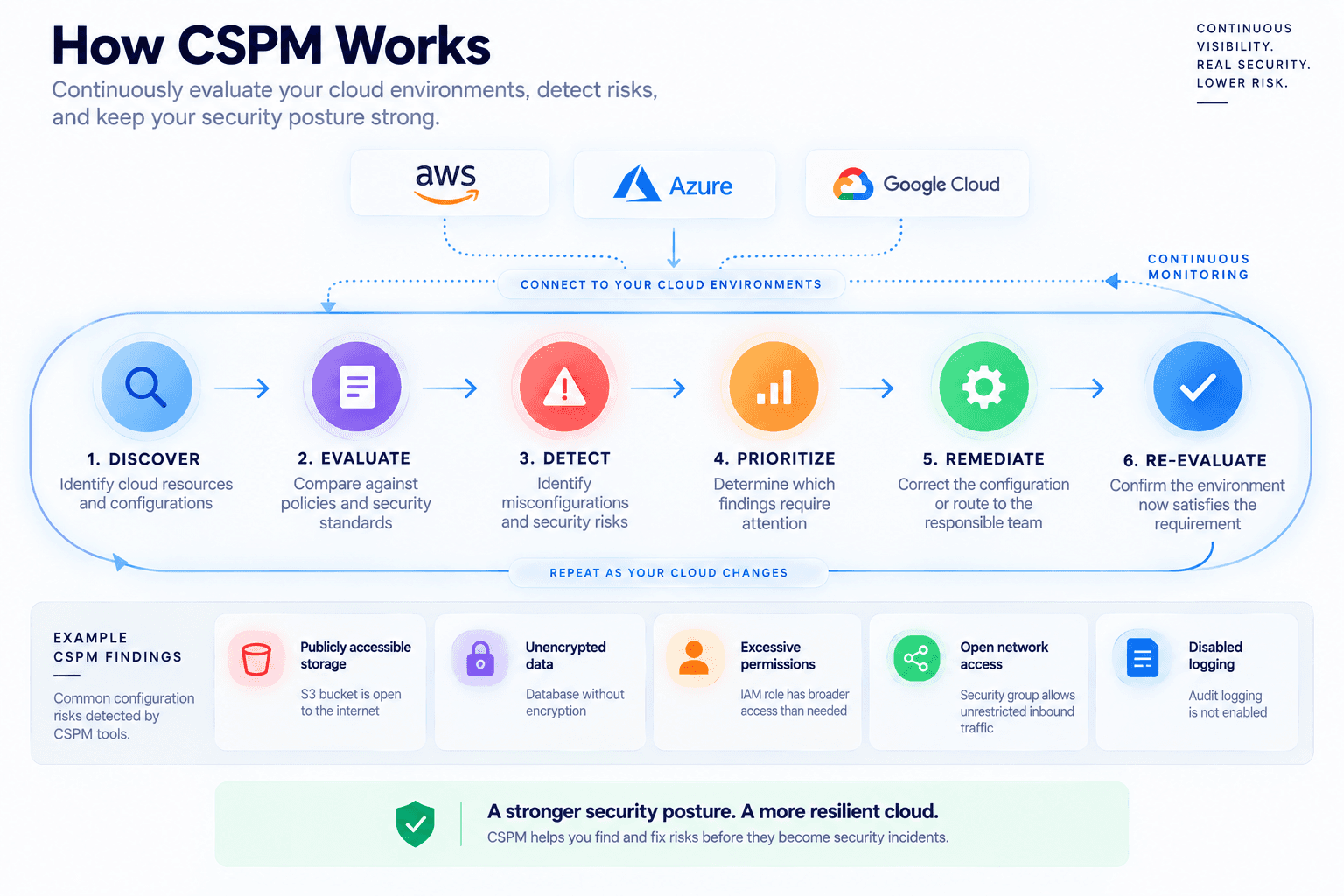
A CSPM platform connects to cloud environments, evaluates resources and configurations against security policies or best practices, and produces findings when something does not meet the expected standard. Depending on the platform, those checks can include public exposure, encryption, identity configuration, network security, logging, data protection, and many other aspects of cloud infrastructure.
The basic CSPM lifecycle can be summarized as:
Discover → Evaluate → Detect → Prioritize → Remediate → Re-evaluate
The objective is continuous visibility into whether cloud infrastructure is configured securely, rather than relying exclusively on periodic audits or manual reviews.
Why CSPM Became Necessary
Traditional infrastructure security was built around environments that were relatively centralized and slow moving. Security teams could establish network boundaries, configure infrastructure, and periodically review whether those controls remained effective.
Cloud computing changed that operating model. Developers can create infrastructure through APIs, deployment pipelines can modify hundreds of resources in minutes, and individual teams can operate their own accounts, subscriptions, or projects. Managed cloud services also expose large numbers of configuration options that can directly affect security.
This creates an enormous configuration surface. A storage service might become public because of an incorrect policy, a database might be deployed without encryption, a security group might allow unnecessary internet access, or logging might be disabled in an environment where it is required.
None of these conditions necessarily require an attacker to exploit a software vulnerability. The infrastructure itself may simply be configured in a way that creates unnecessary risk.
CSPM gives organizations a way to evaluate those configurations continuously.
What Does a CSPM Platform Actually Do?
Although CSPM products differ significantly, most follow a similar operating model. The platform first needs enough visibility into the cloud environment to understand what infrastructure exists and how it is configured.
Traditionally, CSPM platforms accomplish this by connecting to cloud-provider APIs and collecting information about resources, identities, networks, storage, databases, security controls, and other infrastructure. Many platforms maintain their own representation of this cloud state so they can evaluate relationships, run queries, track changes, and perform security analysis.
The collected state is then evaluated against policies. Those policies may come from the vendor, industry frameworks, regulatory standards, cloud-provider recommendations, or custom organizational requirements.
When the platform identifies a configuration that violates a policy, it creates a finding. Security teams can then investigate, prioritize, assign, suppress, accept, or remediate that finding depending on the organization's processes.
What Does CSPM Detect?
CSPM focuses heavily on configuration-related security risks. The exact checks vary between products and cloud providers, but the category covers a broad range of cloud posture problems.
A CSPM platform might identify storage that is unintentionally accessible from the internet, databases without encryption, overly permissive firewall rules, missing audit logging, insecure TLS settings, or identities with excessive permissions. It can also evaluate whether security services are enabled and whether infrastructure complies with defined security baselines.
These findings are valuable because many cloud security incidents begin with relatively ordinary configuration mistakes. The underlying cloud service may be functioning exactly as designed while the configuration exposes the organization to unnecessary risk.
CSPM attempts to find those conditions before they become security incidents.
CSPM and Cloud Misconfiguration
Misconfiguration is central to the CSPM model because cloud providers expose powerful capabilities through configuration. The same flexibility that allows engineers to rapidly build infrastructure also makes it possible to create insecure states.
Consider object storage. There are legitimate reasons for some objects to be publicly accessible, but a storage bucket containing internal data usually should not be exposed to the internet. A CSPM policy can evaluate the relevant configuration and report when it violates the expected security posture.
The same pattern applies to network access, encryption, logging, identity, databases, Kubernetes environments, and many managed services. The platform translates security expectations into checks that can be applied repeatedly across a large environment.
This is much more scalable than expecting security engineers to manually inspect every cloud configuration.
CSPM Is Continuous, Not Just a Scanner
It is tempting to think of CSPM as a cloud vulnerability scanner, but that description misses an important characteristic. Cloud environments change continuously, so posture management has to be continuous as well.
A resource that is secure today can become insecure tomorrow because of a deployment, manual change, policy update, or new dependency. New resources can appear between scans, and an organization can introduce new security requirements that make existing infrastructure noncompliant even though the infrastructure itself did not change.
CSPM platforms therefore re-evaluate cloud environments over time. The value comes not only from finding existing problems but from detecting when the security posture changes.
This continuous model is one reason CSPM became an important component of modern cloud security programs.
CSPM vs. Vulnerability Management
CSPM and vulnerability management address related but different security problems. Vulnerability management traditionally focuses on weaknesses in software, operating systems, libraries, containers, or applications that could be exploited by an attacker.
CSPM focuses primarily on how cloud infrastructure and services are configured.
A virtual machine might have a vulnerable software package, which belongs to vulnerability management. The security group exposing that virtual machine to the entire internet is a cloud posture issue.
Modern cloud security platforms increasingly combine these signals because they become more valuable together. A vulnerable workload that is isolated from the internet may represent a different level of risk than the same workload running behind a publicly accessible endpoint.
Understanding cloud risk often requires both vulnerability information and cloud context.
CSPM vs. Cloud Compliance
CSPM and cloud compliance also overlap because many compliance frameworks contain technical requirements that can be evaluated against cloud infrastructure.
A CSPM platform may map its security checks to frameworks such as CIS benchmarks, PCI DSS, SOC 2, NIST, or other standards. This can help organizations understand which cloud configurations may affect compliance requirements.
However, passing CSPM checks does not automatically make an organization compliant. Compliance frameworks often include procedural, organizational, documentation, personnel, and operational controls that cannot be determined simply by inspecting cloud configuration.
CSPM can provide valuable technical evidence and identify cloud conditions relevant to compliance, but it represents one part of a broader compliance program.
CSPM vs. CNAPP
CSPM increasingly appears as one capability within a broader category known as Cloud-Native Application Protection Platforms, or CNAPP.
A CNAPP can combine posture management with capabilities such as cloud workload protection, vulnerability management, entitlement analysis, container and Kubernetes security, Infrastructure as Code scanning, and other cloud security functions.
In that model, CSPM remains responsible primarily for cloud configuration and posture while the larger platform addresses additional layers of cloud security.
The terminology varies among vendors, and individual products may place capabilities into different categories. The useful distinction is conceptual: CSPM evaluates cloud security posture, while broader platforms may combine posture with workload, identity, vulnerability, application, and runtime security.
CSPM and Infrastructure as Code
Infrastructure as Code changed where cloud security problems can be detected. Instead of waiting until infrastructure has been deployed, organizations can evaluate Terraform, CloudFormation, or other infrastructure definitions before they reach the cloud.
This is sometimes called shifting security left. A policy can identify a potentially insecure configuration during development or CI/CD, allowing the engineer to fix it before deployment.
That is valuable, but pre-deployment analysis does not eliminate the need for CSPM. Infrastructure can change after deployment, resources can exist outside IaC, and new policies can apply to infrastructure that was created long ago.
The strongest model therefore evaluates both intended state and actual state. IaC checks can catch problems before deployment, while continuous posture evaluation determines whether the live environment remains secure afterward.
The Challenge of CSPM Findings
Finding cloud security problems at scale introduces another problem: there can be a lot of them.
Large organizations may generate thousands of findings across multiple cloud providers and environments. If every failed configuration check appears as an equally important alert, security teams can quickly accumulate a backlog that engineering teams struggle to address.
This is why context and prioritization matter. A publicly exposed resource in an isolated development environment may represent a different level of risk from the same configuration in a production environment containing sensitive data.
Ownership matters as well. A finding is much easier to resolve when the organization knows which team owns the affected environment, what application it supports, how critical it is, and where its infrastructure is managed.
CSPM tells an organization that something about its cloud posture requires attention. Turning that finding into an operational response often requires additional context.
From Finding to Remediation
Early posture-management workflows frequently ended with a finding. Security teams discovered the problem and engineering teams were responsible for figuring out how to fix it.
Modern remediation workflows increasingly try to reduce the distance between detection and resolution. Some findings can be mapped to predefined automated actions, while others can be routed to engineering teams with remediation guidance or integrated into ticketing and workflow systems.
Infrastructure as Code creates another useful remediation path. If the affected infrastructure is managed through Terraform or another declarative system, the persistent fix should generally be made in that source of truth rather than only modifying the live resource.
Otherwise, the immediate cloud configuration may be corrected while the original IaC remains unchanged. A future deployment can simply recreate the insecure configuration.
The remediation problem is therefore not always just what API call fixes this resource? It may be what change should be made to the system that manages this resource?
Where AI Changes the CSPM Workflow
AI can potentially address one of the more difficult parts of posture management: the work between finding a problem and producing an appropriate remediation.
A traditional CSPM can identify that a network rule is too permissive, but the correct fix may depend on the architecture around it. Removing the rule might satisfy the policy while breaking the application.
An AI system can investigate the affected environment, examine relevant dependencies, understand organizational context, inspect existing Infrastructure as Code, and generate a proposed remediation for that particular situation. Deterministic tools can then validate the proposal before it enters an approval and deployment workflow.
This does not eliminate the need for CSPM-style detection. It changes what can happen after detection.
The finding becomes the beginning of a remediation workflow rather than necessarily the end of the security platform's responsibility.
CSPM in Multi-Cloud Environments
Multi-cloud environments make posture management more difficult because AWS, Azure, and Google Cloud expose different services, configuration models, APIs, policy mechanisms, and identity systems.
A security requirement may be conceptually consistent across all three providers while requiring completely different technical evaluations. Requiring production object storage to prevent unauthorized public access is one organizational objective, but determining whether that requirement is satisfied involves provider-specific resources and controls.
CSPM platforms can provide a common security view across those providers while maintaining the provider-specific logic needed to evaluate them.
The challenge is avoiding a lowest-common-denominator model. Effective multi-cloud posture management should unify organizational intent and operational context without pretending that the underlying clouds are identical.
CSPM Is Valuable, but Posture Is Only One Part of Cloud Governance
CSPM answers an important question: Is our cloud infrastructure configured in a way that creates security risk?
Organizations also have to answer broader operational questions. Which policies should apply to which environments? Who owns the affected environment? Should an exception be allowed? How should a finding be remediated? Who is authorized to approve or execute that remediation? How should cloud access itself be governed? How do we verify that the environment remains compliant afterward?
Those questions extend beyond posture detection into the broader cloud governance lifecycle.
This does not make CSPM less useful. It establishes where CSPM fits. Posture management provides continuous security evaluation, while a broader governance model connects those findings to organizational context, policy scope, remediation, access, approvals, and verification.
That distinction will become increasingly important as cloud operations incorporate more automation and AI.
How StratoCloud Fits Alongside CSPM
StratoCloud approaches the problem from the perspective of a broader cloud control plane rather than trying to recreate a traditional CSPM resource inventory.
The platform maintains organizational context around AWS accounts, Azure subscriptions, Google Cloud projects, namespaces, and cloud identities. Cloud-agnostic labels can describe concepts such as ownership, environment, business function, and criticality without requiring those concepts to align with a single provider's hierarchy.
Continuous Governance can evaluate cloud environments against organizational requirements and surface findings that need attention. When deeper investigation is required, StratoCloud can query live cloud APIs rather than depending on a synchronized inventory of every individual cloud resource.
That context can then continue into remediation. Intelligent Remediation can investigate a finding and generate proposed Infrastructure as Code inside an isolated execution environment, validate the change, and deliver it through an authorized GitHub pull request so the organization's existing review and deployment process remains in control.
Secure Execution addresses another part of the governance lifecycle by controlling how humans, workloads, and AI receive temporary access to cloud environments.
The relationship is important because CSPM solves a valuable part of the cloud security problem. The broader opportunity is connecting understanding, governance, remediation, and execution into a continuous operating model.
What Should You Look for in a CSPM?
The right CSPM depends on the size and complexity of the environment, but organizations should evaluate more than the number of security checks a product advertises. Coverage matters, but so do the quality of findings and the operational workflows around them.
A useful platform should provide broad visibility across the cloud providers and services the organization actually uses, continuously evaluate configuration against relevant security requirements, and give teams enough context to understand why a finding matters. Organizations should also consider how the platform handles custom policies, compliance frameworks, prioritization, exceptions, ownership, integrations, and remediation.
For multi-cloud organizations, the ability to create a coherent view across AWS, Azure, and Google Cloud becomes particularly important. That view should simplify operations without hiding the provider-specific details engineers need to resolve problems.
Ultimately, CSPM should help teams reduce cloud risk rather than simply produce a larger list of security findings.
Frequently Asked Questions
What does CSPM stand for?
CSPM stands for Cloud Security Posture Management. It describes technologies that continuously evaluate cloud environments for insecure configurations and other security posture risks.
What does a CSPM tool do?
A CSPM tool connects to cloud environments, evaluates infrastructure and configuration against security policies or best practices, and generates findings when it identifies potential risks. Many platforms also provide prioritization, compliance mapping, workflow integrations, and remediation capabilities.
What are examples of CSPM findings?
Common examples include publicly accessible storage, excessive network exposure, missing encryption, disabled logging, insecure identity configuration, and cloud services that do not meet organizational security standards.
Is CSPM the same as cloud compliance?
No. CSPM can evaluate technical cloud controls that contribute to compliance, but regulatory and security frameworks often contain requirements that cannot be verified solely through cloud configuration.
Is CSPM the same as vulnerability management?
No. CSPM primarily evaluates cloud configuration and posture, while vulnerability management traditionally identifies exploitable weaknesses in software, operating systems, libraries, containers, and applications. Modern cloud security platforms often combine both.
What is the difference between CSPM and CNAPP?
CSPM focuses primarily on cloud security posture and configuration. CNAPP is a broader category that can combine CSPM with workload protection, vulnerability management, entitlement analysis, Infrastructure as Code security, container security, and other cloud-native security capabilities.
Does CSPM replace Infrastructure as Code scanning?
No. IaC scanning can identify problems before infrastructure is deployed, while CSPM evaluates deployed cloud environments and can detect drift, manual changes, existing infrastructure, and newly introduced policy requirements.
Can CSPM work across AWS, Azure, and Google Cloud?
Yes. Multi-cloud CSPM platforms can evaluate infrastructure across multiple providers, although the underlying checks and implementations remain provider specific.
Can CSPM automatically remediate findings?
Some CSPM platforms support automated or guided remediation. The appropriate approach depends on the finding because some problems have deterministic fixes while others require context and engineering judgment before a safe change can be made.
How does AI change CSPM?
AI can help investigate findings, understand surrounding cloud and organizational context, and generate proposed remediations for situations that do not map cleanly to predefined actions. Deterministic authorization, validation, approval, and deployment controls can remain responsible for deciding whether those proposals affect production.