Published:
Estimated reading time:
8–9 minutes

A cloud credential is authority encoded into something software can use. Whoever possesses a valid access key, service account key, token, password, or other credential may be able to perform whatever actions that credential permits.
The security problem is not limited to how powerful the credential is. How long it remains useful matters too.
A credential that exists for a year gives an attacker a year-long opportunity to discover and abuse it. A credential that exists for an hour dramatically reduces that window. If access can be created only when it is needed and disappear automatically afterward, the organization no longer has to protect the same reusable secret indefinitely.
This is why cloud security is gradually moving away from static credentials toward identity-based authorization and temporary access. The objective is not simply better secret management. It is to reduce how many reusable secrets need to exist at all.
What Are Static Cloud Credentials?
Static cloud credentials are credentials that remain valid until they are manually rotated, revoked, expired by policy, or otherwise changed. They are commonly created once and then stored somewhere so a human, application, script, CI/CD pipeline, or integration can authenticate repeatedly.
Examples include AWS access keys, service account keys, long-lived API tokens, passwords, and credentials stored in environment variables, configuration files, CI/CD secrets, secret managers, or developer machines.
The exact implementation varies by provider and workload, but the security characteristic is the same: possession of the credential can continue granting access without requiring the original identity to prove itself again.
That persistence is convenient. It is also what makes static credentials dangerous.
Credential Lifetime Is Part of the Attack Surface
Security discussions often focus on privilege. If a credential can administer an entire cloud account, it obviously represents more risk than one that can read a single storage bucket.
Privilege is only one dimension of exposure, though. Duration matters as well.
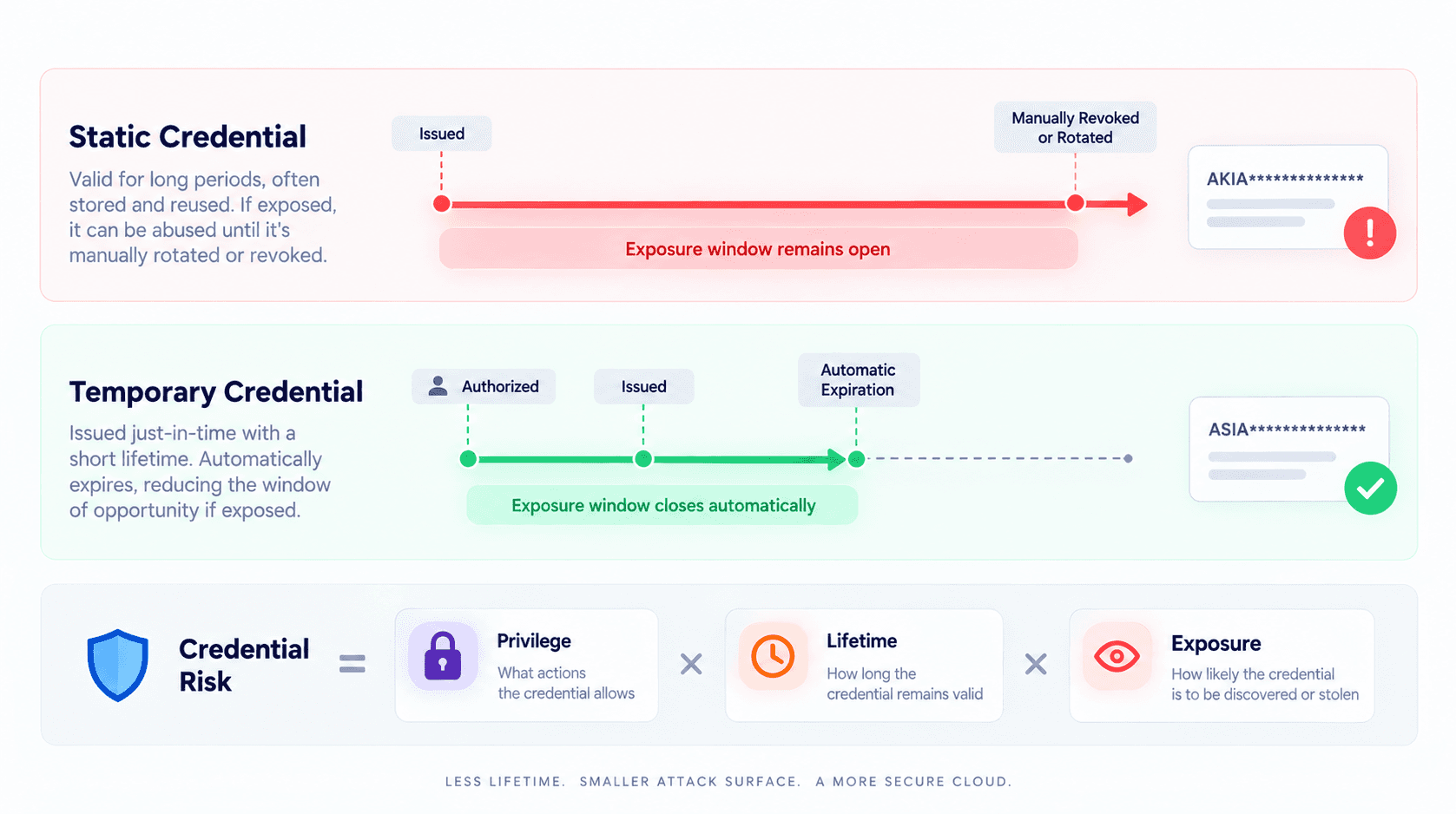
Imagine two credentials with identical permissions. One remains valid for a year while the other expires after 30 minutes. An attacker who obtains the first credential may be able to return repeatedly until someone detects the compromise and revokes it. The second credential naturally becomes useless when its short lifetime ends.
This gives us a useful way to think about credential risk:
Credential Risk ≈ Privilege × Lifetime × Exposure
The formula is conceptual rather than mathematical, but it captures an important principle. Reducing permissions helps. Protecting credentials from exposure helps. Reducing how long credentials remain useful also helps, and unlike perfect secret protection, expiration does not depend on detecting that a compromise occurred.
Secret Management Does Not Eliminate the Problem
Organizations have invested heavily in protecting secrets, and for good reason. Secret managers, encryption, access controls, rotation policies, repository scanning, and credential-detection tools all reduce the likelihood that sensitive credentials will be exposed.
Those controls are still valuable, but they manage the consequences of having persistent secrets. They do not remove the underlying characteristic that makes those secrets valuable to an attacker.
A perfectly stored static credential still has to become available somewhere when it is used. Applications retrieve secrets into memory, CI/CD systems inject them into jobs, developers export them into shells, and automation passes them between systems. Every place a reusable credential travels becomes another opportunity for accidental disclosure or compromise.
This creates an important distinction between managing secrets better and needing fewer secrets. Modern cloud identity architectures increasingly aim for the second outcome.
Rotation Helps, but Rotation Is Not the End State
Credential rotation reduces risk by limiting how long one version of a static secret remains valid. Instead of allowing an access key to survive indefinitely, an organization might require it to be replaced every 90 days.
That is better than never rotating it, but rotation introduces its own operational complexity. The new credential has to be distributed to every legitimate consumer, the old credential has to be retired without breaking workloads, and the organization has to know everywhere the secret is being used.
Frequent rotation can make those problems more difficult. Infrequent rotation leaves a longer exposure window.
Temporary credentials change the model. Rather than repeatedly replacing one persistent secret with another persistent secret, the system issues credentials with a deliberately short lifetime and allows them to expire automatically.
The question shifts from “How often should we rotate this secret?” to “Why does this identity need a reusable secret in the first place?”
Static Credentials Create an Identity Problem
A static credential proves possession of the credential. It does not necessarily prove who or what is using it at this moment.
Suppose an AWS access key was originally created for a developer. Months later, the key is copied into a local script, added to a CI/CD secret, pasted into a troubleshooting environment, or accidentally committed to a repository.
The credential may continue working, but the relationship between the original identity and the current actor has weakened. Cloud audit logs can identify the access key or associated principal, yet that does not necessarily tell the organization which human or workload actually possessed the credential when the action occurred.
This becomes even more problematic when credentials are shared. A credential intended for one automation workflow can gradually become infrastructure used by multiple systems because copying the existing secret is easier than creating a proper identity for each consumer.
The result is authentication without strong identity provenance.
Humans Should Authenticate as Humans
Human cloud access increasingly starts with an identity provider rather than a permanent cloud credential. The user authenticates using their organizational identity, potentially including MFA and other security controls, and receives access appropriate to the task they are performing.
That access can then be translated into temporary cloud credentials.
The distinction is important because authentication and credential issuance become separate events. The organization first establishes who the user is, then decides whether that user should receive access to a particular cloud environment, role, or capability at that moment.
This makes it possible to incorporate additional context into the authorization decision. The system can consider the target environment, requested role, approval state, device posture, on-call status, security signals, or other information before issuing credentials.
The cloud credential becomes the temporary result of an authorization decision rather than a permanent representation of the user's authority.
Workloads Should Have Identities Too
The same principle applies to machines.
Applications, CI/CD pipelines, containers, Kubernetes workloads, serverless functions, and AI agents all need ways to prove who or what they are. Historically, many of these systems have authenticated by storing long-lived credentials in environment variables, secret stores, configuration files, or pipeline settings.
Modern platforms increasingly provide stronger identity primitives. A workload can present evidence of its runtime identity and exchange that identity for temporary access rather than retrieving a permanent cloud secret.
This creates a fundamentally different trust model. The system no longer asks whether the workload knows the right secret. It asks whether the workload can prove that it is the identity authorized to receive access.
That difference is particularly important for automation because machine credentials are often widely distributed and rarely observed directly by humans.
Just-in-Time Access Changes When Credentials Exist
Temporary credentials reduce how long access survives. Just-in-time access goes further by changing when the credentials are created in the first place.
Instead of maintaining credentials continuously in case someone eventually needs them, JIT systems issue access when an authorized request occurs. The credential exists for the duration of the approved activity and expires afterward.
For human access, that might mean an engineer requests temporary read-only access to a production AWS account while investigating an incident. The system verifies the engineer's identity, evaluates the request, checks relevant context and approvals, and then issues credentials with a short expiration.
For workloads, the same principle can happen programmatically. A workload proves its identity, receives narrowly scoped temporary authority, performs its task, and loses that authority when the credential expires.
The result is a cloud environment with less persistent authority waiting to be abused.
Zero Standing Privilege Is the Logical Destination
If JIT access is applied consistently, organizations can move toward Zero Standing Privilege, or ZSP.
Standing privilege exists when an identity has privileged access available continuously, regardless of whether that access is currently needed. Zero Standing Privilege aims to eliminate or dramatically reduce that persistent authority by granting privileged access dynamically when legitimate work requires it.
Temporary credentials are an important technical mechanism for achieving that goal, but ZSP is broader than simply shortening credential expiration. The authorization itself should be dynamic.
A user who can always generate administrator credentials without additional evaluation effectively still has standing privilege, even if each individual credential expires after an hour. The credential is temporary, but the entitlement remains permanently available.
A stronger model evaluates whether access should be granted at the moment it is requested.
That distinction connects temporary credentials, JIT access, and context-based authorization into one security architecture.
Temporary Does Not Automatically Mean Least Privilege
Short-lived credentials reduce exposure time, but they do not excuse excessive permissions.
A 15-minute credential with unrestricted administrator access can still cause enormous damage during those 15 minutes. Temporary access and least privilege solve different dimensions of the problem.
The strongest approach combines both. Credentials should exist for as little time as practical and contain only the authority required for the intended operation.
This is another reason dynamic authorization is useful. Instead of assigning a permanent set of permissions and merely issuing short-lived copies of them, the system can evaluate what the actor is trying to do and issue appropriately scoped authority for that request.
The goal becomes minimum necessary privilege for the minimum necessary time.
Temporary Credentials Improve Revocation by Design
Revocation is difficult when credentials are distributed widely. If a static secret is compromised, the organization must identify it, revoke it, distribute a replacement to legitimate consumers, and verify that nothing still depends on the old credential.
Short-lived credentials reduce the importance of emergency revocation because expiration is built into the credential lifecycle.
This does not eliminate the need for revocation. An active temporary credential may still need to be invalidated during an incident, and the underlying identity may need to be prevented from obtaining another one.
The difference is that the system has a natural safety boundary. Even if a stolen credential is never explicitly found, its usefulness eventually ends.
That property is particularly valuable when credential compromise is discovered long after the initial exposure.
Temporary Credentials Improve Auditability
Identity-based credential issuance can also improve the quality of cloud audit trails.
With static credentials, logs often tell investigators which cloud principal or key performed an action. If that credential was shared, copied, or used by multiple systems, determining the real actor may require additional investigation.
A stronger identity chain connects the action back to the human or workload that requested the temporary authority. The credential is not simply a reusable secret associated with a generic principal. It is the result of a specific authorization event involving a specific identity.
For human access, this can preserve attribution from the organizational user through credential issuance and into the cloud activity. For workloads, it can preserve the relationship between runtime identity and the authority exercised in the provider.
Audit logs become more useful when they answer not only what credential was used, but who or what was actually behind it.
AI Makes Credential Architecture More Important
AI agents introduce another class of actor capable of interacting with cloud infrastructure. An agent may investigate resources, query configurations, analyze findings, generate remediation code, or eventually participate in operational workflows.
Giving every AI system a shared long-lived cloud credential would recreate many of the problems organizations are trying to eliminate for humans and workloads.
It also creates an attribution problem. If multiple users ask an AI agent to investigate the cloud and every investigation runs through the same agent identity, the cloud sees the agent rather than the human authority behind each request.
A stronger architecture preserves the initiating identity. The system verifies the requesting user, determines what that user is authorized to access, and obtains temporary credentials on the user's behalf. The AI can then perform its investigation within those boundaries.
This allows AI to become a new interface to cloud operations without becoming a new source of permanent cloud authority.
Read Access and Modification Should Have Different Boundaries
Not every temporary credential should provide the same capabilities. Investigating cloud infrastructure and modifying it are fundamentally different trust decisions.
An AI assistant helping an engineer understand a production environment may need broad visibility into configuration and relationships while requiring no ability to change those resources. Temporary read-only credentials can support that investigation without exposing unnecessary write authority.
If the investigation leads to a proposed infrastructure change, that change can cross a separate authorization boundary. The organization might require a pull request, policy evaluation, human approval, or deployment through an existing CI/CD system rather than simply upgrading the original investigative credential to administrative access.
Separating observation from modification limits the consequences of both mistakes and compromise.
The same principle applies to human workflows. Being authorized to understand what is happening does not automatically mean being authorized to change it.
Multi-Cloud Makes Static Credentials Even Harder to Manage
Static credential management becomes increasingly complicated when organizations operate across AWS, Azure, and Google Cloud. Each provider has different credential formats, identity mechanisms, role systems, expiration behavior, and security controls.
Without a coherent identity model, teams can accumulate provider-specific keys and secrets across developer machines, CI/CD systems, integrations, scripts, and secret managers. Rotation and ownership become more difficult as the environment expands.
An identity-first approach provides a more consistent model. Humans and workloads establish their identities first, authorization determines what they can access, and provider-specific temporary credentials are created only when needed.
The credentials remain cloud specific because the providers are different. The trust model above them can still be consistent.
This allows organizations to unify the principles of access without pretending that AWS IAM, Microsoft Entra and Azure RBAC, and Google Cloud IAM work identically.
How StratoCloud Approaches Ephemeral Cloud Access
StratoCloud's Secure Execution model is designed around reducing persistent cloud authority for humans, workloads, and AI.
For human access, StratoCloud can verify the requesting user's identity and evaluate the requested cloud environment, role, organizational policy, approvals, and contextual signals before granting access. When the request is authorized, the platform obtains temporary just-in-time cloud credentials on behalf of that user rather than relying on one shared StratoCloud identity for cloud operations.
This preserves the identity chain between the human making the request and the cloud activity performed with the resulting credentials. It also allows access to disappear automatically when the credential expires instead of leaving reusable authority behind.
For workloads, StratoCloud uses SWAT, the Short-Lived Workload Access Token, as part of an identity-based exchange model. A workload can exchange an OAuth 2.0 identity token for a short-lived token that participates in obtaining authorized cloud access without requiring the workload to maintain a permanent provider credential.
The same architecture can support AI-assisted cloud investigation. Talk to Your Cloud can use Secure Execution to obtain temporary read-only credentials on behalf of an authorized user, allowing AI to query live provider APIs while preserving the user's access boundaries and attribution.
Across these scenarios, the principle remains consistent: establish identity, evaluate authorization, issue temporary authority, perform the operation, and allow that authority to disappear.
The Goal Is Not Better Static Credentials
Organizations will not eliminate every persistent secret overnight. Legacy applications, third-party integrations, unsupported platforms, and migration constraints can make static credentials necessary in some environments for years.
Those credentials should still be protected, inventoried, rotated, monitored, and reduced wherever practical.
But better management should not become the long-term architectural goal.
When a platform supports strong human or workload identity, the better question is whether a persistent cloud credential needs to exist at all. If authority can be created dynamically from a verified identity, scoped to the required task, and allowed to expire automatically, the organization removes an entire class of long-lived secrets from its attack surface.
The future of cloud access is therefore not a better vault filled with more carefully rotated credentials. It is an environment where fewer reusable cloud credentials exist in the first place.
Frequently Asked Questions
What is a static cloud credential?
A static cloud credential is an access key, password, token, service account key, or similar credential that remains valid until it is rotated, revoked, or otherwise changed. It can typically be reused without repeating the original identity verification and authorization process.
Why are static credentials dangerous?
Static credentials remain useful for long periods and can be copied, leaked, shared, or stolen. If compromised, an attacker may retain access until the credential is discovered and revoked or rotated.
Are temporary credentials completely safe?
No. A temporary credential can still be abused while it remains valid, particularly if it has excessive permissions. Temporary credentials reduce the exposure window but should still be combined with least privilege, strong authorization, monitoring, and appropriate security controls.
What is the difference between credential rotation and temporary credentials?
Rotation replaces one credential with another, usually on a schedule. Temporary credentials are intentionally created with short lifetimes and expire automatically, often requiring a new authorization or identity exchange before additional credentials can be obtained.
What is just-in-time cloud access?
Just-in-time access grants cloud authority when it is actually needed rather than maintaining that access continuously. An authorized request can result in temporary credentials that expire after the approved period.
Is JIT access the same as Zero Standing Privilege?
They are related but not identical. JIT access is a mechanism for granting temporary access when needed. Zero Standing Privilege is the broader objective of eliminating persistent privileged authority and requiring access to be dynamically authorized.
Can workloads avoid static cloud credentials?
Often, yes. Modern cloud platforms, CI/CD systems, Kubernetes environments, and identity providers increasingly support workload identity mechanisms that allow applications to prove their identity and obtain temporary credentials instead of storing permanent secrets.
Should AI agents have their own permanent cloud credentials?
A shared permanent AI credential can weaken least privilege and attribution. A stronger architecture can authorize the human or workload initiating the operation and provide temporary credentials within that identity's permitted boundaries.
Do temporary credentials eliminate the need for secret managers?
No. Organizations may still have passwords, API keys, certificates, legacy credentials, and other secrets that require secure storage. Temporary cloud credentials reduce the number of persistent provider credentials that need to be managed but do not eliminate every type of secret.
What does minimum privilege for minimum time mean?
It means granting an identity only the permissions required for a particular task and allowing that authority to exist only for the period in which it is needed. This combines least privilege with short credential lifetime to reduce both the power and duration of potential compromise.