Published:
Estimated reading time:
8–10 minutes

Cloud access requires more than deciding whether an identity should be allowed to perform an action. The identity also needs a secure way to authenticate to the cloud platform and exercise that access.
Historically, that often meant creating credentials that could remain valid for months or years. Access keys, client secrets, passwords, certificates, and other reusable secrets were distributed to people and applications so they could authenticate whenever they needed to interact with cloud services.
That model is increasingly being replaced by temporary cloud credentials.
Instead of giving an identity a credential that remains useful indefinitely, a cloud platform can issue credentials with a limited lifetime. The identity uses them for a session or operation, and after they expire they can no longer be used.
This changes an important assumption in cloud security. A credential does not need to remain valid forever just because an identity may need access again in the future.
What Are Temporary Cloud Credentials?
Temporary cloud credentials are authentication credentials that are issued with a limited lifetime.
Depending on the cloud platform and authentication mechanism, temporary credentials may take the form of tokens, dynamically issued access keys, signed assertions, or other short-lived authentication material.
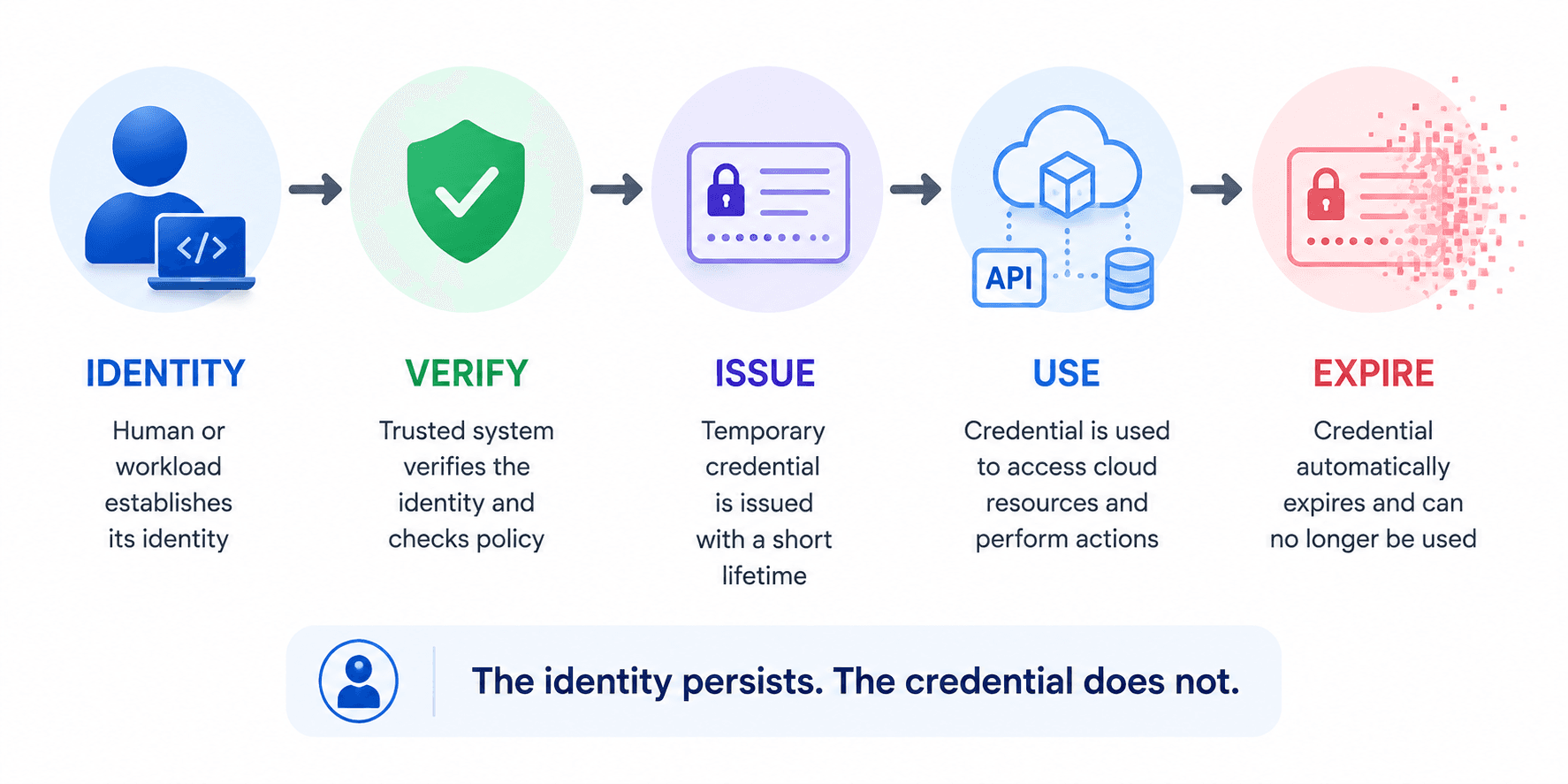
The exact implementation varies, but the basic lifecycle is similar:
An identity establishes who or what it is.
A trusted system determines whether that identity can obtain access.
Temporary credentials are issued.
The identity uses those credentials to interact with cloud services.
The credentials expire.
New credentials must be obtained for future access.
The expiration is a security property of the credential itself. Once its lifetime ends, simply possessing the old credential should no longer be sufficient to authenticate.
Temporary Credentials vs. Permanent Credentials
The most important difference between temporary and permanent credentials is what happens over time.
A long-lived credential continues to work until it is rotated, revoked, deleted, or otherwise invalidated. A temporary credential is designed to stop working after a defined period.
Long-Lived Credentials | Temporary Credentials | |
|---|---|---|
Lifetime | Potentially months or years | Minutes or hours |
Expiration | Often requires administrative action | Built in |
Reuse | Reusable until revoked | Limited by lifetime |
Rotation | Must be managed | New credentials can be issued automatically |
Impact of theft | May persist until discovered | Limited by expiration |
Common use | Legacy applications, static integrations | Sessions, roles, workloads, federation |
Temporary credentials do not prevent credentials from being stolen. They reduce the amount of time a stolen credential remains useful.
That distinction matters because preventing every possible credential exposure is extremely difficult. Limiting the lifetime of exposed authentication material provides another layer of defense.
Why Long-Lived Credentials Are Dangerous
Long-lived credentials create a simple operational model: create a secret once and continue using it.
The security problem is that the same property that makes the credential convenient also makes it valuable to an attacker.
Imagine an access key created for an automation script. The key is copied into a configuration file and continues working for two years. During that period it might be copied to a developer laptop, stored in a CI/CD platform, included in a backup, accidentally written to logs, or committed to a repository.
Each copy creates another opportunity for exposure.
If an attacker discovers the credential eighteen months after it was created and the key is still valid, its age provides no protection. The attacker may be able to authenticate exactly as the legitimate application does.
Long-lived credentials therefore create both a secret-management problem and an exposure-time problem.
Expiration Changes the Economics of Credential Theft
Consider two credentials with identical permissions.
The first remains valid until manually revoked. The second expires in 60 minutes.
If both credentials are exposed at the same moment, they initially present similar risk. After an hour, however, the temporary credential becomes useless while the long-lived credential may continue working.
This creates a useful security principle: reduce both what a credential can do and how long it can do it.
Least privilege reduces capability. Short credential lifetimes reduce opportunity.
Neither eliminates risk, but together they can significantly reduce the useful window available to an attacker.
Temporary Credentials Are Not the Same as Temporary Access
Temporary credentials and temporary access are closely related, but they solve different problems.
Temporary access is an authorization concept. It determines how long an identity is allowed to perform certain actions.
Temporary credentials are an authentication concept. They determine how long particular authentication material can be used to prove identity and exercise that access.
An organization can have one without the other.
For example, an administrator might permanently possess a powerful cloud role but authenticate using credentials that expire every hour. The credentials are temporary, but the authorization is standing.
Alternatively, an organization might grant a user an administrator role for one hour while allowing that user to authenticate through a credential with a much longer lifetime. The authorization is temporary, but the underlying authentication material is not.
A stronger design can combine the two. Privileged authorization exists only when needed, and the credentials used to exercise it are also short-lived.
Where Temporary Credentials Come From
Temporary credentials usually require an identity to establish trust through some other mechanism first.
For a human, that trust might originate with an enterprise identity provider. The user authenticates through the organization's normal sign-in process, and federation allows the cloud provider to issue a temporary session.
For a workload, trust might come from the environment where the workload is running. A cloud platform, Kubernetes cluster, CI/CD system, or workload identity platform can provide evidence that allows the application to establish its identity.
For an external system, trust may be established through federation, signed tokens, certificates, or another identity mechanism.
The important architectural change is that the application does not necessarily need to begin with a permanent cloud secret.
It can prove its identity and obtain temporary credentials when they are needed.
Temporary Credentials in AWS
AWS has long supported temporary security credentials through AWS Security Token Service, commonly known as AWS STS.
When an identity assumes an IAM role, AWS can issue temporary credentials that typically include an access key ID, secret access key, session token, and expiration time. Applications use these credentials to sign AWS API requests during the session.
IAM roles allow AWS workloads to use this model without permanently storing IAM user access keys.
For example, an application running on an EC2 instance can use an IAM role associated with the instance. AWS makes temporary credentials available to the workload and refreshes them as necessary.
Similar patterns exist across services such as Lambda, ECS, and EKS.
Federated human users can also obtain temporary AWS credentials. Instead of creating a permanent IAM user and access key for every employee, organizations can federate their identity provider with AWS and create temporary sessions based on roles.
The result is a model where AWS access can exist without distributing permanent AWS credentials to every human and workload.
Temporary Credentials in Azure
Microsoft Azure relies heavily on token-based authentication through Microsoft Entra ID.
Applications and users can obtain access tokens that have limited lifetimes and are used to authenticate to Azure services. Rather than treating a permanent password or secret as the credential used for every cloud operation, the identity obtains tokens that represent authenticated sessions.
Azure managed identities extend this model to workloads.
A supported Azure resource can receive an identity managed by the platform. The workload can use that identity to obtain tokens for Azure services without developers embedding credentials directly into application code.
This separates the workload's identity from a manually distributed secret and allows Azure to manage much of the credential lifecycle.
Service principals can also participate in token-based authentication, although the method used to authenticate the service principal matters. A service principal protected by a long-lived client secret still creates a secret-management challenge even if the resulting access token is temporary.
The strongest architecture therefore considers both the lifetime of the final token and the mechanism used to obtain it.
Temporary Credentials in Google Cloud
Google Cloud also supports short-lived authentication through OAuth tokens, service-account impersonation, workload identity federation, and related mechanisms.
A workload can establish an external or platform identity and exchange that identity for short-lived Google Cloud credentials rather than storing a permanent service-account key.
Service-account impersonation provides another useful pattern. An authenticated identity can be authorized to act as a service account and receive short-lived credentials associated with that account.
This reduces the need to distribute service-account private keys, which can otherwise remain valid until they are explicitly revoked.
As with AWS and Azure, the important architectural goal is to establish trust dynamically and issue temporary authentication material rather than treating permanent secrets as the default.
Federation Changes the Credential Model
Federation allows one trusted identity system to establish identity on behalf of another system.
For humans, this might mean using an enterprise identity provider to authenticate employees rather than maintaining separate permanent credentials in every cloud.
For workloads, federation can allow an application running outside a particular cloud provider to establish its identity and exchange that proof for temporary cloud credentials.
This can eliminate a common pattern where an application running in one environment receives a permanent secret simply because it needs to access another environment.
Instead, the systems establish a trust relationship.
The workload proves its identity, the cloud evaluates that identity against the trust configuration, and temporary credentials are issued when appropriate.
This is particularly important in multi-cloud environments where workloads increasingly need to communicate across provider boundaries.
Workload Identity Reduces the Need for Stored Secrets
The strongest temporary-credential models begin with a reliable workload identity.
If an application can prove what it is based on its runtime environment, platform identity, cryptographic identity, or another trusted mechanism, it may not need a permanent cloud credential at all.
The sequence becomes:
Workload Identity → Trust Evaluation → Temporary Credential → Cloud API
The application still receives authentication material, but that material can be generated dynamically and expire quickly.
This reduces the number of secrets organizations need to distribute and maintain. It also changes credential rotation from a periodic administrative project into a normal part of the authentication process.
Temporary Credentials Still Need Protection
Short-lived credentials are safer in important ways, but they are not harmless.
A credential that remains valid for 60 minutes can still be abused during those 60 minutes. If it provides administrator access, an attacker may need only a few minutes to cause significant damage.
Temporary credentials should therefore be combined with other security controls.
Organizations should consider:
Least-privilege permissions
Appropriate credential lifetimes
Temporary or ephemeral authorization
Strong identity verification
Contextual access policies
Monitoring and audit logging
Secure token handling
Protection against credential exfiltration
Rapid response to suspicious activity
Expiration limits the window of misuse. It does not make the actions performed inside that window safe.
How Short Should a Credential Lifetime Be?
There is no universal credential lifetime that works for every system.
A credential should generally remain valid long enough to perform the legitimate task without creating unnecessary operational failures, but not significantly longer than required.
Interactive administrative sessions might need a different lifetime from automated API calls. A deployment that lasts 20 minutes does not necessarily need credentials valid for eight hours. A continuously running workload may need credentials refreshed automatically rather than receiving one credential that lasts for the life of the application.
The appropriate lifetime depends on factors such as:
Sensitivity of the target environment
Privilege level
Type of identity
Expected task duration
Ability to refresh credentials automatically
Operational impact of expiration
Risk associated with credential theft
The objective is not simply to choose the shortest possible number. It is to make credential lifetime proportional to legitimate operational need.
Context Can Influence Credential Issuance
Credential issuance does not need to depend only on whether an identity technically exists.
For human users, a system might consider whether the user has completed strong authentication, whether their device is managed and healthy, whether they are currently on call, whether an active incident exists, whether vulnerability-management systems identify serious endpoint risk, and how critical the requested cloud environment is.
For workloads, relevant signals could include workload identity, runtime environment, application ownership, deployment pipeline, target environment, requested operation, and security posture.
These signals can help answer a more useful question than simply "Can this identity authenticate?"
The broader question is "Should this identity receive credentials for this capability under the current circumstances?"
This is where temporary credentials, ephemeral access, and context-based access control begin to work together.
Machine Identities Benefit Disproportionately
Temporary credentials are particularly valuable for machine identities because machines often operate continuously and at enormous scale.
A human can sometimes respond to a credential-rotation request or authenticate again when a session expires. Requiring manual credential rotation for thousands of workloads is far less practical.
Automatic issuance and renewal allow workloads to operate continuously while the individual credentials remain short-lived.
If a workload needs access for months, that does not mean one credential needs to remain valid for months. The workload can repeatedly prove its identity and receive new short-lived credentials.
This distinction is fundamental:
Long-lived workload does not require long-lived credential.
AI Agents Should Not Start With Permanent Cloud Secrets
AI agents make temporary credential design even more important.
An AI agent may interact with multiple cloud environments and request different capabilities depending on the task it is performing. Giving the agent a permanent administrator credential simply because it may occasionally need administrative access creates unnecessary risk.
A safer model begins with the agent's identity and the task being performed.
The system can evaluate the agent, the initiating identity, the requested operation, the target environment, and relevant contextual signals. If the operation is authorized, the agent or its execution environment can receive temporary credentials appropriate to that specific task.
Those credentials can expire when the access window ends.
This creates a much stronger foundation for autonomous cloud operations than storing powerful cloud secrets in an AI platform and trusting the agent to use them correctly.
Identity Chains Should Survive Credential Exchange
Temporary credentials are often created through a sequence of identity exchanges.
A human might authenticate to an enterprise identity provider, launch an automation workflow, cause a workload to execute, and ultimately trigger an operation in AWS, Azure, or Google Cloud.
If each exchange loses the previous identity context, the final cloud log may show only the technical identity that executed the request.
A stronger architecture preserves the relationship between the identities involved:
Human → Automation → Workload → Temporary Credential → Cloud Action
For AI operations, the chain might become:
Human → AI Agent → Execution Environment → Temporary Credential → Cloud Action
Preserving this context makes it easier to understand not only which credential performed an action, but why that credential existed and which identity initiated the sequence that created it.
That distinction becomes increasingly valuable as automated systems perform more privileged operations.
Common Temporary Credential Mistakes
Moving to temporary credentials does not automatically produce a secure architecture.
Temporary Tokens Backed by Permanent Secrets
An application may receive a short-lived token but use a permanent client secret to obtain every new token. The visible credential is temporary, but a long-lived credential still exists underneath the process.
Excessively Long Sessions
A technically temporary credential that lasts for days may provide little improvement over a permanent credential for many threat scenarios.
Overly Broad Permissions
A five-minute credential with unrestricted administrator access can still cause significant damage. Credential lifetime and permission scope need to be considered together.
Poor Identity Verification
If an attacker can easily impersonate the identity used to request new temporary credentials, short expiration provides limited protection because the attacker can simply request another credential.
Missing Audit Context
A cloud log that records only the temporary technical identity may not provide enough information to understand the human, workload, automation system, or AI agent responsible for the action.
The goal is not merely to replace permanent strings with expiring strings. It is to build a stronger identity and access lifecycle around credential issuance.
Moving Toward Temporary Credentials
Organizations can transition gradually rather than attempting to replace every credential immediately.
A practical starting point is to identify long-lived cloud credentials and understand where they are used. Credentials with broad privileges, unclear ownership, long rotation periods, or access to critical production environments deserve particular attention.
Teams can then ask whether each credential can be replaced by:
Federated human identity
Cloud-native workload identity
Managed identities or IAM roles
Service-account impersonation
Workload identity federation
Dynamically issued tokens
Another short-lived credential mechanism
The migration is not only about changing credential formats. It is about moving from stored trust toward dynamically established trust.
Frequently Asked Questions
What are temporary cloud credentials?
Temporary cloud credentials are authentication credentials issued with a limited lifetime. They allow an identity to authenticate to cloud services for a defined period and automatically become unusable after expiration.
Are temporary credentials safer than permanent credentials?
Generally, temporary credentials reduce the exposure window if credentials are stolen because they expire automatically. Their security still depends on permission scope, identity verification, credential handling, and the mechanism used to obtain them.
Are temporary credentials the same as JIT access?
No. JIT access determines when authorization is granted. Temporary credentials are short-lived authentication material used to exercise access. The two approaches can be combined.
Are temporary credentials the same as ephemeral access?
No. Ephemeral access describes temporary authorization, while temporary credentials describe temporary authentication material.
Does AWS support temporary credentials?
Yes. AWS STS and IAM roles are widely used to issue temporary AWS security credentials for federated users and workloads.
Does Azure support temporary credentials?
Yes. Microsoft Entra ID issues access tokens with limited lifetimes, and Azure managed identities allow supported workloads to obtain tokens without storing credentials directly.
Does Google Cloud support temporary credentials?
Yes. Google Cloud supports mechanisms including OAuth tokens, service-account impersonation, and workload identity federation that can provide short-lived credentials without relying on permanent service-account keys.
Do temporary credentials eliminate secrets?
Not automatically. A temporary token may still be obtained using a long-lived secret. Workload identity and federation can help remove those underlying permanent secrets as well.
Can AI agents use temporary cloud credentials?
Yes. AI agents and their execution environments can use temporary credentials to perform authorized cloud operations without requiring permanently stored administrative secrets.
Key Takeaways
Temporary cloud credentials change the assumption that authentication material must remain valid for as long as an identity might need access. Instead, identities can establish trust when necessary and receive credentials that expire automatically.
AWS, Azure, and Google Cloud all provide mechanisms for short-lived authentication, although their terminology and implementations differ. IAM roles and AWS STS, Microsoft Entra tokens and managed identities, and Google Cloud workload identity and service-account impersonation all support variations of this model.
Temporary credentials are not the same as temporary authorization. Strong cloud access architectures can combine JIT access, ephemeral authorization, workload identity, contextual policy, and short-lived credentials so that both the permission and the authentication material exist only as long as necessary.
This becomes especially important for workloads, automation, and AI agents. Software may need to operate continuously, but the individual credentials it uses do not need to live continuously.
The long-term goal is not simply better secret rotation. It is to reduce how many permanent secrets need to exist at all.
Related Reading
Workload Identity Federation Explained (coming soon)
OAuth Token Exchange for Cloud Workloads (coming soon)
AWS STS and Temporary Credentials Explained (coming soon)
Azure Managed Identities Explained (coming soon)
Google Cloud Service Accounts Explained (coming soon)
Why AI Agents Need Temporary Credentials (coming soon)
Secure AI-to-Cloud Communication (coming soon)
How Strato Cloud Helps
Strato Cloud approaches cloud access around the idea that identities should not require permanently available cloud credentials simply because they may need to perform cloud operations.
Across AWS, Azure, and Google Cloud, temporary access can be combined with cloud-native short-lived credential mechanisms so that authorized users and systems receive the capabilities they need without turning every access requirement into another long-lived secret.
The decision to provide that access can also incorporate context. For human identities, relevant signals can include identity-provider information, device management, endpoint security, vulnerability status, on-call responsibility, active incidents, and the organizational context of the target cloud environment. Machine identities can be evaluated using workload identity, application ownership, execution environment, requested operation, and other machine-specific signals.
Strato Cloud's Secure Execution model extends this principle to workloads and automated systems. A workload can exchange an OAuth 2.0 token for a Short-Lived Workload Access Token, or SWAT, rather than requiring a static cloud credential to be embedded in the workload.
This also helps preserve a verifiable identity chain between the identity initiating an operation, the workload or agent executing it, and the resulting cloud action. That becomes increasingly important as automation and AI agents perform operations that previously required direct human access.
The objective is a cloud access model where identity establishes trust, context determines whether access is appropriate, and credentials exist only for as long as the authorized operation requires them.