Published:
Estimated reading time:
8–10 minutes

Cloud access has traditionally been treated as something a person receives and keeps. An engineer joins a team, receives permissions to several cloud environments, and those permissions often remain in place until someone remembers to remove them.
That model made sense when infrastructure changed slowly and access was relatively static. Modern cloud environments are different. Engineers move between projects, production systems change constantly, contractors come and go, automation operates continuously, and organizations may manage hundreds of AWS accounts, Azure subscriptions, and Google Cloud projects.
Just-in-time cloud access takes a different approach. Instead of giving people permanent privileged access because they might need it someday, organizations provide access when it is needed, for a defined purpose and period of time, and remove it automatically when that need ends.
What Is Just-in-Time Cloud Access?
Just-in-time cloud access, often abbreviated as JIT access, is an access-control model in which cloud permissions are granted temporarily when a user needs them rather than remaining permanently assigned.
A developer who normally has no administrative access to production might need elevated permissions to investigate an incident. With JIT access, the developer requests the required level of access, receives it for an approved period, performs the work, and automatically loses the elevated permissions when the access window expires.
The basic lifecycle is:
Request → Evaluate → Grant → Use → Expire
The important difference is what happens after the work is finished. The privileged access does not remain attached to the user indefinitely.
The Problem With Standing Privileges
Traditional cloud access models rely heavily on standing privileges, which are permissions that remain available whether or not someone is actively using them.
Suppose an engineer needs production administrator access approximately twice per month. Under a standing-access model, the organization might assign that role permanently because it is easier than repeatedly granting and removing it.
The engineer therefore has privileged access 24 hours a day, seven days a week, even though the permission may only be needed for a few hours each month.
That creates unnecessary exposure. If the engineer's identity is compromised, an attacker may immediately inherit the same privileged access. If the engineer accidentally runs a command against the wrong environment, the permissions are already available. If the engineer changes teams and the access is not removed, the privilege can persist long after the original business need disappears.
The problem is not that the engineer should never have administrative access. The problem is that the engineer has it when it is not needed.
JIT Access Changes the Default
Just-in-time access changes the default state from:
Access exists until someone removes it
to:
Access does not exist until there is a reason to grant it
That is a meaningful change in security posture.
Instead of reviewing a large collection of permanent permissions and asking whether each one is still necessary, organizations can make privileged access temporary by design. Access has a beginning, a defined scope, and an expiration.
This reduces the amount of privilege continuously available across the organization without preventing engineers from obtaining the permissions they legitimately need.
How Just-in-Time Cloud Access Works
A JIT access workflow typically begins when a user needs permission they do not currently possess.
For example, an engineer investigating a production problem might request:
Environment: Production Payments
Access: Database Administrator
Duration: 60 minutes
Reason: Investigate payment processing incident
The access system then evaluates the request according to organizational policy.
Depending on the environment and risk involved, the request might be approved automatically, require approval from another person, or be rejected.
If approved, the user receives the necessary cloud access. When the approved duration ends, the elevated access expires automatically.
A mature JIT system should therefore answer several questions for every request:
Who is requesting access?
What are they requesting access to?
What permissions do they need?
Why do they need them?
How long should the access last?
Does policy allow the request?
Does another person need to approve it?
What happened while the access was active?
JIT access is not simply temporary permission. It is a controlled lifecycle around privileged access.
JIT Access Reduces the Privilege Window
One of the easiest ways to understand JIT access is to think about the privilege window.
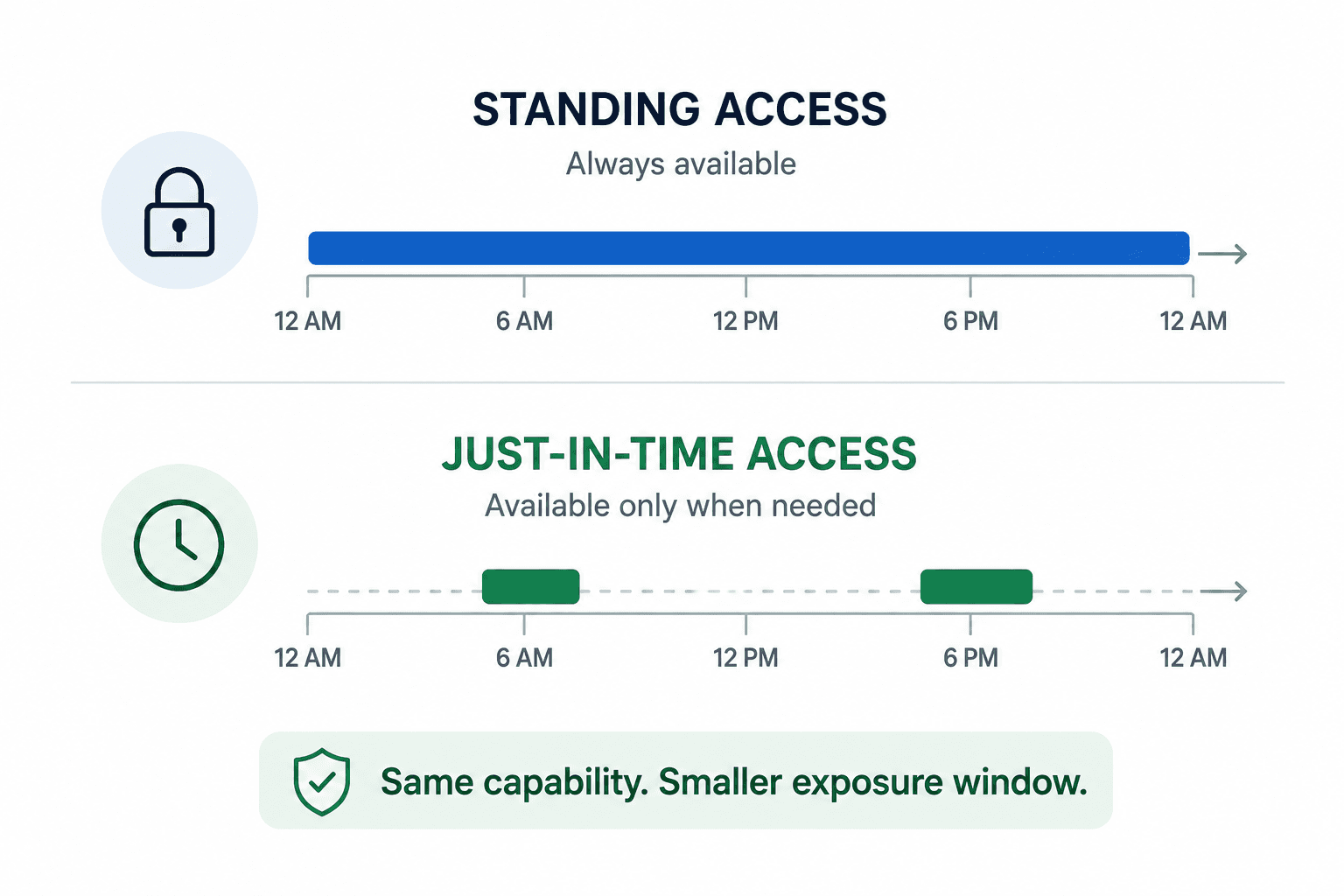
With standing access, the privilege window may last months or years. The user can exercise the permission at any moment during that period.
With JIT access, the privilege window might last 30 minutes, two hours, or the duration of a particular operational task.
If an engineer needs production administration for two hours per month, there is little security benefit in exposing that permission for the other hundreds of hours in the month.
Reducing the privilege window does not eliminate identity risk, but it reduces the amount of time during which compromised credentials or human mistakes can take advantage of elevated permissions.
JIT Access and Least Privilege
Just-in-time access is closely related to the principle of least privilege, but the two concepts are not identical.
Least privilege asks:
What is the minimum access this identity needs?
Just-in-time access adds another question:
When does this identity actually need that access?
An organization can technically follow least privilege while still granting permissions permanently. A developer may have exactly the correct production role, but if that role is available every hour of every day, the organization still has standing privilege.
A stronger access model combines both ideas. Give an identity only the permissions required for the task and make those permissions available only for the period when they are required.
This adds a time dimension to least privilege.
JIT Access Does Not Mean Every Request Needs Human Approval
A common misconception is that just-in-time access requires an administrator to manually approve every request.
That would quickly become impractical.
Low-risk requests may be approved automatically when they satisfy organizational policy. Higher-risk requests might require approval from an application owner, security team, manager, or another authorized person.
For example, an organization might allow engineers to automatically receive read-only access to development environments for four hours. Production administrator access might require approval and be limited to one hour.
The objective is not to create more tickets. It is to evaluate each access request according to its context and risk.
Context Makes JIT Access More Powerful
Not every access request should be evaluated the same way.
Consider two requests from the same engineer for the same administrative role.
The first request is for a development environment during normal working hours.
The second request is for a critical production cybersecurity environment at 2:00 AM.
The identity requesting access may be the same and the requested role may be identical, but the risk is clearly different.
A more sophisticated JIT access system can evaluate context such as:
User identity
Team membership
Requested role
Target environment
Production status
Business criticality
Time of request
Request duration
Approval status
Authentication strength
Organizational policy
This allows access decisions to reflect the actual circumstances of the request rather than relying entirely on static role assignments.
That concept becomes especially important when organizations move toward context-based access control.
JIT Access in Multi-Cloud Environments
Implementing JIT access becomes more difficult when an organization operates across AWS, Azure, and Google Cloud because each provider has its own identity and authorization model.
AWS uses concepts such as IAM users, roles, policies, and temporary credentials. Azure relies heavily on Microsoft Entra ID, Azure RBAC, role assignments, and privileged identity capabilities. Google Cloud uses IAM roles, policies, service accounts, and its own resource hierarchy.
Organizations can implement temporary access independently inside each provider, but that creates separate operational models.
An engineer may need to understand one process for requesting access to an AWS account, another for an Azure subscription, and another for a Google Cloud project. Security teams must then govern and audit those systems separately.
A cloud-agnostic JIT model can provide a consistent access workflow above the individual providers while still using each provider's native security mechanisms underneath.
The Access Request Should Describe Intent
Traditional permission systems often force users to think in terms of implementation details.
An engineer may need to know a particular AWS role ARN, Azure role assignment, or provider-specific IAM structure before requesting access.
A more useful model allows the engineer to describe what they are trying to accomplish.
For example:
I need read-only access to the production Payments environment for two hours.
The access system can then determine which cloud environment the request refers to, which provider-specific permissions are appropriate, which policies apply, and whether approval is required.
This separates human intent from cloud-specific implementation.
The user asks for the access they need. The access system determines how that intent should be implemented safely in the underlying cloud.
Temporary Access Is Not the Same as Temporary Credentials
These concepts are related, but they should not be confused.
Temporary access describes how long an authorization exists.
Temporary credentials describe how authentication material is issued and how long those credentials remain valid.
A JIT workflow may grant temporary authorization and then provide short-lived credentials that allow the user to exercise that authorization.
The combination is powerful because both the permission and the credentials used to access it can disappear automatically.
This avoids replacing permanent permissions with temporary approval while still relying on long-lived credentials.
We will explore temporary cloud credentials in more detail separately.
JIT Access Improves Auditability
A well-designed JIT workflow creates a record around privileged access.
Instead of seeing only that a user possesses an administrator role, an auditor or security team can understand the circumstances surrounding the access.
A request can capture:
Who requested access
What they requested
Which environment was involved
Why access was needed
When it was approved
Who approved it
How long it remained active
When it expired
This creates a much richer audit trail than a permanent role assignment alone.
It can also make periodic access reviews easier. Instead of trying to determine whether hundreds of standing privileged assignments are still necessary, teams can examine the history of actual privileged-access requests.
JIT Access Can Improve the Developer Experience
Security controls are often described as a tradeoff between security and productivity. Poorly implemented access controls can certainly create that problem.
An engineer who needs production access during an incident cannot wait hours for a ticket to move through several teams.
A well-designed JIT system can actually improve the experience.
Instead of requesting permanent access through a ticket, waiting for someone to configure it, and later hoping someone remembers to remove it, the engineer can use a predictable access workflow. Low-risk requests can be approved automatically, higher-risk requests can be routed to the correct approver, and expiration happens without additional work.
The goal is not to make access difficult. It is to make safe access easy and permanent access unnecessary.
JIT Access for Humans and Machines
Just-in-time access is commonly discussed in the context of human engineers, but the same principle becomes increasingly important for non-human identities.
Applications, CI/CD pipelines, automation systems, workloads, and AI agents all need access to cloud infrastructure.
Historically, many of these systems have relied on static credentials or permanently assigned permissions because machines need to operate without waiting for a person to approve every action.
Modern identity systems make more dynamic approaches possible.
A workload can authenticate itself, receive temporary authorization appropriate for a particular task, perform the operation, and lose that authorization afterward.
This becomes especially important as AI agents begin performing cloud operations. An AI system should not necessarily possess permanent administrative access simply because it may occasionally need to make an infrastructure change.
The same principle applies:
Access should exist when the task requires it and disappear when the task is complete.
Common JIT Access Mistakes
Simply making access temporary does not automatically create a strong JIT program.
One common mistake is granting overly broad permissions for a shorter period. Giving someone unrestricted administrator access for one hour may reduce the exposure window, but it does not address whether the user actually needed that level of privilege.
Another mistake is creating such a burdensome approval process that engineers begin looking for ways around it. If every low-risk request requires several people and a ticket, teams may push for permanent access simply to remain productive.
Organizations can also undermine JIT access by leaving long-lived credentials or alternative access paths in place. Removing standing role assignments provides limited benefit if users still possess static credentials capable of bypassing the JIT workflow.
Effective JIT access therefore needs to address scope, time, policy, credentials, and usability together.
Building a JIT Cloud Access Strategy
Organizations moving toward just-in-time access do not need to eliminate every standing permission immediately. A practical strategy usually starts with the privileges that create the most risk.
Production administration, security infrastructure, sensitive data environments, and highly privileged cloud roles are natural starting points.
Teams can then define:
Which access should become temporary
How users request that access
How long different types of access should last
Which requests can be approved automatically
Which requests require human approval
What contextual information should influence the decision
How temporary access is implemented in each cloud provider
How access events are logged and reviewed
Over time, the organization can reduce standing privileges while making JIT access the normal path for elevated cloud permissions.
Frequently Asked Questions
What is just-in-time cloud access?
Just-in-time cloud access is an access-control model where cloud permissions are granted temporarily when they are needed and automatically removed when the approved access period ends.
What is the difference between JIT access and standing access?
Standing access remains continuously available until someone removes it. JIT access is created for a specific need and expires automatically after a defined period.
Does JIT access require manager approval?
Not always. Organizations can automatically approve lower-risk requests when they meet policy requirements while requiring human approval for more sensitive access.
Is JIT access the same as least privilege?
No. Least privilege focuses on minimizing the scope of permissions. JIT access focuses on minimizing how long those permissions exist. Strong access controls combine both.
Is JIT access the same as temporary credentials?
No. JIT access describes temporary authorization, while temporary credentials are short-lived authentication material. The two approaches are often used together.
Can JIT access work across AWS, Azure, and Google Cloud?
Yes. Each provider has mechanisms that can support temporary or dynamic access. A cloud-agnostic access layer can provide a consistent workflow while translating requests into the appropriate provider-specific controls.
Can machines use JIT access?
Yes. Workloads, automation systems, CI/CD pipelines, and AI agents can also use dynamic authorization and temporary credentials rather than relying entirely on permanent permissions and static secrets.
Key Takeaways
Just-in-time cloud access changes privileged access from something identities permanently possess into something they obtain when a legitimate need arises.
This reduces the privilege window and complements least privilege by adding a time dimension to access control. Instead of asking only what permissions an identity needs, organizations can also ask when those permissions should exist and for how long.
A mature JIT model considers identity, target environment, requested permissions, duration, business context, risk, approval requirements, and auditability. It can operate across human and machine identities and becomes particularly valuable in complex multi-cloud environments.
The objective is not to make engineers wait for permission every time they need to do their jobs. It is to create a system where safe access is easy to obtain, while unnecessary standing privilege becomes increasingly difficult to justify.
Related Reading
Zero Trust for Cloud Infrastructure (coming soon)
Cross-Cloud Identity Management (coming soon)
How Strato Cloud Helps
Strato Cloud provides a cloud-agnostic access layer across AWS, Azure, and Google Cloud so organizations can manage temporary access through a consistent workflow rather than building a separate operational process around each provider.
Users can request access to cloud environments when they need it instead of requiring permanent privileged assignments. The request can include the target environment, required access, duration, and business justification, giving the organization context around why the privilege is being requested.
Because Strato Cloud understands AWS accounts, Azure subscriptions, Google Cloud projects, cloud identities, namespaces, and the organizational labels associated with them, access decisions can incorporate more than the identity of the requester. Policies can also consider context around the environment being accessed.
A request involving a development environment can therefore be treated differently from a request involving a critical production environment.
Once access is authorized, Strato Cloud can use temporary cloud access mechanisms so the user can perform the approved work without turning that temporary business need into permanent standing privilege.
The result is a simpler principle for cloud access:
Give identities the access they need, when they need it, for as long as they need it, and no longer.