Published:
Estimated reading time:
8–9 minutes

Cloud teams have been automating remediation for years. Security tools can trigger Lambda functions, workflows can execute scripts, runbooks can respond to alerts, and infrastructure platforms can automatically correct known configuration problems.
AI does not make any of those approaches obsolete.
Traditional automated remediation is extremely effective when a team already knows exactly what should happen in response to a particular condition. If an unattached temporary resource should always be deleted after a defined period, or a known configuration should always be restored to a predefined value, deterministic automation can perform that task quickly and predictably.
The harder problems begin when the correct remediation depends on context.
A security finding might identify an overly permissive network rule, for example, but simply deleting that rule could break an application. Determining the appropriate fix may require understanding which workloads use it, what traffic is legitimate, how the infrastructure is represented in Terraform, which organizational policies apply, and whether the proposed change affects other dependencies.
This is where AI remediation introduces a different model. Instead of requiring engineers to encode the complete solution in advance, AI can investigate the situation, reason about the surrounding context, and generate a proposed remediation while still operating within defined authorization, validation, review, and execution boundaries.
The difference is not manual versus automated. Both approaches can automate work.
The difference is primarily predefined execution versus contextual reasoning.
What Is Traditional Automated Remediation?
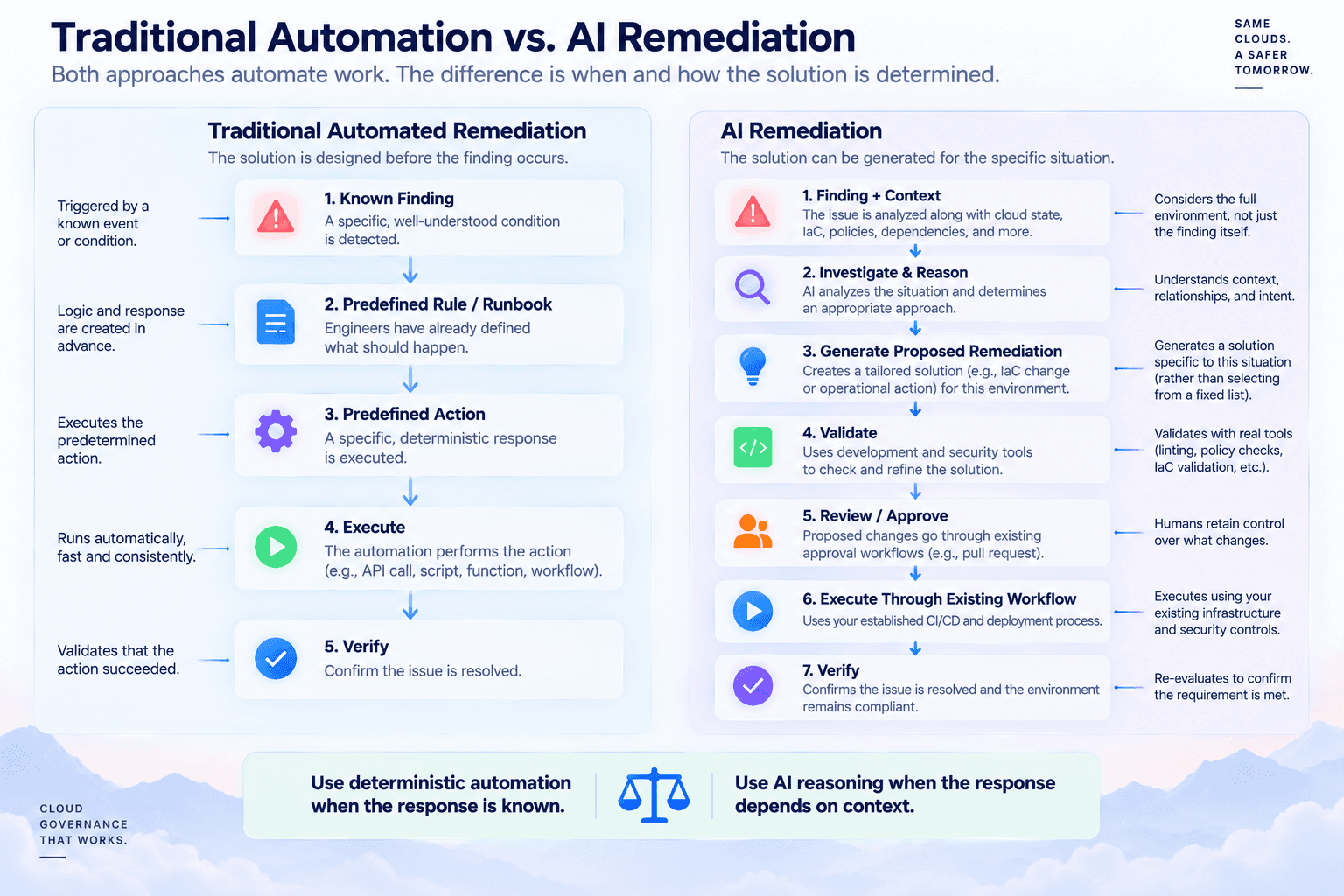
Traditional automated remediation uses predefined logic to respond to a known condition. Engineers determine the trigger, encode the response, and define how the automation should execute before the event occurs.
The basic model is straightforward:
Known Condition → Predefined Logic → Predefined Action
A cloud security tool might detect an unencrypted storage resource and invoke a function that enables encryption. An operations platform might identify a stopped development instance and terminate it after a retention period. A runbook might receive a specific alert and execute a documented series of API calls.
These workflows can be sophisticated. They may contain conditions, branches, approvals, retries, rollback logic, and integrations with multiple systems. What makes them traditional automation is not that they are simple, but that the decision logic and available responses were designed ahead of time.
When the input matches what the developers anticipated, deterministic automation can be fast, inexpensive, testable, and highly reliable.
What Is AI Remediation?
AI remediation changes where some of the decision-making occurs. Rather than requiring developers to predefine the exact remediation for every possible finding, an AI system can analyze the problem and surrounding context at runtime before proposing a solution.
A simplified model looks more like:
Finding + Context → AI Reasoning → Proposed Remediation → Validation → Approval → Execution → Verification
The context may include live cloud configuration, Infrastructure as Code, organizational policies, ownership information, dependencies, previous changes, security findings, or other information relevant to the problem.
The resulting remediation does not have to be a direct cloud API action. In many infrastructure scenarios, a safer output is a proposed change to the Infrastructure as Code that already manages the affected environment.
AI can therefore automate the reasoning and generation portions of remediation without automatically receiving authority to deploy the resulting change.
That distinction is important. AI remediation does not inherently mean autonomous remediation.
The Fundamental Difference Is When the Solution Is Defined
The easiest way to understand the distinction is to ask when the remediation logic is created.
With traditional automation, engineers define the solution before the problem occurs. They decide what conditions should trigger the workflow and what actions should follow. Runtime execution primarily determines whether the predefined conditions have been satisfied.
With AI remediation, some of that problem-solving can happen after the finding occurs. Engineers define the boundaries, available tools, policies, authorization model, validation requirements, and execution process, while AI reasons about the specific situation within those constraints.
This makes AI remediation particularly interesting for cloud infrastructure because two findings with the same control identifier may require different fixes.
Two publicly accessible storage resources, for example, may look identical to a scanner. One might be accidentally exposed and require a straightforward configuration change. The other might intentionally serve public assets through an architecture that requires a more nuanced adjustment.
A static remediation mapped only to the finding type has limited ability to understand that distinction. An AI system with access to appropriate context can investigate before proposing a change.
Traditional Automation Is Better for Deterministic Problems
AI should not be inserted into a workflow merely because it is available. If a problem has a predictable input and a well-understood response, deterministic automation usually provides the cleaner solution.
Consider a development resource that should be deleted after it has remained detached for 30 days. If the organization has already established the conditions under which deletion is safe, a predefined workflow can evaluate those conditions and execute the action.
There is little value in asking an AI model to rediscover the same answer every time.
Traditional automation also offers useful operational properties. The possible behavior is constrained by code written in advance, tests can exercise known branches, execution tends to be inexpensive, and teams can reason precisely about what the workflow is capable of doing.
These characteristics make deterministic automation an important part of cloud operations even as AI becomes more capable.
AI Becomes Useful When Remediation Depends on Context
Many infrastructure findings are not deterministic enough to map cleanly to one predefined action. A scanner may identify what is wrong without having enough information to determine the correct engineering change.
Imagine a governance control detects that a security group allows inbound traffic from the internet. A simplistic remediation could remove the offending rule, but that response assumes the traffic is unnecessary.
A more useful investigation might determine which application uses the security group, what load balancer or service depends on it, whether the traffic should instead originate from another security group, where the configuration is defined in Terraform, and what change would satisfy the security requirement without disrupting legitimate traffic.
The desired outcome is known: unnecessary public exposure should be removed. The exact infrastructure change required to achieve that outcome safely is not necessarily known until the environment is investigated.
AI remediation can help bridge that gap between knowing the requirement and determining the appropriate implementation.
AI Remediation Can Generate Rather Than Select
Traditional remediation systems often work from a catalog of known actions. A finding maps to a runbook, script, function, workflow, or predefined remediation procedure.
That model can scale well for common problems, but the catalog itself has to be created and maintained. Engineers must anticipate the situations they want to automate and implement the corresponding responses.
AI creates another possibility. Instead of selecting exclusively from predefined fixes, the system can generate a remediation for the specific environment.
For infrastructure managed as code, this could mean examining the existing Terraform configuration and producing a minimal change that addresses the finding. The AI can preserve the repository's existing modules, variables, naming conventions, and architecture rather than generating a generic configuration detached from how the organization actually manages infrastructure.
Generation expands the range of problems that can be assisted through automation, but it also creates new trust requirements. Generated code has to be treated as a proposal that requires appropriate validation and authorization before it affects production.
Reasoning and Execution Should Be Separate Trust Decisions
One of the most important design principles for AI remediation is separating the ability to determine what should change from the authority to make that change.
An AI system may need access to cloud state, repository contents, policy requirements, and development tools in order to investigate a finding and generate a useful remediation. None of those capabilities inherently require unrestricted production credentials.
The AI can perform investigation and code generation in a controlled environment. The proposed change can then cross a separate trust boundary where repository permissions, policy checks, human reviewers, CI/CD systems, and deployment credentials determine whether it is allowed to execute.
This creates a more defensible architecture than giving the reasoning system broad production authority simply because it generated the solution.
The same principle applies even as organizations become more comfortable with autonomous workflows. Increasing the amount of automated approval does not require collapsing reasoning and execution into the same security boundary.
Infrastructure as Code Creates a Natural Review Boundary
Infrastructure as Code is particularly useful for AI remediation because it turns the proposed solution into an artifact that humans and software can inspect before execution.
Instead of an AI agent directly modifying a network rule, for example, it can update the Terraform configuration responsible for that rule. The proposed change can then be validated, committed to an authorized repository, and presented as a pull request.
The pull request provides a familiar review surface. Engineers can see exactly what changed, automated checks can evaluate the code, policy systems can inspect the proposed infrastructure, and the organization's existing deployment pipeline remains responsible for applying the change.
This also reduces the risk of fixing the live environment while leaving the declared state unchanged. If an AI directly modifies a Terraform-managed resource, the next deployment may simply restore the original configuration.
For persistent infrastructure changes, remediation should generally address the source of truth rather than only correcting the runtime symptom.
Validation Matters More When Solutions Are Generated
Traditional automation executes code that engineers created and ideally tested before deployment. AI remediation can generate a new solution at runtime, which means validation has to become part of the remediation process itself.
For Infrastructure as Code, validation can include formatting, syntax checks, provider validation, linting, security analysis, policy evaluation, and other tools appropriate to the repository. The AI can use the results of those tools to iterate on its proposed solution before presenting it for review.
Validation does not prove that a generated change is safe, but it can eliminate many classes of obvious errors and provide additional evidence to reviewers.
The key architectural principle is that the model should not be expected to validate itself purely through another round of language-model reasoning. Whenever deterministic tools can evaluate an objective property of the proposed remediation, those tools should be part of the workflow.
AI is strongest when reasoning handles ambiguity and deterministic systems handle properties that can be tested precisely.
Human-in-the-Loop Does Not Mean Manual Remediation
Requiring approval before an AI-generated infrastructure change is executed does not turn the workflow back into manual remediation.
Without AI assistance, an engineer may need to investigate the finding, locate the affected resources, understand the policy, find the relevant repository, determine the correct code change, implement it, run validation tools, and prepare a pull request.
An AI remediation system can potentially perform much of that work before a human becomes involved. The reviewer receives a concrete proposed solution, supporting context, validation results, and a code diff rather than a raw finding that still requires investigation.
Human involvement shifts from doing all of the remediation work to making the consequential decision about whether the proposed change should proceed.
That distinction allows organizations to preserve meaningful control without giving up the productivity benefits of automation.
Not Every Remediation Belongs in Infrastructure as Code
Infrastructure as Code is a strong model for persistent infrastructure configuration, but not every cloud remediation naturally belongs in Terraform or another declarative system.
Some findings require discrete operational actions. A detached volume may need to be deleted, a compromised credential may need to be revoked, a stale snapshot may need to be removed, or an abandoned resource may need to be cleaned up.
For predictable cases, traditional automated remediation may still be the best answer. For more contextual actions, organizations can use controlled remediation playbooks that define how an operation is executed while allowing AI to help determine when or how the playbook should be applied.
Those playbooks can themselves participate in governed workflows. A remediation request can become a repository change or pull request that records the intended action, passes through existing approval controls, and triggers a pipeline responsible for executing the operation.
The objective is not to force every remediation into IaC. It is to ensure that the execution mechanism matches the type of change while preserving authorization, review, and auditability.
AI and Traditional Automation Work Better Together
AI remediation and traditional automated remediation are often presented as competing approaches, but a mature remediation platform should be able to use both.
Deterministic automation provides predictable execution for known problems. AI provides contextual reasoning for situations where the correct response cannot be completely encoded in advance. Infrastructure tooling validates generated artifacts, policy systems enforce boundaries, repositories provide version control and review, and deployment pipelines perform authorized execution.
A workflow might even combine them. AI can investigate a finding and determine that an existing approved remediation playbook is appropriate, after which deterministic automation executes that playbook. In another case, the AI might determine that the existing runbooks do not fit the environment and generate a proposed Infrastructure as Code change instead.
The important architectural question is not whether AI or automation should win. It is which parts of the remediation problem benefit from reasoning and which parts should remain deterministic.
What Should Remain Deterministic?
Even in an AI-driven remediation architecture, many controls should remain deterministic. Authentication, authorization, policy enforcement, credential issuance, repository permissions, validation tools, approval requirements, and production deployment boundaries should not depend solely on a model deciding that an action seems appropriate.
AI can reason inside those boundaries, but it should not silently redefine them.
This separation creates a useful division of responsibility. AI handles ambiguity, investigation, contextual reasoning, and solution generation, while deterministic systems enforce the constraints under which that reasoning can affect infrastructure.
The result is not an autonomous model surrounded by optional guardrails. It is a governed remediation system in which AI is one component of a larger control architecture.
How StratoCloud Approaches AI Remediation
StratoCloud's Intelligent Remediation is designed around the idea that finding a cloud problem and changing production infrastructure are separate stages with different trust requirements.
When Continuous Governance identifies a finding, AI can help investigate the affected environment and determine an appropriate remediation. For infrastructure configuration that belongs in code, StratoCloud can generate a proposed Infrastructure as Code change inside an isolated execution environment rather than directly modifying the cloud.
The isolated environment gives the AI access to the files and development tools needed to work on the remediation without treating the code-generation environment as a production cloud environment. Appropriate validators and linters can inspect the proposed change, and the AI can iterate based on their results.
Once the proposal is ready, StratoCloud can commit it to an explicitly authorized GitHub repository and open a pull request. Repository permissions, automated checks, human review, and the organization's existing deployment pipeline determine whether the change ultimately reaches production.
For discrete actions that do not naturally belong in Infrastructure as Code, remediation playbooks can provide controlled execution procedures. These can also be connected to repository and approval workflows so that operational actions do not require bypassing the organization's established change-management boundaries.
This architecture allows AI to expand what can be remediated without requiring AI to become the final authority over production.
Choosing Between AI and Traditional Automated Remediation
The choice between AI remediation and traditional automation depends primarily on how much uncertainty exists between detecting the problem and determining the correct response.
If the condition is well understood, the response is always the same, and the safety conditions can be precisely encoded, deterministic automation is usually the better tool. It is predictable, efficient, and easier to test.
If the remediation depends on infrastructure relationships, existing code, organizational context, provider configuration, or other information that varies between environments, AI reasoning can add significant value. The AI can investigate the specific situation and generate a proposed solution instead of forcing engineers to prebuild a remediation for every possible variation.
Many organizations will ultimately use both approaches. The goal is not to maximize the amount of AI in cloud operations. The goal is to use the least complex mechanism capable of solving the problem safely.
Frequently Asked Questions
What is automated cloud remediation?
Automated cloud remediation uses software to respond to detected cloud problems without requiring an engineer to manually perform every remediation step. Traditional approaches typically map known conditions to predefined scripts, runbooks, functions, or workflows.
What is AI cloud remediation?
AI cloud remediation uses AI reasoning to investigate a finding, understand relevant context, and determine or generate an appropriate remediation. The resulting change can still require deterministic validation, authorization, human approval, and controlled execution.
Is AI remediation better than traditional automation?
Neither approach is universally better. Traditional automation is particularly effective when the response is known and deterministic, while AI is useful when the correct remediation depends on context that varies between environments.
Does AI remediation mean autonomous remediation?
No. AI can automate investigation and solution generation without receiving authority to execute the resulting change. An AI-generated remediation can pass through validation, policy checks, pull-request review, and existing deployment workflows before reaching production.
Why use Infrastructure as Code for AI remediation?
Infrastructure as Code creates a reviewable, versioned representation of the proposed change and helps keep the declared infrastructure state consistent with the live environment. It also allows existing validation, Git, approval, and CI/CD workflows to remain part of the remediation process.
Can AI remediation use existing runbooks?
Yes. AI can determine that an existing approved runbook or remediation playbook is appropriate and allow deterministic automation to perform the actual operation. AI does not need to generate a unique solution for every finding.
Should AI directly modify production cloud resources?
Direct modification is not inherently required for AI remediation. For persistent infrastructure configuration, generating a proposed Infrastructure as Code change and passing it through established review and deployment controls can provide stronger separation between reasoning and execution.
What should remain deterministic in an AI remediation system?
Authentication, authorization, policy enforcement, credential issuance, repository permissions, validation tools, approval requirements, and deployment boundaries are strong candidates for deterministic controls. AI can reason within those constraints without becoming responsible for defining its own authority.
What kinds of problems are best suited to traditional automated remediation?
Problems with predictable inputs, known responses, and precisely defined safety conditions are strong candidates. Examples include lifecycle cleanup, known configuration resets, or approved operational runbooks where contextual reasoning adds little value.
What kinds of problems are best suited to AI remediation?
Problems where the appropriate response depends on surrounding infrastructure, dependencies, existing Infrastructure as Code, organizational policies, or other environment-specific context can benefit from AI investigation and reasoning.