Published:
Estimated reading time:
8-10 minutes

Cloud security and governance tools are very good at finding problems.
They identify misconfigurations, policy violations, compliance gaps, risky permissions, missing controls, and configuration drift across cloud environments. In large organizations, those findings can number in the hundreds or thousands.
Finding the problem, however, is only the first step.
Someone still has to understand what is wrong, determine the appropriate fix, write or modify the infrastructure code, validate the change, put it through the organization's engineering process, and eventually deploy it.
That gap between detection and remediation is where many cloud governance programs slow down.
Intelligent cloud remediation uses AI and automation to help turn cloud findings into safe, reviewable engineering changes rather than simply generating more alerts and tickets.
The goal is not to give AI unrestricted control over production infrastructure. It is to reduce the manual work required to move from a known problem to a proposed, validated, auditable fix.
What Is Intelligent Cloud Remediation?
Intelligent cloud remediation is the use of AI, automation, cloud context, and engineering workflows to analyze cloud findings and generate appropriate remediation actions.
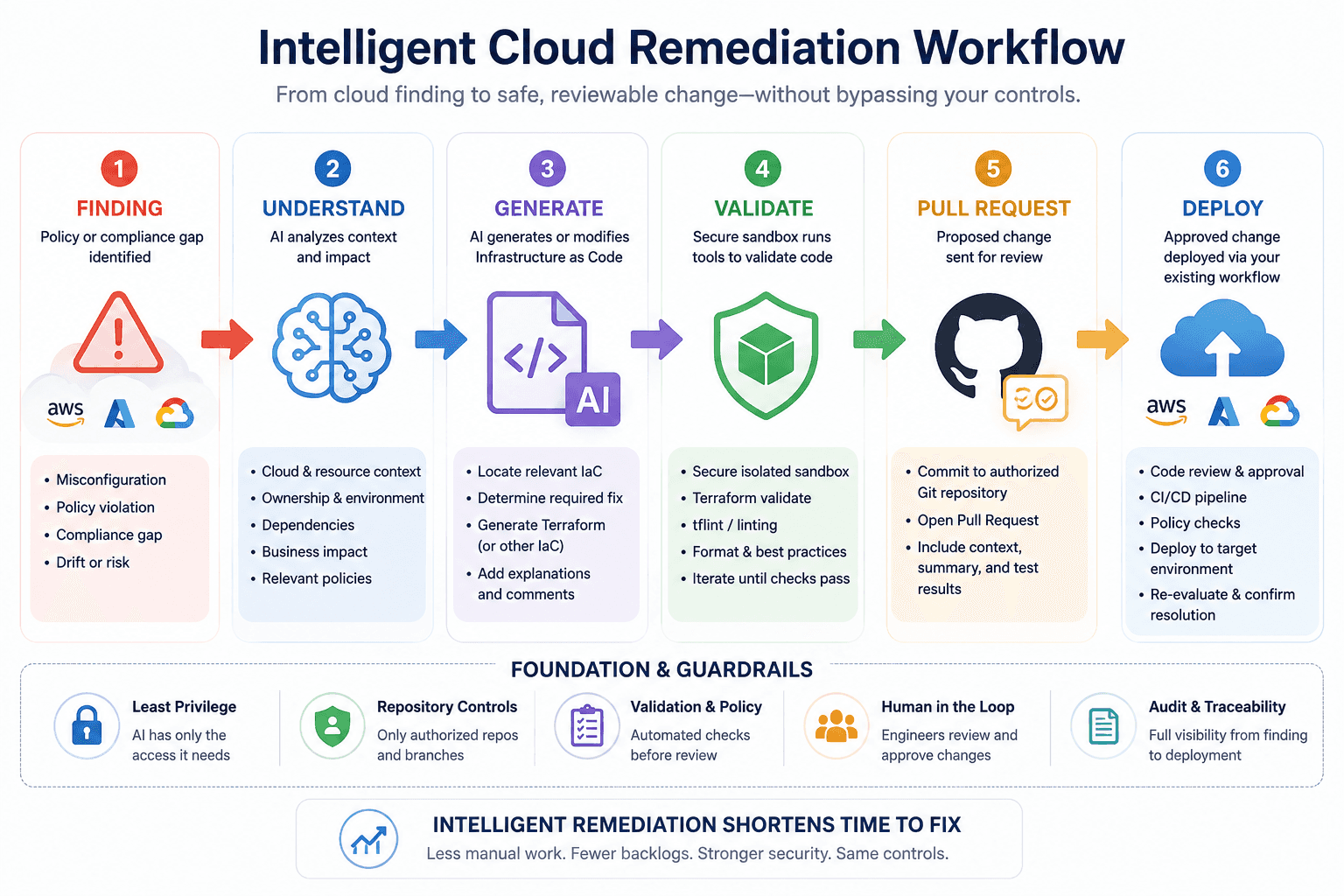
A modern remediation workflow might look like this:
Detect → Understand → Generate → Validate → Review → Deploy → Re-evaluate
A governance or security system first identifies a problem.
AI then helps understand the finding, determine the affected infrastructure, and generate the Infrastructure as Code necessary to address it.
The generated code can be created inside a secure sandbox where the AI can safely work with files and execute development tools such as Terraform validation, formatting, linting, or tflint.
Once the proposed code is ready, it can be committed to an authorized Git repository and presented through a pull request.
The organization's engineers remain in control of review and deployment.
Why Cloud Remediation Is Still So Manual
The cloud industry has spent years improving detection.
Organizations now have security scanners, CSPM platforms, compliance tools, vulnerability systems, identity governance tools, cloud-native security services, and internal policy engines.
The result is often better visibility into problems.
It can also create a much larger remediation backlog.
A finding might say that a storage configuration violates policy or that a cloud resource does not meet a CIS benchmark requirement.
That sounds simple.
But an engineer may still need to determine which team owns the environment, how the infrastructure was created, whether it is managed through Terraform or another Infrastructure as Code system, which repository contains the configuration, what other resources depend on it, and what change can safely correct the problem.
The engineer then needs to write the code, validate it, create a branch, commit the change, open a pull request, wait for review, and move it through the normal deployment process.
Multiply that workflow across hundreds or thousands of findings and remediation becomes a significant operational burden.
Detection Without Remediation Creates Backlogs
A security or governance finding has limited value if the organization cannot act on it.
Teams often respond by prioritizing only the most severe findings and leaving lower-priority issues unresolved.
Over time, those unresolved findings accumulate.
The backlog can become so large that teams begin treating it as normal.
This is particularly challenging for platform engineering and cloud security teams because the people identifying problems are often not the same people responsible for the infrastructure.
A security team may identify a violation.
A platform team may own the deployment standards.
An application team may own the affected service.
The remediation must move between those groups before anyone changes the infrastructure.
Intelligent remediation aims to reduce the manual translation between finding and engineering change.
Intelligent Remediation Is Not the Same as Automatic Remediation
The word "automation" can create the impression that a system should simply detect an issue and immediately change production.
That approach may be appropriate for some highly controlled actions, but it is not a safe default for every cloud change.
Infrastructure changes can have dependencies, side effects, business implications, and unexpected blast radius.
Intelligent remediation therefore does not have to mean autonomous production modification.
A safer model is to automate the preparation of the change while preserving the organization's existing approval and deployment boundaries.
AI can help investigate the finding, generate the remediation, validate the code, and prepare the pull request.
Humans can still decide whether the proposed change is appropriate and when it should be deployed.
This combines automation with control.
Why Infrastructure as Code Is Important
Infrastructure as Code is a natural interface for intelligent remediation.
Instead of directly modifying cloud infrastructure, the remediation can be represented as code.
That creates several advantages.
The proposed change becomes reviewable. Engineers can see exactly what is being modified before anything reaches production.
It becomes version controlled. The change has a history, an author, a commit, and a pull request.
It becomes reproducible. The organization can understand how the desired configuration is defined rather than relying on a one-time console change.
It also fits existing engineering workflows.
Organizations already use Git, pull requests, code review, CI/CD, policy checks, and deployment pipelines to manage infrastructure.
Intelligent remediation can work with those controls instead of bypassing them.
Why AI Is Useful for Remediation
Cloud findings often require interpretation rather than a simple predefined action.
A scanner might identify the same policy violation in multiple environments, but the correct fix may differ depending on how those environments are configured.
AI can help reason across the finding, existing Infrastructure as Code, cloud context, organizational requirements, and supporting documentation.
It can also perform many of the repetitive tasks engineers do manually.
For example, AI can:
Analyze the finding and affected environment.
Locate the relevant infrastructure configuration.
Determine what needs to change.
Generate or modify Terraform or other IaC.
Run formatting and validation tools.
Respond to validation errors and refine the code.
Explain the proposed remediation.
Prepare a commit and pull request.
The value comes from combining reasoning with tools and a controlled execution environment.
Secure Sandboxes for AI-Generated Code
Allowing AI to generate infrastructure code creates an execution problem.
The AI may need to create files, inspect code, modify configuration, invoke command-line tools, run linters, and respond to the output.
Those activities should not happen with unrestricted access to an organization's environment.
A secure sandbox gives the AI an isolated place to perform that work.
Inside the sandbox, the AI can generate Infrastructure as Code and run appropriate development tools to verify basic correctness and quality.
For Terraform, that might include formatting, validation, or tools such as tflint.
If a tool identifies a problem, the AI can update the code and run the check again.
The important distinction is that the sandbox is not necessarily a temporary cloud account where the proposed infrastructure is deployed.
It is an isolated execution environment where the AI can safely write and validate code using approved tools.
Validation Before the Pull Request
AI-generated code should not be treated as correct simply because it looks plausible.
Infrastructure as Code can contain syntax errors, invalid references, unsupported arguments, insecure configurations, or logic that does not match the intended remediation.
Validation tooling provides an important control before a proposed change reaches human reviewers.
Different workflows may use different tools, but the principle is consistent.
AI should be able to generate code, run validation, inspect the results, and improve the output before handing the change to a human.
That creates a better starting point for code review.
It also reduces the likelihood that engineers spend their time reviewing changes that fail basic technical checks.
Git and Pull Requests Create an Important Boundary
One of the most useful boundaries in intelligent remediation is the pull request.
A pull request separates what the AI proposes from what the organization deploys.
The AI can create a proposed change.
The organization's repository permissions, branch protections, required reviewers, CI/CD checks, policy engines, and deployment processes remain intact.
This is important because AI capability and production authority do not have to be the same thing.
An AI system may be capable of writing a production-ready infrastructure change without having permission to deploy that change itself.
The pull request becomes the handoff point.
Existing Repositories vs. New Repositories
Not every cloud environment is already managed through a clean Infrastructure as Code repository.
Some organizations have mature Terraform repositories for most infrastructure.
Others have environments that were created manually or have incomplete IaC coverage.
Intelligent remediation should be able to operate within both situations.
When the affected infrastructure already has an authorized repository, remediation can be prepared against that existing codebase.
When appropriate and explicitly permitted, the remediation can instead be placed into a new repository so the organization has a version-controlled starting point for managing that infrastructure.
The organization should control which repositories AI is allowed to access and whether creating new repositories is permitted.
Continuous Governance and Intelligent Remediation
Intelligent remediation becomes particularly powerful when connected directly to continuous governance.
Continuous governance continuously evaluates cloud environments against organizational policies, security requirements, and compliance frameworks.
When it identifies a gap, the finding can become the input to a remediation workflow.
Consider a CIS benchmark assessment.
Continuous governance identifies several controls that are not satisfied.
The user reviews those findings and selects the ones they want to address.
For each selected issue, AI can generate the Infrastructure as Code required to remediate the configuration, validate that code using appropriate tooling, and prepare a pull request for review.
After the organization deploys the approved change, continuous governance evaluates the environment again.
The lifecycle becomes:
Evaluate → Find → Remediate → Review → Deploy → Re-evaluate
This closes a loop that has traditionally required a large amount of manual coordination.
Intelligent Remediation Needs Context
The same finding does not always require the same response.
A configuration issue in a disposable development environment may be treated differently from the same issue in a critical production system.
Useful context can include ownership, environment, criticality, business function, cloud account or subscription, affected application, repository, compliance requirement, and infrastructure dependencies.
Context helps the remediation system understand not only what is wrong, but also where it exists and what matters around it.
That can influence prioritization, remediation strategy, repository selection, and review requirements.
Intelligent Remediation Across Multiple Clouds
Multi-cloud environments add another layer of difficulty.
AWS, Azure, and Google Cloud expose different services, APIs, IAM models, configuration structures, and security controls.
The same governance intent may therefore require different technical remediation depending on the cloud provider.
For example, an organization might have a policy requiring storage to remain private.
The policy intent is consistent.
The infrastructure code required to enforce it differs among AWS, Azure, and Google Cloud.
Intelligent remediation can help translate organizational intent and findings into the provider-specific Infrastructure as Code required to make the correction.
Human-in-the-Loop Remediation
Human review is not a weakness in intelligent remediation.
For many infrastructure changes, it is an important control.
Engineers often know things that are not fully represented in cloud configuration or policy data.
They may know that a migration is underway, that an application has an unusual dependency, or that a proposed configuration change conflicts with another operational requirement.
Human review allows the organization to combine AI speed with human judgment.
The goal is not to make engineers perform all of the remediation work manually.
The goal is to move their effort toward reviewing decisions and exceptions rather than repeatedly writing routine fixes from scratch.
What Should Be Automated?
Not every remediation requires the same level of human involvement.
Organizations can choose different levels of automation depending on risk.
A low-risk development configuration might eventually be eligible for highly automated remediation.
A sensitive production IAM change might require multiple reviewers.
A regulated environment might require specific evidence and approval steps.
Intelligent remediation should therefore support policy-driven control over how far automation is allowed to proceed.
The key question is not simply:
Can AI make this change?
It is:
How much authority should AI have for this type of change, in this environment, under these conditions?
AI Remediation Needs Guardrails
AI systems can make mistakes.
Cloud infrastructure is too important to ignore that reality.
A responsible intelligent remediation architecture should therefore include controls around identity, permissions, tools, repositories, validation, auditability, and approval.
The AI should know which environments it can inspect.
It should know which repositories it is permitted to access.
Its tools should run in controlled environments.
Generated code should be validated.
Changes should be traceable.
And deployment authority should match the organization's risk tolerance.
These guardrails allow organizations to gain the productivity benefits of AI without turning the AI into an unrestricted cloud administrator.
A Practical Example
Imagine a continuous governance assessment identifies a CIS benchmark gap in an AWS environment.
The finding indicates that a configuration does not meet the organization's desired security baseline.
The user selects the finding for remediation.
The remediation system gathers the relevant cloud and organizational context and identifies the appropriate Infrastructure as Code workflow.
AI works inside a secure sandbox to generate or modify the Terraform required to correct the issue.
It runs formatting, validation, and linting tools such as tflint.
If the tooling identifies an issue, the AI updates the code.
Once the proposed remediation passes the configured checks, the system commits the change to a GitHub repository authorized by the organization.
A pull request is opened with the proposed change and relevant remediation context.
An engineer reviews the pull request.
The organization deploys the approved change through its existing workflow.
Continuous governance then evaluates the environment again and confirms whether the finding has been resolved.
That is intelligent remediation in practice.
How Strato Cloud Approaches Intelligent Remediation
Strato Cloud connects Continuous Governance findings with AI-assisted Infrastructure as Code remediation.
When governance or compliance evaluations identify gaps, users can select findings they want to remediate.
Strato AI can then work inside secure sandboxes to generate the necessary Infrastructure as Code and run approved development tools such as Terraform validation and tflint to improve the correctness of the proposed change.
The resulting remediation can be committed to a GitHub repository explicitly authorized by the organization and delivered through a pull request for review.
When permitted, Strato Cloud can also create a new repository containing the remediation when an appropriate existing repository is not available.
The goal is not to replace the organization's engineering controls.
It is to reduce the manual work between finding a cloud problem and producing a safe, reviewable fix.
Continuous Governance identifies the gap.
Intelligent Remediation prepares the change.
The organization's existing Git, review, and deployment process remains the boundary before production.
Frequently Asked Questions
What is intelligent cloud remediation?
Intelligent cloud remediation uses AI, automation, cloud context, and engineering tooling to help turn cloud governance, security, or compliance findings into proposed remediation actions.
Does intelligent remediation automatically change production?
It does not have to. A controlled model can use AI to generate and validate Infrastructure as Code, then submit the proposed change through a Git pull request for human review and normal deployment.
Why use Infrastructure as Code for remediation?
Infrastructure as Code makes remediation reviewable, version controlled, reproducible, auditable, and compatible with existing engineering workflows.
What role do AI sandboxes play?
Secure sandboxes provide isolated execution environments where AI can create and modify files and run approved development tools. They allow the AI to work with code without giving it unrestricted access to the surrounding environment.
Does sandbox validation mean deploying the change into a test cloud account?
Not necessarily. In this model, the sandbox is used for secure code generation and tooling execution. Tools such as Terraform validation and tflint can check the generated Infrastructure as Code before it reaches a pull request.
Why are pull requests important for AI remediation?
Pull requests create a clear boundary between an AI-proposed change and an organization-approved change. Existing code review, repository permissions, CI/CD checks, and deployment controls can remain in place.
Can intelligent remediation work with compliance findings?
Yes. Compliance findings such as CIS benchmark gaps are strong candidates because they identify specific differences between current cloud configuration and a desired control.
Can intelligent remediation work across AWS, Azure, and Google Cloud?
Yes, although the technical implementation of a remediation may differ by provider. AI can help translate consistent governance intent into provider-specific Infrastructure as Code.
Related Reading
From Cloud Finding to Pull Request: A Safer Model for AI Remediation
How Secure Sandboxes Let AI Safely Generate Infrastructure as Code (coming soon)