Published:
Estimated reading time:
8-9 minutes

Cloud governance often begins with documentation. Security teams define requirements, platform teams establish standards, compliance teams document controls, and engineering teams create processes for requesting access, reviewing exceptions, fixing violations, and proving that requirements are being followed.
The challenge is turning those requirements into something that can keep pace with the cloud. Infrastructure changes continuously as developers deploy applications, Infrastructure as Code modifies environments, autoscaling adjusts runtime resources, engineers respond to incidents, and organizations create new accounts, subscriptions, projects, and workloads. A governance process that depends primarily on people reading documents, checking dashboards, opening tickets, and manually verifying fixes becomes increasingly difficult to operate at that scale.
Governance as Code turns the organization's governance operating model into something software can consistently apply. It goes beyond expressing individual policies as machine-readable rules by addressing how those requirements are targeted, evaluated, enforced, investigated, remediated, approved, and verified throughout the cloud lifecycle.
What Is Governance as Code?
Governance as Code is the practice of representing cloud governance requirements and workflows in machine-readable forms so they can be applied consistently and repeatedly by software. Instead of treating governance primarily as documentation describing what teams should do, it makes governance an active part of how cloud environments operate.
A complete governance model needs to capture more than the requirement itself. It needs to determine where the requirement applies, how it should be evaluated, what happens when an environment fails the requirement, how exceptions are handled, how remediation is approved and performed, and how the organization verifies that the problem has actually been resolved.
This creates a lifecycle that can be expressed as:
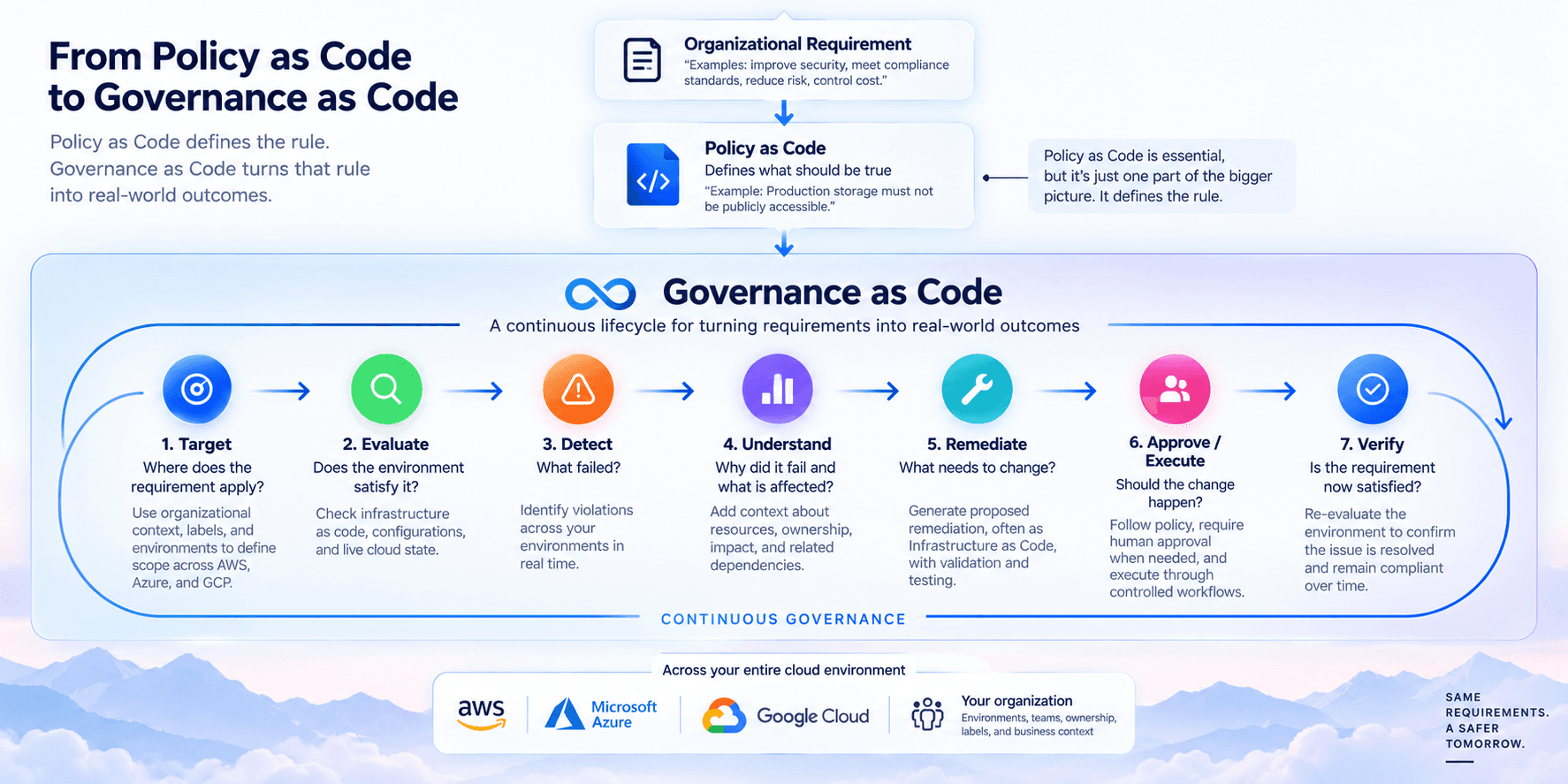
Define → Target → Evaluate → Detect → Understand → Remediate → Approve → Execute → Verify
Different forms of code, configuration, and structured data can participate at different stages. Policies can represent requirements, organizational metadata can determine scope, Infrastructure as Code can represent proposed remediations, workflow definitions can govern approvals, and automated controls can verify outcomes. Governance as Code is the operating model that connects those pieces.
Governance as Code vs. Policy as Code
Governance as Code and Policy as Code are closely related, but they describe different layers of the governance problem. Policy as Code translates a requirement into a machine-readable rule that software can evaluate, such as requiring production object storage to prevent public access.
That rule alone does not establish the complete governance process. The organization still needs to determine which environments count as production, whether the requirement applies to every business unit, whether it should be enforced preventively or evaluated continuously, what should happen when a violation is discovered, and how legitimate exceptions should be handled.
The distinction becomes particularly important once remediation enters the picture. A failed policy can identify that an environment violates a requirement, but governance determines how that finding moves from detection through investigation, remediation, approval, execution, and verification.
In simple terms, Policy as Code defines what should be true, while Governance as Code defines how the organization continuously turns that requirement into an operational outcome.
Why Cloud Governance Needs to Be Operational
Traditional governance processes were often designed for environments that changed relatively slowly. Cloud infrastructure behaves differently because deployments occur throughout the day, infrastructure is created programmatically, runtime state changes dynamically, new environments appear frequently, and engineers sometimes make changes outside normal deployment workflows.
A governance system therefore cannot evaluate an environment once and declare it governed. Requirements need to remain applicable as infrastructure changes, which means evaluation, detection, remediation, and verification have to continue throughout the cloud lifecycle.
The requirements themselves also change. An organization might introduce a new security standard today that applies to infrastructure deployed months or years ago. Nothing about the original deployment necessarily failed, but the infrastructure may no longer satisfy the organization's current expectations.
Governance as Code makes this ongoing process repeatable. Rather than relying on periodic manual reviews to reconcile written requirements with a constantly changing environment, software can continuously participate in translating those requirements into decisions and outcomes.
Governance Starts With Organizational Intent
Every governance control begins with something the organization wants to be true. Security teams might require production databases to use encryption, compliance teams might require access to regulated environments to be auditable, and platform teams might require production infrastructure to be deployed through approved repositories.
Governance can extend beyond security and compliance as well. Organizations may establish standards around cost, reliability, ownership, deployment processes, operational readiness, or resource lifecycle management.
These requirements should begin as organizational intent rather than being defined around a particular provider's implementation. AWS, Azure, and Google Cloud may each require different technical mechanisms to satisfy the same requirement, but the business objective remains consistent.
Separating intent from implementation allows an organization to define what it expects once while still respecting the technical differences between cloud providers.
Targeting Is Part of Governance
A governance requirement is incomplete without a clear definition of where it applies. Some requirements may legitimately apply everywhere, but many depend on the context of the environment.
Production environments might require stronger controls than development environments. Regulated workloads may require additional safeguards, while experimentation environments may have explicitly approved exceptions. Business-critical systems might also require controls that are unnecessary for low-risk internal workloads.
Cloud-provider hierarchy can help express some of this scope. AWS organizational units, Azure management groups, and Google Cloud folders all provide useful mechanisms for organizing and governing resources within their respective providers.
The challenge becomes more pronounced in multi-cloud environments because organizational boundaries do not necessarily align with provider boundaries. A single product may operate across several AWS accounts, an Azure subscription, and a Google Cloud project. If governance scope is defined only through each provider's hierarchy, the organization has to recreate its business structure independently inside every cloud.
Organizational Context Makes Governance Portable
A higher-level governance model allows scope to be expressed in terms the organization actually uses. Instead of targeting a policy exclusively through provider hierarchy, the organization could define a requirement for every business-critical production environment owned by the Payments team.
Concepts such as environment, ownership, business function, criticality, geography, data sensitivity, and application can provide this organizational context. The governance system can determine which AWS accounts, Azure subscriptions, and Google Cloud projects match those conditions and then use the appropriate provider-specific mechanisms underneath.
This creates a useful separation between where and why the organization wants governance and how each cloud provider implements it. The governance intent becomes portable without pretending that AWS, Azure, and Google Cloud have identical policy systems.
That same organizational context also becomes valuable later in the governance lifecycle. When a finding occurs, knowing that it affects a business-critical production environment owned by a particular team is far more useful than seeing only a provider account identifier.
Preventive and Detective Controls Work Together
Governance as Code is sometimes associated primarily with preventing bad infrastructure from being deployed. Preventive controls are important because policies can evaluate Infrastructure as Code during CI/CD, provider-native mechanisms can block prohibited configurations, and access policies can stop unauthorized operations before credentials are issued.
Prevention alone cannot cover every condition. Existing infrastructure may predate a policy, resources can change outside expected deployment paths, provider behavior can create unexpected state, and new organizational requirements can make previously acceptable infrastructure noncompliant.
Detective controls address this gap by evaluating what actually exists in the cloud. A mature governance model combines both approaches, preventing known violations where practical while continuing to detect conditions that appear despite those protections.
The goal is not to choose between preventive and detective governance. It is to use each where it provides the strongest control and connect both to the same organizational requirements.
Governance Has to Evaluate Live Cloud State
Infrastructure as Code is an important source of governance information because it represents what an organization intends to deploy. It does not necessarily prove what currently exists.
Suppose Terraform defines a compliant configuration but someone later modifies the resource directly through the cloud provider. The repository can remain perfectly compliant while the live environment violates policy. Similarly, a new requirement introduced today may apply to resources whose Infrastructure as Code has not changed in months.
Continuous evaluation of live cloud state helps identify these conditions. Governance can compare current infrastructure against current organizational requirements rather than assuming that successful pre-deployment checks guarantee continued compliance.
This is why Governance as Code should not be reduced to running policy checks in CI/CD. Pre-deployment controls are one part of the lifecycle, while continuous evaluation determines whether the deployed environment continues to satisfy the requirement.
Detection Should Produce Actionable Context
Detecting a violation is useful only if the organization can understand what happened and decide what to do about it. A finding that simply reports a failed control can leave engineering and security teams with significant investigative work before remediation can even begin.
A useful finding should connect the failed requirement with the affected environment, the reason the evaluation failed, relevant infrastructure, organizational ownership, and the context needed to understand the potential impact. When available, it should also help explain what needs to change to satisfy the requirement.
This becomes especially important at scale. A governance system that generates thousands of technically correct but poorly contextualized findings can create another operational backlog rather than reducing risk.
Governance as Code should therefore treat understanding as part of the lifecycle between detection and remediation. The objective is not merely to produce more findings, but to produce findings that can move toward resolution.
Exceptions Are Part of Governance Too
Not every policy violation should result in an immediate infrastructure change. Organizations sometimes have legitimate reasons to temporarily or permanently accept a condition that would normally violate policy.
A public endpoint might exist intentionally, a migration might require a temporary configuration, or a legacy workload may need additional time before it can satisfy a new standard. Weakening the policy globally to accommodate one of these cases creates unnecessary risk.
A stronger governance model makes the exception explicit. The record can identify the affected environment, the requirement being waived, the justification, the approver, and an expiration date when appropriate. The underlying policy remains intact while the organization preserves evidence explaining why this particular case is treated differently.
This illustrates an important principle of Governance as Code. Automation does not eliminate human judgment. It gives that judgment a structured place in the governance process so decisions can be consistently applied and audited.
Remediation Is Part of the Governance Lifecycle
Many governance platforms are very good at finding problems but leave resolution largely outside the system. A finding appears in a dashboard, someone creates a ticket, an engineer eventually investigates the problem, and a separate workflow is used to modify the infrastructure.
That separation is one reason remediation backlogs can become so large. Detection can operate at machine speed while understanding and remediation remain heavily manual.
Governance as Code can connect those stages without allowing the governance system to make uncontrolled production changes. For infrastructure configuration problems, the system can translate a finding into a proposed Infrastructure as Code remediation that can be validated and reviewed before deployment.
The resulting workflow can follow the organization's existing engineering controls:
Finding → Proposed IaC Change → Validation → Pull Request → Approval → Deployment → Re-evaluation
The governance system helps move the problem toward a solution, while the organization's repository permissions, human reviewers, CI/CD controls, and deployment processes retain authority over production.
Policy as Code and Infrastructure as Code Have Different Jobs
Policy as Code and Infrastructure as Code frequently participate in the same governance workflow, but they represent different sides of the problem. Policy as Code describes the condition infrastructure should satisfy, while Infrastructure as Code describes the infrastructure configuration itself.
For example, a policy might require production storage to prevent public access. If the policy detects a violation, the corresponding IaC remediation can modify the storage configuration so that it satisfies the requirement.
The policy identifies the gap and the Infrastructure as Code change represents a proposed solution. Governance as Code connects the two, determines where the requirement applies, manages the workflow around the finding, and verifies the outcome after deployment.
This relationship is one reason Governance as Code is broader than either Policy as Code or Infrastructure as Code individually.
AI Can Help Close the Governance Loop
Traditional automation works particularly well when engineers already know the exact response to a condition. If a predefined event occurs, software can execute a predefined action.
Cloud governance findings are not always that predictable. The correct remediation may depend on surrounding architecture, existing Infrastructure as Code, organizational conventions, dependencies, provider-specific configuration, or the reason a resource exists in the first place.
AI can help reason about that context. It can investigate a finding, examine relevant infrastructure, understand the requirement, inspect existing code, and generate a proposed solution that did not need to be predefined as a static remediation script.
That flexibility does not require giving AI unrestricted authority over production. An AI-generated remediation can be created inside an isolated execution environment, validated with appropriate infrastructure tooling, committed to an explicitly authorized repository, and delivered as a pull request for the organization's normal review and deployment process.
The combination is powerful because the reasoning can be dynamic while the execution remains governed.
Governance Also Applies to Access
Cloud governance is not limited to resource configuration. The way humans, workloads, automation, and AI gain access to cloud environments is itself a governance concern.
An organization might require production access to be temporary, privileged roles to require approval, sensitive environments to be accessed only from appropriately managed devices, or workloads to use verifiable identities instead of static credentials. These are organizational requirements in much the same way that encryption or network configuration requirements are.
Machine-readable access policies can evaluate identity, requested role, target environment, approvals, device posture, operational context, and other signals before credentials are issued. Governance therefore extends beyond asking whether infrastructure is configured correctly and into determining whether cloud operations are occurring under acceptable conditions.
This becomes increasingly important as the number and type of actors operating cloud infrastructure expands.
Governance Has to Include Humans, Workloads, and AI
Cloud environments are no longer operated exclusively by human engineers. Applications call cloud APIs, CI/CD pipelines deploy infrastructure, automation responds to events, and AI agents increasingly investigate environments and generate proposed changes.
The identity mechanisms for these actors may differ, but the governance questions are remarkably similar. The organization needs to understand who or what is acting, what authority that actor has, where that authority applies, what contextual conditions should influence the decision, and how the resulting activity is recorded.
Governance as Code provides a framework for expressing and enforcing those boundaries consistently. A human may authenticate through an identity provider, a workload may exchange a verifiable identity for temporary access, and an AI agent may operate on behalf of an authorized user, but all three can remain subject to organizational policy.
As AI becomes capable of performing more operational work, making these boundaries explicit becomes more important rather than less.
Multi-Cloud Governance Requires a Layer Above the Clouds
AWS, Azure, and Google Cloud each provide powerful native governance capabilities, and organizations should take advantage of them. The challenge is maintaining a coherent governance model when infrastructure spans more than one provider.
One organizational requirement may translate into an AWS control, an Azure policy, and a Google Cloud constraint. Those implementations can and should remain provider specific because the underlying cloud platforms are different.
The organizational intent does not need to be provider specific. A unified cloud control plane can maintain the business context, scope, policies, identities, and workflows that exist above individual providers while using native capabilities to perform evaluation or enforcement underneath.
This avoids two undesirable extremes. Organizations do not need to rebuild their entire governance model separately for every cloud, and they do not need to reduce each provider to an artificial lowest-common-denominator abstraction.
Governance as Code Does Not Mean Everything Is Literally Code
The name can create the impression that every governance decision must live in a source-code file. That is neither necessary nor particularly useful.
The more important characteristics are that governance becomes machine-readable, repeatable, versionable, auditable, and automatable where appropriate. A policy may be represented as configuration, environment targeting may come from labels and namespaces, an exception may be a structured record, an approval may be represented by a workflow decision, and a remediation may be expressed as Terraform.
Different representations serve different purposes. What matters is that the governance system can understand and operate them consistently instead of depending on undocumented manual knowledge.
Governance as Code is therefore less about forcing everything into code and more about making governance executable.
How StratoCloud Approaches Governance as Code
StratoCloud approaches governance as a continuous lifecycle spanning AWS, Azure, and Google Cloud. The model begins with organizational context so that governance can be defined around the way the business understands its environments rather than being constrained by each provider's hierarchy.
AWS accounts, Azure subscriptions, and Google Cloud projects can be grouped into StratoCloud namespaces representing business environments. Cloud-agnostic labels can add context such as ownership, environment, business function, or criticality to those namespaces and cloud environments, giving governance a consistent way to determine where requirements apply.
Define and Target
Organizations can define governance requirements and associate them with the environments where those requirements should apply. The requirement remains organizational while StratoCloud can use provider-specific mechanisms appropriate to AWS, Azure, or Google Cloud underneath.
This makes it possible to express common governance intent across multiple providers without pretending their native policy and enforcement systems are identical.
Evaluate, Detect, and Understand
Governance can evaluate current cloud environments and identify conditions that violate organizational requirements. Detective controls can inspect live cloud state, which helps uncover drift, existing violations, and changes that occurred outside the expected deployment path.
A finding can then be connected to the organizational context surrounding the affected AWS account, Azure subscription, or Google Cloud project. Namespaces and labels can help establish ownership, environment, business function, and criticality, while AI can investigate live cloud state when additional technical context is required.
The objective is to move beyond reporting that a control failed and toward understanding what the failure means in the environment where it occurred.
Remediate Through Governed Workflows
For findings that can be corrected through persistent infrastructure configuration, StratoCloud's Intelligent Remediation can generate proposed Infrastructure as Code inside an isolated execution environment. The AI can use development tools and infrastructure validators, iterate on the solution, commit the resulting code to an explicitly authorized GitHub repository, and open a pull request.
The organization's existing review and deployment process remains responsible for deciding whether the proposed change reaches production. For discrete operational actions that do not naturally belong in Infrastructure as Code, controlled remediation playbooks can provide an alternative while preserving explicit approval and execution boundaries.
This allows remediation to become part of the governance lifecycle without turning AI into an unrestricted production operator.
Govern Access and Execution
StratoCloud's Secure Execution extends governance to the actors interacting with cloud environments. Authorization can consider identity, target environment, requested role, approvals, policy conditions, and contextual signals before temporary credentials are issued.
This allows humans, workloads, and AI to operate under governed, short-lived access rather than relying on permanent standing credentials. Access therefore becomes another continuously evaluated governance decision rather than a static entitlement that exists indefinitely.
Verify the Outcome
A remediation workflow is not complete merely because a change was approved or deployed. The original governance requirement should be evaluated again against the resulting environment.
If the environment now satisfies the requirement, the finding can be resolved. If it does not, the governance lifecycle continues with evidence that the proposed remediation did not produce the intended outcome.
This closes the loop from policy definition through actual cloud state:
Define → Target → Evaluate → Detect → Understand → Remediate → Approve → Execute → Verify
Governance as Code Is an Operating Model
The most important idea behind Governance as Code is not the code itself. It is the transition from governance as documentation to governance as an operating system for cloud decisions.
Requirements become machine-readable and their scope becomes explicit. Cloud state can be evaluated continuously, findings can be connected to organizational context, exceptions can become structured and auditable, remediation can flow through existing engineering controls, and outcomes can be verified against the requirement that initiated the process.
This matters because both cloud infrastructure and the actors operating it are becoming more dynamic. Humans now work alongside workloads, automation, and AI, while infrastructure can change many times between traditional governance reviews.
Organizations will still need policies, standards, security expertise, and human judgment. Governance as Code does not replace those things. It provides the operational machinery that can continuously translate them into consistent decisions across the cloud.
Frequently Asked Questions
What is Governance as Code?
Governance as Code is the practice of making cloud governance requirements and workflows machine-readable and operational. It allows software to consistently participate in targeting requirements, evaluating environments, detecting violations, managing remediation and approvals, and verifying outcomes.
Is Governance as Code the same as Policy as Code?
No. Policy as Code defines machine-readable rules describing what should be true. Governance as Code encompasses the broader operating model around those rules, including scope, evaluation, detection, exceptions, remediation, approvals, execution, and verification.
Is Governance as Code the same as Infrastructure as Code?
No. Infrastructure as Code represents infrastructure configuration, while Governance as Code represents the requirements and processes governing infrastructure and cloud operations. IaC can become part of a Governance as Code workflow when it is used to implement or remediate a requirement.
Does Governance as Code replace human approvals?
No. Human judgment can remain an important part of governance. Governance as Code makes approval points and exceptions explicit and auditable while allowing routine evaluation and workflow steps to be automated.
Can Governance as Code work across multiple clouds?
Yes. Organizational governance intent can be defined above individual cloud providers while AWS, Azure, and Google Cloud use their appropriate native mechanisms underneath. This allows common requirements and targeting models without requiring identical provider implementations.
Does Governance as Code only apply to security?
No. Governance can cover security, compliance, identity, access, cost, reliability, ownership, operational standards, and other organizational requirements.
How does Governance as Code handle exceptions?
Exceptions can be represented explicitly with the affected requirement, environment or scope, justification, approver, and expiration when appropriate. This allows the underlying policy to remain intact while documenting why a specific case is treated differently.
How does AI fit into Governance as Code?
AI can investigate findings, reason about infrastructure context, and generate proposed remediations that were not predefined in advance. Those proposals can still move through validation, authorization, human review, and existing deployment controls before affecting production.
Does Governance as Code require Infrastructure as Code?
No. IaC is particularly useful when remediating persistent infrastructure configuration, but governance also applies to infrastructure not managed through IaC, discrete operational actions, identity, access, exceptions, and other cloud activities.
Why does Governance as Code need continuous evaluation?
Cloud environments and organizational requirements both change over time. Continuous evaluation helps identify drift, manual changes, newly introduced violations, and existing infrastructure that no longer satisfies current requirements.