Published:
Estimated reading time:
8–9 minutes

Cloud security and governance tools have become very good at finding problems. They can identify misconfigurations, policy violations, compliance gaps, excessive permissions, and other conditions that require attention.
Finding the problem, however, does not fix it.
Someone still needs to understand the finding, determine the appropriate change, write or modify infrastructure code, validate the solution, find the correct repository, submit the change, review it, deploy it, and confirm that the original issue has been resolved.
At enterprise scale, this creates a growing gap between detection and remediation. AI has the potential to close that gap, but allowing an autonomous system to directly modify production infrastructure introduces a different set of risks.
A safer model is emerging:
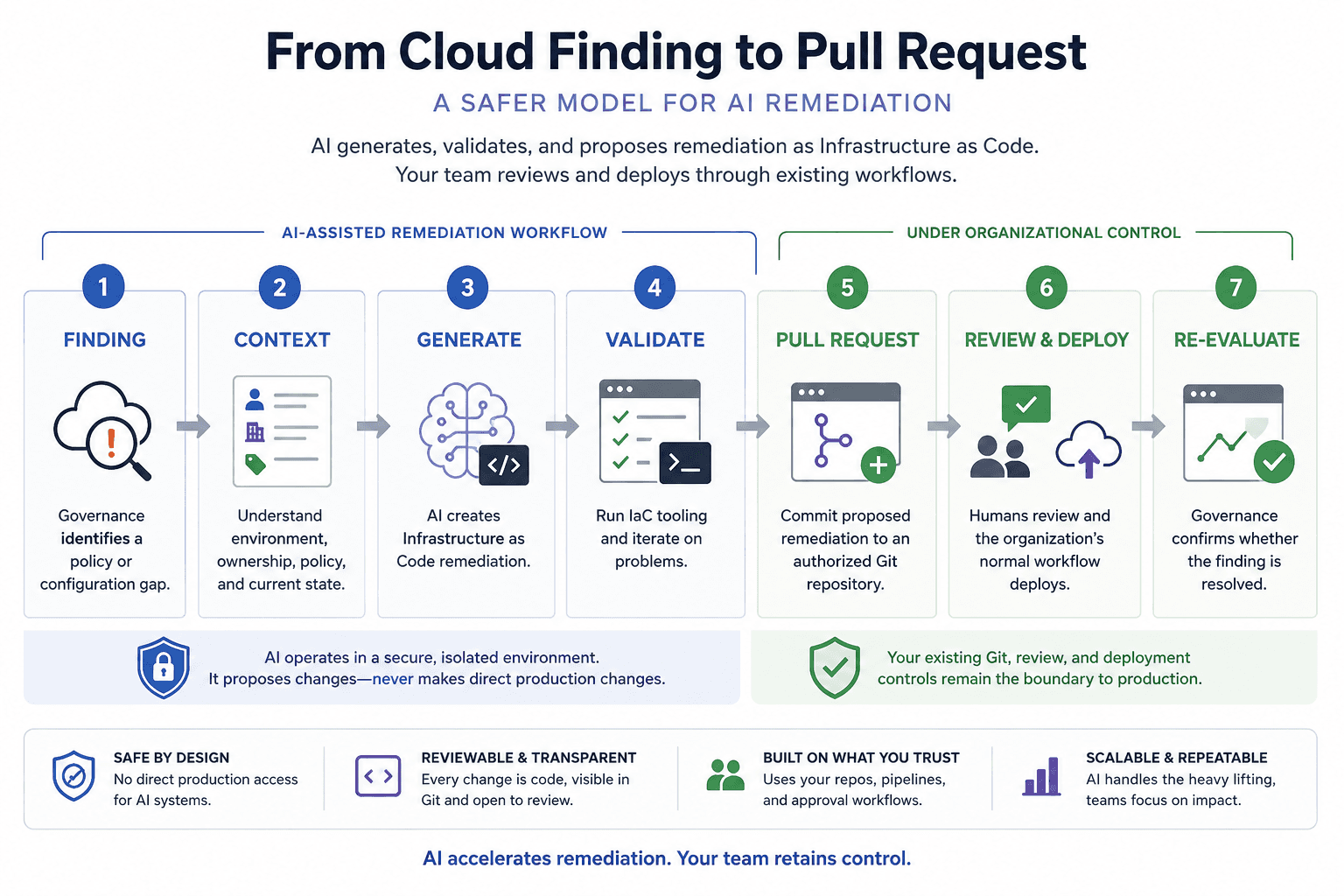
Cloud Finding → AI-Generated Infrastructure as Code → Validation → Pull Request → Human Review → Deployment → Re-evaluation
Instead of giving AI unrestricted authority to change production, organizations can use AI to turn findings into reviewable, reproducible infrastructure changes that move through the same engineering controls already used for other code.
The Cloud Remediation Bottleneck
Consider a governance system that discovers 500 cloud configuration problems across an enterprise.
The findings may be accurate and appropriately prioritized, but each one still represents work. Engineers must determine what the configuration should be, understand the affected infrastructure, create the fix, validate it, and move it through the organization's deployment process.
Some findings may take only a few minutes to resolve. Others require investigation across cloud consoles, documentation, Terraform modules, repositories, ownership records, and deployment pipelines.
Multiply that process across hundreds or thousands of findings and remediation becomes a significant operational backlog.
This is why improving detection alone eventually produces diminishing returns. A security platform that identifies problems faster than an organization can resolve them can actually increase the visible backlog without materially reducing risk.
The next challenge for cloud governance is therefore not simply finding more problems. It is shortening the path from finding to safe resolution.
Why Direct AI Remediation Is Risky
The fastest theoretical remediation workflow would be simple. Give an AI agent broad cloud permissions, tell it what is wrong, and allow it to make whatever API calls are necessary to correct the problem.
That approach eliminates many intermediate steps, but it also creates an enormous security and operational boundary around the AI system.
Cloud infrastructure is interconnected. A configuration that appears incorrect in isolation may exist because of an application dependency, migration, temporary operational requirement, or architecture decision that the remediation system does not fully understand.
A seemingly straightforward change could disrupt production traffic, remove required access, break an integration, or alter infrastructure that another system expects to remain unchanged.
There is also the question of accountability. If an AI system directly mutates production through cloud APIs, teams need a reliable way to understand exactly what changed, why it changed, who initiated the process, what information influenced the decision, and how the previous state can be reproduced or restored.
The objective should not be to maximize the number of cloud changes AI can make autonomously. It should be to maximize how much remediation work AI can safely remove from humans while preserving the controls that make infrastructure changes trustworthy.
Infrastructure as Code Creates a Safer Interface
Infrastructure as Code provides a useful boundary between AI reasoning and production infrastructure.
Rather than instructing AI to directly change a cloud resource, the system can ask AI to produce the infrastructure definition that would correct the finding. That change can be represented using Terraform, CloudFormation, or another IaC framework already used by the organization.
This changes the output of the AI from an immediate production action into an artifact that engineers can inspect.
Code has several useful properties in this context. It can be validated before deployment, compared with the existing configuration, reviewed by humans, stored in version control, tested through established pipelines, and associated with a clear history.
The resulting model separates two responsibilities:
AI proposes the change. The organization's existing delivery process controls whether that change reaches production.
That separation creates a meaningful trust boundary.
Start With the Finding and Its Context
Generating useful remediation requires more than passing an error message to an AI model.
A finding needs context.
The system may need to understand which cloud provider is involved, which account, subscription, or project contains the issue, what policy was violated, how the affected infrastructure is configured, who owns the environment, whether it is production or development, and what remediation outcome is expected.
For example, a CIS benchmark finding might indicate that a particular security control is not configured correctly. The appropriate remediation may depend on the current environment and the way the organization manages that infrastructure.
Context helps AI move from generic advice such as "enable this setting" toward a concrete infrastructure change that fits the environment in which the finding actually exists.
This is where Continuous Cloud Governance and Intelligent Remediation begin to work as one lifecycle. Governance identifies and contextualizes the problem, while remediation uses that information to construct a potential solution.
Generate the Fix in an Isolated Environment
Once the system understands the finding, AI needs somewhere to work with the remediation code.
That environment should be isolated.
A secure AI sandbox provides a controlled execution environment where the agent can create files, inspect code, modify Infrastructure as Code, and run development tools without requiring unrestricted access to the production cloud environment.
It is important to distinguish this from a sandbox cloud account.
The purpose is not necessarily to deploy a copy of the infrastructure into a temporary AWS account, Azure subscription, or GCP project. The sandbox is an execution environment for the AI and its tools.
Inside that environment, the agent can reason about the proposed change, generate the required IaC, inspect the result, and iterate on it before anything is presented for deployment.
This gives AI the ability to work like an engineer working on code without automatically giving it the authority of an engineer with production administrator access.
Validation Should Happen Before the Pull Request
AI-generated code should not automatically be assumed to be correct.
Before remediation reaches a repository, the system can use development and IaC tooling to validate the generated change. For Terraform, for example, tools such as terraform validate, tflint, formatting checks, security scanners, or organization-specific validation tools can identify problems before the code reaches human review.
The important point is that the AI is not limited to generating text once and stopping.
It can generate the remediation, run validation tools, observe the results, correct identified problems, and validate the code again. This creates an iterative development loop inside the controlled execution environment.
Validation does not prove that a change is operationally safe in every environment, and it does not replace human review. It does remove a large class of syntax, formatting, configuration, and policy problems before an engineer spends time examining the proposed remediation.
Git Creates a Trust Boundary
Once the proposed remediation has been generated and validated, Git provides an important boundary between the AI system and production infrastructure.
The remediation can be committed to a repository that the organization has explicitly authorized. If the workflow permits it, a new repository can also be created specifically to contain the proposed remediation.
The system then opens a pull request rather than directly deploying the change.
This gives engineering and security teams a familiar interface for evaluating what the AI wants to do. Reviewers can inspect the exact code changes, see which files are affected, discuss the proposal, request modifications, run existing CI checks, and approve or reject the remediation.
The pull request becomes more than a collaboration mechanism. It becomes a control point between AI-generated intent and production execution.
Human Review Still Matters
Human review is sometimes described as a temporary limitation that will disappear as AI becomes more capable. For infrastructure changes, that assumption deserves scrutiny.
Cloud environments contain business context that may not be fully represented in configuration data. An engineer may know that a migration is underway, a legacy integration depends on an unusual setting, or a supposedly unnecessary configuration is required by another team.
Human review provides an opportunity to combine that organizational knowledge with the AI-generated proposal.
The amount of review required can also vary with risk. A low-risk change in a development environment may eventually move through a highly automated approval process, while a networking or identity change affecting critical production systems may require explicit human approval.
The goal does not have to be a human manually performing every remediation step. A better objective is to place human judgment at the points where it provides the greatest value.
Deployment Stays With the Organization
Opening a pull request does not mean the remediation system should control deployment.
Once approved, the change can proceed through the organization's existing CI/CD, GitOps, Terraform, or infrastructure deployment process. Existing approval rules, testing requirements, policy checks, deployment credentials, and change-management controls continue to apply.
This is important because organizations have already invested significant effort in establishing trustworthy software and infrastructure delivery processes.
AI remediation does not need to replace those controls. It can dramatically reduce the work required to create a valid proposed fix and then hand that change to the systems the organization already trusts to deploy infrastructure.
This makes AI remediation easier to adopt because the security model does not depend on creating an entirely new privileged path into production.
Re-Evaluation Closes the Governance Loop
Deployment should not be the final step.
After the organization deploys the remediation, the governance system should evaluate the environment again and determine whether the original condition has actually been resolved.
This creates a closed loop:
Detect → Understand → Remediate → Deploy → Verify
If the finding disappears, the organization has evidence that the remediation achieved the intended governance outcome. If it remains, the system can continue the investigation rather than assuming that a successful deployment automatically means a successful remediation.
This feedback loop is especially important as AI becomes more involved in cloud operations. Autonomous systems need observable outcomes, not simply confirmation that an action was attempted.
A CIS Compliance Example
Consider a Continuous Governance scan evaluating cloud environments against CIS benchmarks.
The system identifies a configuration that does not meet the required benchmark and presents the finding with information about the affected environment, policy requirement, current state, and organizational context.
An engineer selects the finding for remediation.
AI uses that context to determine the required infrastructure change and generates the corresponding IaC inside an isolated execution environment. Validation tools inspect the generated code, and the AI corrects problems identified during validation.
Once the proposed remediation passes the available checks, it is committed to an authorized Git repository and presented as a pull request.
An engineer reviews the change and approves it. The organization's existing infrastructure pipeline deploys the remediation using its established credentials and controls.
Continuous Governance then evaluates the environment again. If the configuration now satisfies the benchmark, the finding can be resolved.
The AI performed much of the repetitive remediation work, but it never required unrestricted authority to independently change production.
Why This Model Scales Better
The primary advantage of this workflow is not simply security. It can also improve the economics of remediation.
Engineers often spend substantial time on repetitive tasks surrounding cloud findings: interpreting configuration requirements, locating documentation, writing small infrastructure changes, fixing syntax errors, running validation, and preparing pull requests.
AI can absorb much of that mechanical work.
Humans can then spend more time reviewing whether a proposed change makes sense rather than constructing every remediation from scratch.
This changes the scaling model. As governance detects more problems, remediation capacity does not have to grow at exactly the same rate as the finding volume.
AI becomes a force multiplier for engineering and security teams without requiring the organization to abandon its existing infrastructure controls.
Multi-Cloud Remediation Makes the Problem More Valuable
The remediation challenge becomes even more pronounced across AWS, Azure, and Google Cloud.
A governance requirement may represent the same organizational outcome across all three providers while requiring completely different technical implementations. Engineers need to understand each provider's services, APIs, IAM models, configuration formats, and IaC resources.
AI can help translate a governance objective into provider-specific remediation while maintaining a common workflow.
The AWS remediation may generate one set of Terraform resources, while Azure and GCP require different resources and configuration. Each can still move through the same high-level process of context gathering, generation, validation, pull request, review, deployment, and re-evaluation.
This allows organizations to standardize the remediation lifecycle without pretending the underlying cloud platforms are identical.
What a Safe AI Remediation Workflow Should Include
Organizations evaluating AI-driven cloud remediation should look beyond whether the system can generate a technically correct fix. The surrounding control model is just as important.
A strong workflow should include:
Contextual findings. AI needs enough information to understand the affected environment and expected outcome.
Isolated AI execution. Code generation and tooling should occur inside a controlled environment.
Infrastructure as Code output. Proposed changes should be inspectable, reproducible, and version controlled.
Automated validation. Development and IaC tools should evaluate generated code before human review.
Explicit repository authorization. AI should interact only with repositories the organization has approved.
Pull-request delivery. Proposed changes should enter an established review workflow rather than bypass it.
Risk-appropriate human oversight. Sensitive changes should retain meaningful approval boundaries.
Existing deployment controls. Organizations should continue using trusted CI/CD or GitOps workflows.
Post-deployment verification. Governance should confirm whether the remediation actually resolved the finding.
End-to-end auditability. Teams should be able to trace the finding, generated remediation, review, deployment, and outcome.
These controls allow organizations to increase remediation speed without making autonomous production access the price of automation.
How Strato Cloud Approaches Finding-to-PR Remediation
Strato Cloud connects Continuous Governance with Intelligent Remediation so that identified governance findings can move into a controlled AI-assisted remediation workflow.
When a user selects a finding for remediation, Strato AI can use the finding and relevant cloud context to generate Infrastructure as Code inside a secure, isolated execution environment. Within that environment, the AI can work with files and run development tooling such as tflint to validate and improve the proposed remediation.
The resulting code can be committed to a GitHub repository explicitly selected and authorized by the organization. Where permitted, Strato Cloud can instead create a new repository to contain the remediation. A pull request then presents the proposed change for review.
The organization remains responsible for approving and deploying the change through its normal infrastructure workflow. After deployment, Continuous Governance can evaluate the environment again to determine whether the original finding has been resolved.
This architecture allows AI to do substantially more than explain how a cloud problem might be fixed while avoiding the need to give it unrestricted authority to directly modify production infrastructure.
The result is a practical middle ground between manual remediation and uncontrolled autonomous changes: AI does more of the work, while the organization retains control of production.
Frequently Asked Questions
What is AI cloud remediation?
AI cloud remediation uses AI to help understand cloud findings and develop appropriate fixes. In a controlled model, AI can generate and validate Infrastructure as Code while the organization retains review and deployment authority.
Why use Infrastructure as Code for AI remediation?
Infrastructure as Code makes proposed changes inspectable, version controlled, reproducible, testable, and reviewable before they reach production.
Should AI agents directly modify production cloud infrastructure?
Direct modification is possible, but it creates a larger security and operational boundary. Using IaC and pull requests allows AI to propose changes while existing review and deployment controls remain in place.
Why use a secure sandbox for AI-generated remediation?
A sandbox gives the AI an isolated environment where it can create files, modify code, and run development tools without requiring unrestricted access to production infrastructure.
Does the sandbox deploy a copy of the cloud environment?
Not necessarily. In this model, the sandbox is an isolated execution environment for the AI and its development tools. It should not be confused with deploying infrastructure into a separate sandbox cloud account.
What can validate AI-generated Terraform?
Tools such as terraform validate, tflint, formatting checks, security scanners, policy checks, and organization-specific tooling can help identify issues before the proposed code reaches human review.
Why are pull requests useful for AI remediation?
Pull requests create a familiar review boundary where teams can inspect exact code changes, run CI checks, discuss the proposal, and approve or reject the remediation before deployment.
Does human review prevent autonomous cloud operations?
No. Automation can increase progressively based on risk. Human review can remain for sensitive changes while lower-risk workflows become more automated as organizations establish confidence and appropriate controls.