Published:
Estimated reading time:
8-10 minutes
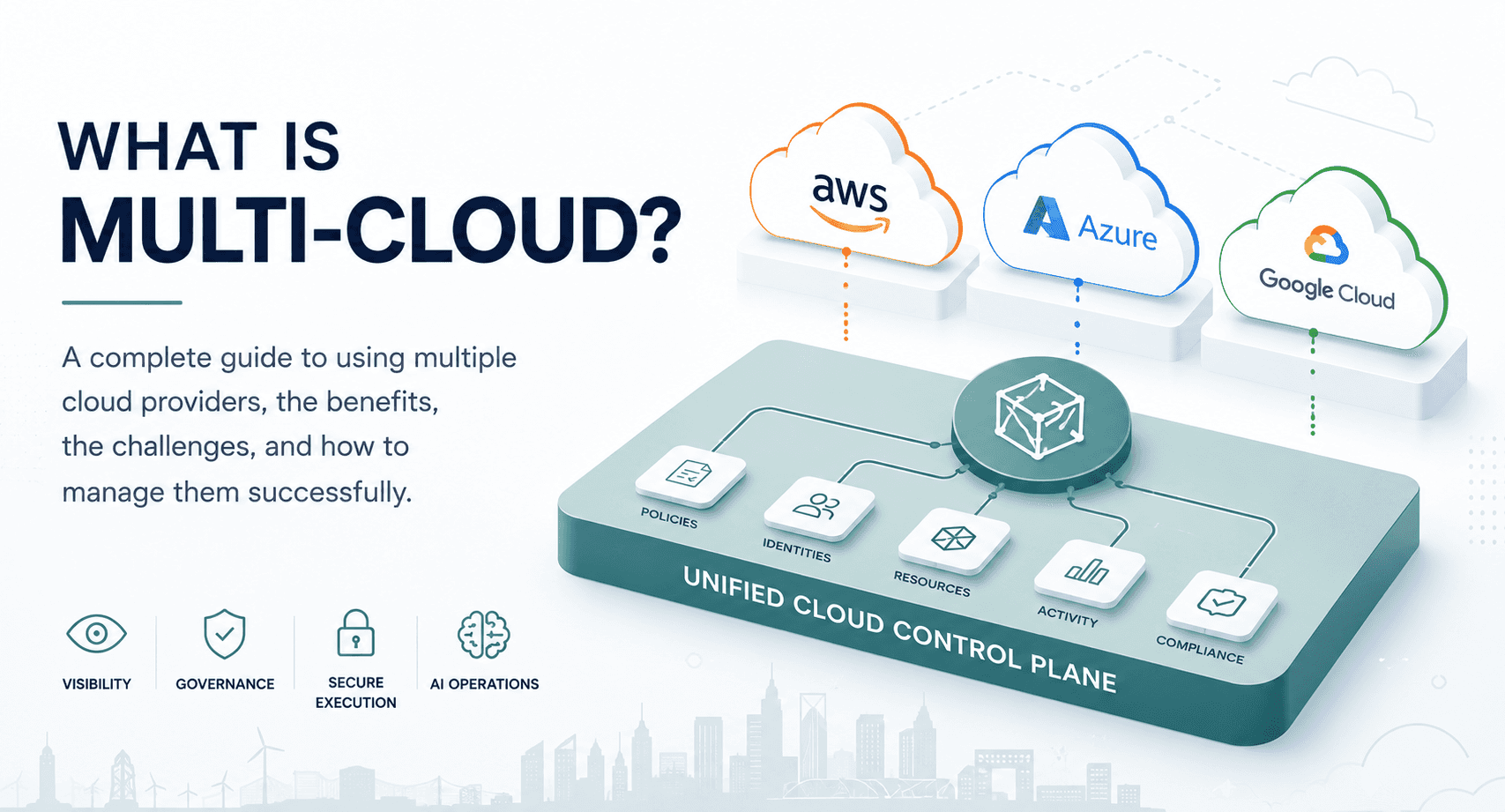
Multi-cloud is the practice of using cloud services from two or more public cloud providers such as Amazon Web Services (AWS), Microsoft Azure, and Google Cloud Platform (GCP) to run an organization's applications, infrastructure, and data.
Rather than relying on a single provider, organizations adopt multi-cloud strategies to take advantage of different platforms' strengths, improve resilience, meet regulatory requirements, reduce dependence on a single vendor, and support different business units or acquisitions.
For many organizations, multi-cloud is not a deliberate architecture decision made all at once. It evolves over time.
A company may run customer-facing applications in AWS, Microsoft-centric workloads in Azure, AI and analytics workloads in Google Cloud, and still maintain important systems on-premises.
The challenge is no longer simply adopting multiple clouds. The real challenge is operating them consistently.
Why Organizations Choose Multi-Cloud
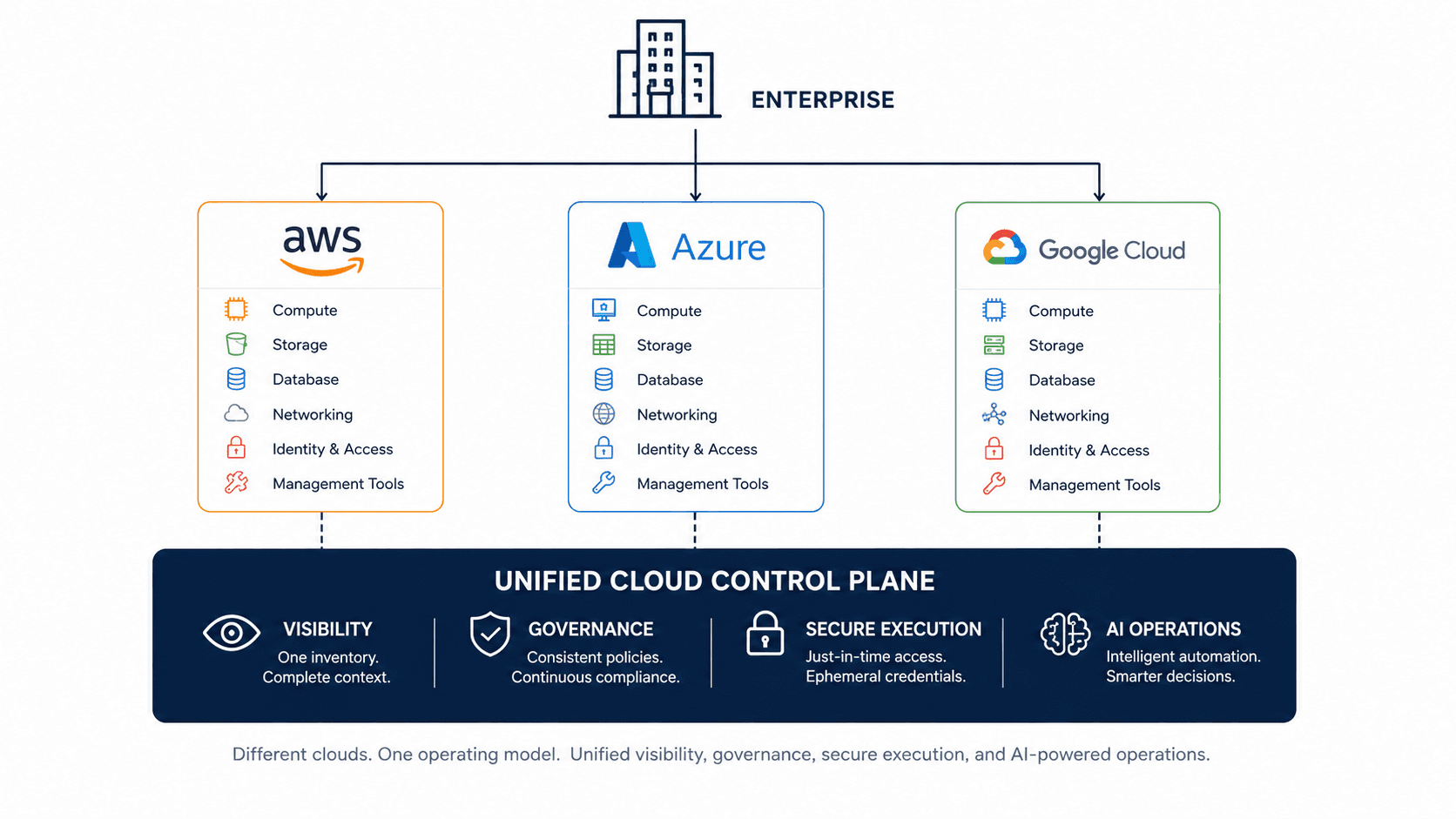
There is rarely a single reason an organization becomes multi-cloud. In most cases, several business and technical forces gradually lead to it.
Mergers and Acquisitions
When organizations merge or acquire other companies, they often inherit different cloud environments. One business may have standardized on AWS while another relies heavily on Azure or Google Cloud.
Attempting to immediately consolidate everything into one provider can be expensive, disruptive, and unnecessary.
As a result, the combined organization becomes multi-cloud.
Best-of-Breed Services
Each cloud provider has different strengths.
Organizations may choose AWS for one workload, Azure for another, and Google Cloud for a third based on the services that best fit the problem they are trying to solve.
For example, a company might use:
AWS for large-scale application infrastructure
Azure for workloads tightly integrated with Microsoft technologies
Google Cloud for analytics, machine learning, or AI services
Multi-cloud allows teams to choose the best platform for a workload rather than forcing every workload into a single provider.
Regulatory and Data Residency Requirements
Organizations operating across industries and countries may face requirements around where data can be stored, processed, or accessed.
Using multiple cloud providers can give organizations more options for meeting regional, sovereignty, and compliance requirements.
Business Continuity and Resilience
Relying entirely on one cloud provider creates concentration risk.
Multi-cloud can help organizations reduce that dependency, although simply using multiple providers does not automatically create resilience.
True cross-cloud resilience requires deliberate architecture, data replication, operational processes, and testing.
Organizational Autonomy
Large enterprises often have multiple business units, engineering organizations, or product teams making independent technology decisions.
One division may prefer AWS while another standardizes on Azure.
In these environments, multi-cloud is often an organizational reality rather than a centrally planned strategy.
Multi-Cloud vs. Hybrid Cloud
Multi-cloud and hybrid cloud are related concepts, but they are not the same thing.
Multi-cloud means using two or more public cloud providers.
Hybrid cloud means combining public cloud infrastructure with private infrastructure, such as an on-premises data center or private cloud.
An organization can be multi-cloud, hybrid cloud, or both.
For example, a company using AWS and Azure while also operating an on-premises VMware environment is both multi-cloud and hybrid cloud.
Aspect | Single Cloud | Hybrid Cloud | Multi-Cloud |
|---|---|---|---|
Public cloud providers | 1 | Usually 1 | 2 or more |
On-premises infrastructure | Optional | Yes | Optional |
Vendor dependence | Higher | Moderate | Lower |
Operational complexity | Lowest | Medium | Highest |
Governance complexity | Lower | Medium | Higher |
Typical enterprise use | Common | Very common | Very common |
The important distinction is that multi-cloud is primarily about multiple public cloud providers, while hybrid cloud is about combining public and private infrastructure.
Benefits of a Multi-Cloud Strategy
A well-designed multi-cloud environment can provide significant technical and business advantages.
Flexibility
Teams can choose the cloud services that best fit their requirements instead of being limited to one provider's ecosystem.
This can be especially valuable for organizations operating across infrastructure, analytics, AI, security, and enterprise applications.
Reduced Vendor Dependence
Using multiple providers can reduce reliance on the pricing model, roadmap, operational limitations, or strategic direction of a single vendor.
That does not mean applications automatically become portable between providers, but it gives organizations more strategic options.
Improved Resilience
Critical systems can be designed so that a failure affecting one provider does not necessarily disrupt the entire business.
However, multi-cloud resilience must be designed intentionally. Simply having workloads in multiple clouds does not mean those workloads can fail over between them.
Faster Innovation
Cloud providers compete aggressively on new capabilities.
A multi-cloud organization can adopt a new service from one provider without waiting for its preferred provider to offer an equivalent capability.
This is increasingly important in areas such as generative AI, machine learning, data platforms, and security.
Geographic Reach
Different cloud providers have different regional footprints and service availability.
Organizations can use those differences to deploy workloads closer to customers or satisfy regional requirements.
A Real-World Multi-Cloud Example
Consider a global retailer operating across North America, Europe, and Asia.
Its customer-facing applications run primarily in AWS.
Its Microsoft identity environment, internal applications, and some analytics workloads run in Azure.
Its data science organization uses Google Cloud for BigQuery and machine learning.
Several legacy ERP systems still run in private data centers.
No single executive necessarily made the decision to create this architecture. It evolved through acquisitions, technology choices, team preferences, regulatory requirements, and years of investment.
Now imagine a security incident occurs. The security team needs to answer several basic questions:
Which identities have administrative access?
Which resources contain sensitive customer data?
Who owns those resources?
Which permissions were recently changed?
Which workloads communicated with the affected system?
Are similar exposures present in other cloud environments?
The answers may exist, but they are distributed across different APIs, consoles, identity systems, logging systems, and resource models.
That illustrates one of the most important realities of multi-cloud:
The infrastructure may be distributed, but the organization still needs a consistent way to understand and operate it.
The Hidden Challenges of Multi-Cloud
The benefits of multi-cloud are real, but so is the operational complexity.
Each provider has its own architecture, terminology, APIs, identity model, policy system, resource hierarchy, and management tools.
As environments grow, those differences become increasingly difficult to manage.
Different Identity Models
AWS, Azure, and Google Cloud approach identity and access differently.
An organization may need to understand and govern:
AWS IAM users and roles
AWS STS sessions
Microsoft Entra ID identities
Azure RBAC assignments
Managed identities
Google Cloud IAM
Service accounts
Workload identity federation
Third-party identities
Machine and AI-agent identities
The same conceptual question—"Who can access this resource?"—may require entirely different methods to answer in each provider.
Inconsistent Governance
Each cloud provider has different policy engines, resource hierarchies, tagging models, and management APIs.
A security rule that is simple to enforce in one provider may require a completely different implementation in another.
Without a common governance model, organizations often end up maintaining separate policy frameworks for each cloud.
Limited Visibility
Multi-cloud environments make it harder to answer basic operational questions consistently.
For example:
What cloud resources do we have?
Who owns them?
Which resources are publicly accessible?
Which identities have privileged access?
Which resources are unused?
Which accounts or projects violate policy?
What changed yesterday?
When the answers require multiple dashboards and provider-specific queries, investigation and remediation become slower.
Operational Complexity
Cloud teams often maintain separate tooling and processes for AWS, Azure, and Google Cloud.
Security teams may have one set of tools.
Platform engineering may have another.
FinOps may have another.
Application teams may interact only with their preferred provider.
The result is duplicated tooling, inconsistent processes, and increased operational overhead.
Multi-Cloud Is an Operational Problem, Not Just an Infrastructure Problem
Multi-cloud discussions often focus on where applications run.
That is only part of the problem.
The harder questions exist above the infrastructure layer.
Organizations need to answer questions such as:
Who has access?
What changed?
Is this resource compliant?
Who owns it?
Which policy applies?
Is this resource still needed?
Can this workload safely access another system?
Can an AI agent execute this change safely?
These questions are not specific to AWS, Azure, or Google Cloud.
They exist across all of them.
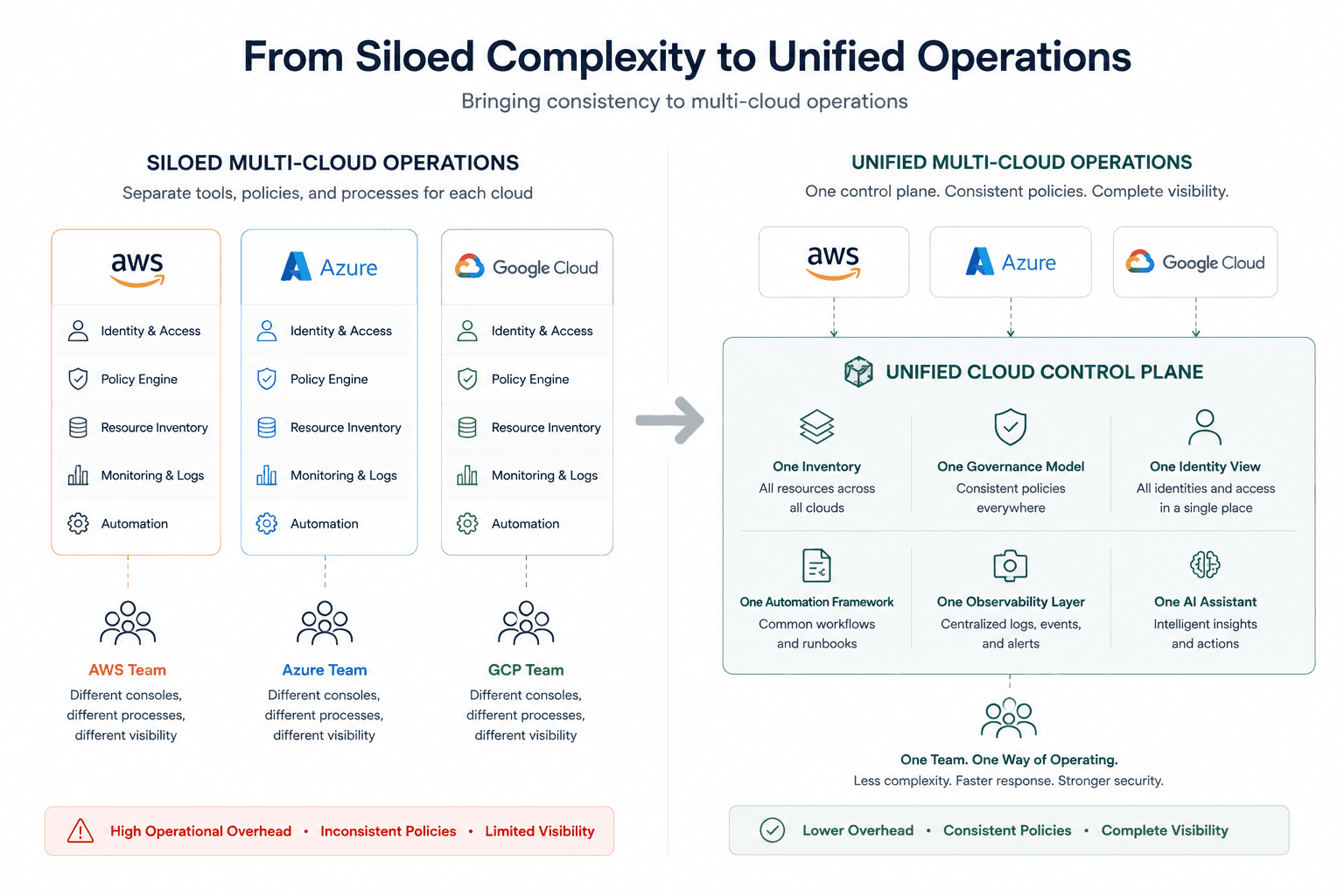
That is why mature multi-cloud organizations increasingly focus on building a consistent operational layer across providers rather than trying to force every cloud to behave identically.
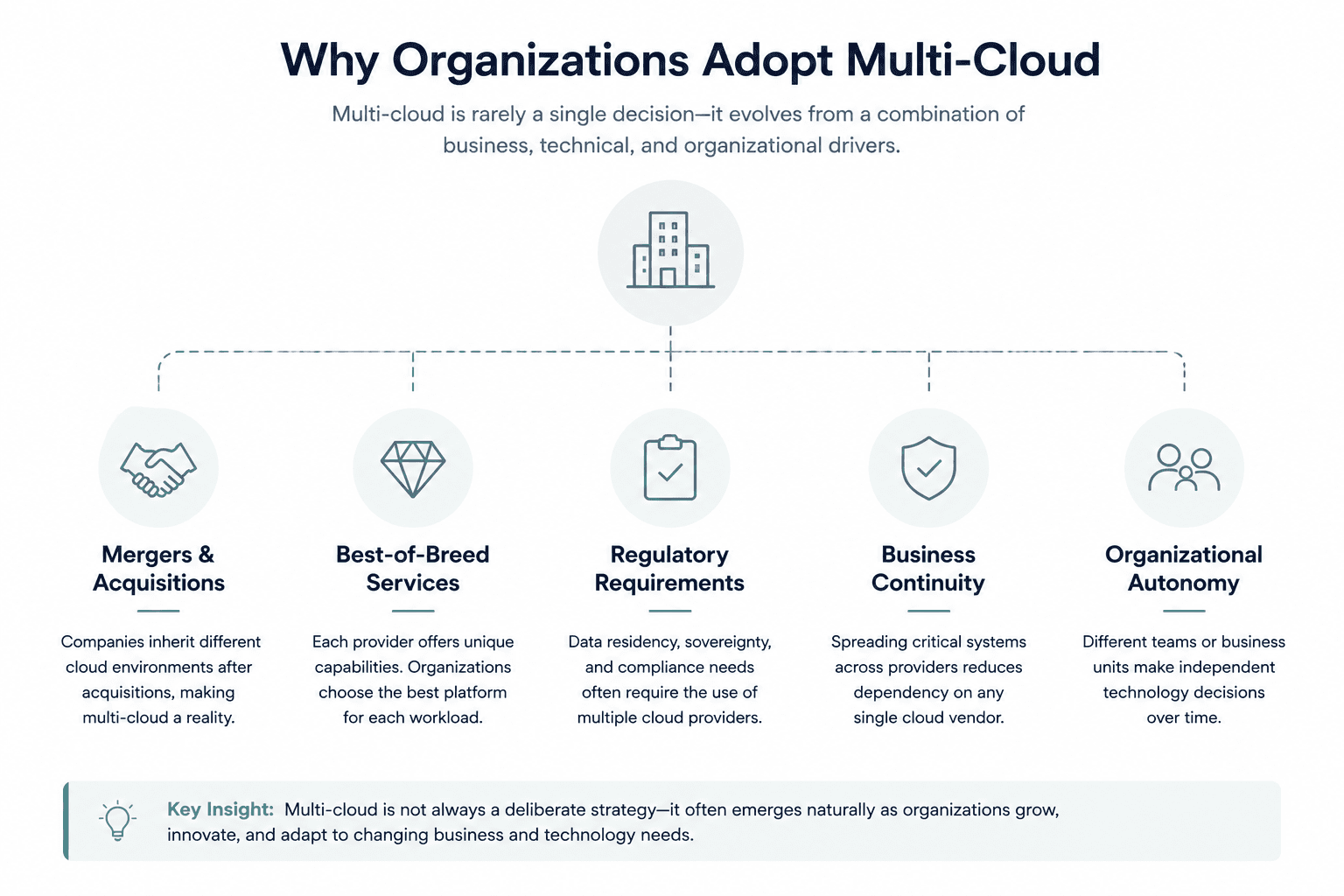
What Is a Cloud Control Plane?
A cloud control plane is a management layer used to apply consistent visibility, governance, access, automation, and operational policies across cloud environments.
The goal is not to replace the native capabilities of AWS, Azure, or Google Cloud.
Instead, a control plane provides a common operating model above them.
A multi-cloud control plane may provide capabilities such as:
Unified resource inventory
Identity and access visibility
Consistent policy enforcement
Resource ownership and labeling
Compliance monitoring
Just-in-time access
Secure execution
Automated remediation
AI-assisted operations
This gives engineering and security teams a consistent way to operate across clouds while still allowing each provider to retain its native strengths.
What Successful Multi-Cloud Organizations Do Differently
Organizations that manage multi-cloud environments effectively tend to focus on consistency rather than uniformity.
The goal is not to make AWS behave like Azure or Google Cloud.
The goal is to create consistent operational outcomes across all of them.
Common practices include:
Standardized Identity Governance
Organizations establish common rules for privileged access, workload identities, temporary credentials, and identity lifecycle management.
Unified Resource Inventory
Teams maintain a centralized view of resources across providers rather than relying exclusively on individual cloud consoles.
Consistent Ownership
Every resource should have a clear owner, business context, environment, and purpose. Cloud-native tags can help, but many organizations need a broader cross-cloud labeling model.
Policy as Code
Governance rules are defined in code so they can be reviewed, versioned, tested, and applied consistently.
Automated Compliance
Instead of relying on periodic audits, organizations continuously evaluate infrastructure against security and compliance policies.
Temporary Privileged Access
Standing administrative permissions increase risk. Mature organizations increasingly use just-in-time access and short-lived credentials for privileged operations.
Centralized Visibility
Security, platform, and operations teams need a shared view of activity across providers.
This becomes even more important as automation and AI agents begin interacting directly with cloud infrastructure.
Is Multi-Cloud More Secure?
Multi-cloud can improve resilience and reduce concentration risk, but it does not automatically improve security.
In fact, poorly governed multi-cloud environments can increase risk because teams must manage more identities, policies, APIs, resources, and tools.
Security depends on whether the organization can maintain consistent controls across providers.
A mature multi-cloud security model should include:
Strong identity governance
Least-privilege access
Short-lived credentials
Centralized visibility
Consistent policy enforcement
Continuous monitoring
Auditable automation
The security advantage comes from better architecture and governance not simply from using multiple providers.
Does Multi-Cloud Prevent Vendor Lock-In?
Not completely.
Using more than one provider reduces organizational dependence on a single vendor, but individual workloads may still depend heavily on proprietary services.
For example, an application built around provider-specific databases, serverless platforms, or AI services may be difficult to move elsewhere.
Multi-cloud provides strategic flexibility, but workload portability is a separate architectural decision.
Is Kubernetes Required for Multi-Cloud?
No.
Kubernetes can provide a common application platform across cloud providers, but it is only one part of the broader multi-cloud landscape.
A multi-cloud environment may include:
Virtual machines
Kubernetes
Serverless functions
Managed databases
Data warehouses
Object storage
SaaS platforms
AI services
Networking services
Identity systems
Multi-cloud is an operating model, not a specific technology stack.
Do You Need a Multi-Cloud Strategy?
Not every organization should intentionally pursue multi-cloud.
If a single cloud provider meets your technical, regulatory, financial, and business requirements, adding another provider purely for the sake of being multi-cloud may introduce unnecessary complexity.
However, many organizations are already multi-cloud whether they planned to be or not.
The more useful question is often:
If we already operate across multiple clouds, how do we manage them consistently?
That question leads directly to governance, identity, visibility, automation, and secure execution.
Key Takeaways
Multi-cloud means using services from two or more public cloud providers.
Organizations adopt it for many reasons, including acquisitions, best-of-breed services, resilience, regulation, and organizational autonomy.
The benefits can be significant, but the operational complexity grows quickly as each provider introduces its own identity models, policies, APIs, resource structures, and management tools.
The most successful organizations do not try to eliminate those differences.
Instead, they create a consistent operational model across them.
That means building unified approaches to visibility, governance, identity, ownership, policy, and automation.
Ultimately, the challenge of multi-cloud is not simply managing multiple clouds.
It is creating one way to understand and operate all of them.
Related Reading
How Strato Cloud Approaches Multi-Cloud
Strato Cloud is designed around the idea that organizations should not need separate operating models for every cloud provider.
It provides a unified control plane across AWS, Azure, and Google Cloud for visibility, governance, secure execution, and AI-powered cloud operations.
Rather than replacing native cloud services, Strato Cloud works across them to provide a consistent view of resources, identities, policies, and activity.
The goal is simple:
Keep the flexibility of multi-cloud without inheriting all of its operational complexity.