Published:
Estimated reading time:
8-10 minutes

Cloud governance has traditionally been treated as something organizations design periodically. Teams define policies, establish standards, review environments, identify problems, and then repeat the process weeks or months later.
Cloud infrastructure does not operate on that schedule.
Resources are created and changed continuously. Infrastructure as Code pipelines deploy new configurations. Engineers receive new permissions. Applications scale. Security requirements evolve. New vulnerabilities appear. Cloud providers release new services. AI and automation can now make changes at machine speed.
A governance policy that was satisfied yesterday may be violated today.
Continuous cloud governance is the practice of continuously evaluating cloud environments against organizational policies, security requirements, operational standards, and compliance expectations so that problems can be identified as conditions change.
The goal is to move governance from periodic inspection toward an ongoing operational process.
What Is Continuous Cloud Governance?
Continuous cloud governance applies governance policies continuously rather than relying primarily on periodic assessments.
Organizations first define what acceptable cloud operations look like. Those expectations may cover security configuration, identity, infrastructure, compliance, ownership, cost, deployment practices, or other organizational requirements.
Cloud environments can then be evaluated against those expectations as conditions change.
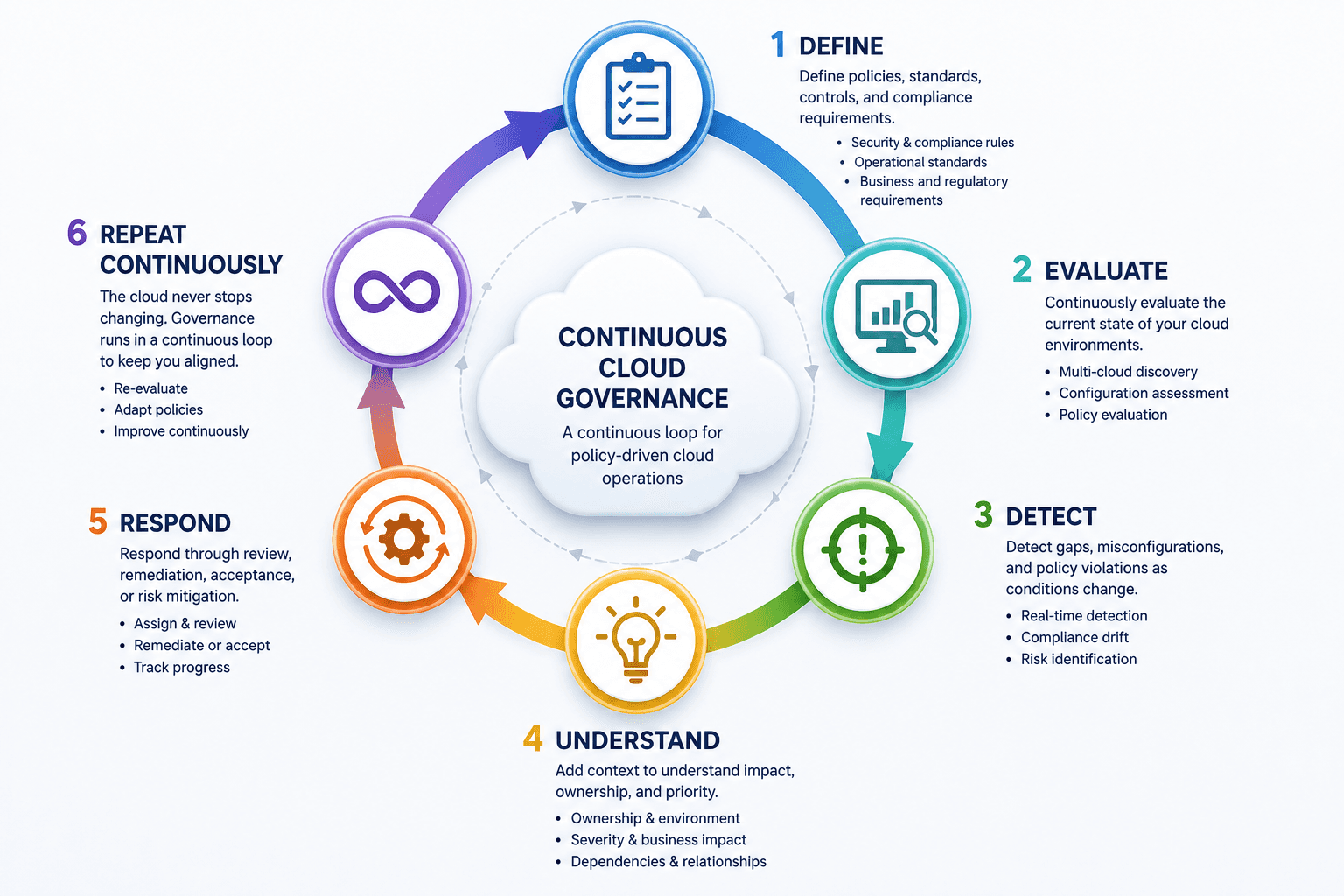
The basic model is:
Define → Evaluate → Detect → Understand → Respond → Repeat
The final step matters. Governance does not end after a report is generated. The environment continues changing, so governance continues as well.
This turns governance into a lifecycle rather than an event.
Why Periodic Governance Falls Behind
Periodic assessments made sense when infrastructure changed relatively slowly.
Modern cloud environments behave differently.
A development team can deploy dozens of infrastructure changes in a day. A new cloud account can be created in minutes. An IAM policy can be modified immediately. A storage service can become publicly accessible through a single configuration change.
If governance is evaluated quarterly, monthly, or even weekly, a significant amount can happen between assessments.
Consider a company that performs a compliance scan every Monday.
The scan completes successfully.
On Tuesday afternoon, an infrastructure change creates a configuration that violates one of the organization's controls.
If the next assessment occurs the following Monday, the environment may remain out of compliance for almost a week.
Continuous governance attempts to shorten that gap.
Governance Is More Than Compliance
Compliance is an important part of governance, but the two are not identical.
Compliance asks whether an organization satisfies specific external or internal requirements. Governance defines the broader rules for how the organization expects cloud environments to operate.
Those rules might include requirements such as:
Production resources must have identifiable ownership.
Privileged access should not remain permanently assigned.
Storage containing sensitive data must not be publicly accessible.
Infrastructure changes must follow approved deployment processes.
Certain workloads may only run in approved regions.
Production cloud environments must meet defined security baselines.
Critical findings must be reviewed within a specified period.
Some of those policies may support SOC 2, ISO 27001, CIS benchmarks, NIST guidance, or another framework.
Others may simply represent good operational practice for that particular organization.
Continuous governance provides a mechanism for evaluating both.
Continuous Governance vs. Cloud Monitoring
Cloud monitoring and cloud governance can observe some of the same infrastructure, but they answer different questions.
Monitoring generally asks:
What is happening?
Governance asks:
Is what is happening acceptable?
A monitoring system might report that a security group changed.
A governance system evaluates whether the resulting configuration violates organizational policy.
Monitoring might show that a cloud resource exists in a particular region.
Governance determines whether that workload is permitted to run there.
Monitoring provides signals. Governance interprets cloud state against rules and expectations.
The two are complementary.
Continuous Governance vs. CSPM
Cloud Security Posture Management, or CSPM, is another closely related concept.
CSPM products typically evaluate cloud environments for security misconfigurations, risky configurations, and compliance issues. They have played an important role in helping organizations understand cloud security posture.
Continuous cloud governance is broader.
Security posture can be one component, but governance can also incorporate identity, access, Infrastructure as Code, organizational ownership, operational policies, cost controls, deployment standards, and other requirements.
The distinction becomes particularly important as organizations begin governing not only infrastructure state but also how infrastructure is changed and who or what is allowed to change it.
Continuous Governance Requires Current Cloud State
Governance decisions are only as useful as the information they evaluate.
Cloud environments change constantly. If governance depends on an outdated representation of the environment, findings may no longer reflect what actually exists.
Continuous governance therefore benefits from access to current cloud state.
This becomes particularly important during investigation.
A finding might identify a configuration problem, but understanding the problem often requires additional questions:
What environment is affected?
Who owns it?
Is it production?
What depends on it?
Has the configuration recently changed?
Are similar configurations present elsewhere?
What would be affected by remediation?
The ability to interrogate current cloud environments helps move governance from simply identifying findings toward understanding what those findings mean operationally.
Context Makes Governance More Useful
Not every violation has the same significance.
Imagine two cloud environments with the same configuration issue.
One belongs to an experimental development project with no sensitive data.
The other belongs to a production cybersecurity system supporting critical operations.
Technically, the finding may be identical.
Operationally, the risk is not.
Context such as ownership, environment, business function, criticality, cloud account, subscription, project, and organizational structure can help teams prioritize findings more intelligently.
This is why visibility and governance are closely connected.
Governance identifies where reality differs from expectations. Context helps explain how much that difference matters.
Continuous Governance Across Multiple Clouds
Multi-cloud environments make governance significantly more complicated.
AWS, Azure, and Google Cloud each have their own resource models, identity systems, policy mechanisms, organizational hierarchies, security services, and terminology.
An organization may still want consistent rules.
For example:
Production storage must not be publicly accessible.
The technical implementation of that rule may differ between AWS, Azure, and Google Cloud.
The organizational intent does not.
Continuous governance can provide a layer where organizations think about desired outcomes consistently while still accounting for the technical differences between cloud providers.
That becomes increasingly important as organizations operate hundreds of accounts, subscriptions, and projects across multiple clouds.
Continuous Governance and Infrastructure as Code
Infrastructure as Code has transformed how cloud environments are created and maintained.
Instead of configuring infrastructure manually, organizations can define desired infrastructure in code and deploy it through engineering workflows.
That creates an important opportunity for governance.
Policies can be evaluated at multiple points in the infrastructure lifecycle.
Organizations can evaluate code before deployment, inspect deployed cloud state afterward, and compare actual infrastructure against expected configurations over time.
This creates both preventive and detective governance.
Preventive controls attempt to stop unacceptable configurations before they are deployed.
Detective controls identify problems that already exist.
Mature governance programs generally need both.
Governance Findings Need Prioritization
One of the biggest problems in cloud security and governance is not finding issues.
It is dealing with the number of issues that are found.
A large enterprise may generate thousands of findings across security tools, cloud providers, compliance systems, and internal controls.
If every finding receives the same priority, teams quickly become overwhelmed.
Continuous governance therefore needs more than detection.
Findings should ideally include enough context to help teams understand severity, ownership, environment, business impact, and potential remediation paths.
This allows teams to focus attention where it matters most.
Detection Is Only Half the Problem
Identifying a governance gap does not fix it.
Once a problem is found, someone still needs to determine what should change, understand the infrastructure involved, write or modify the appropriate configuration, validate the proposed change, move it through the organization's deployment process, and confirm that the governance requirement has been addressed.
Historically, much of that process has been manual.
A security or governance tool generates a finding. The finding becomes a ticket. The ticket is assigned to an engineering team. An engineer investigates the issue, determines how the infrastructure is managed, writes a change, creates a pull request, waits for review, and eventually deploys it.
That gap between detection and remediation is one of the largest opportunities for AI in cloud operations.
From Continuous Governance to Intelligent Remediation
AI creates the possibility of connecting governance findings directly to engineering workflows without giving AI unrestricted authority to modify production environments.
Consider a governance assessment that identifies several CIS benchmark gaps.
A user selects the findings they want to remediate.
An AI system can analyze the findings and generate the Infrastructure as Code necessary to address them. The AI can work inside a secure sandbox where it can create and modify files and run development tools such as linters and validators to check the generated code.
The resulting change can then be committed to an authorized Git repository and presented as a pull request.
The organization retains its existing review and deployment process.
This creates a powerful lifecycle:
Detect → Understand → Generate → Validate → Review → Deploy → Re-evaluate
Continuous governance identifies what needs attention.
Intelligent remediation helps turn that finding into a proposed engineering change.
Human review remains the boundary before the organization decides to deploy it.
AI Changes the Governance Lifecycle
AI can contribute at multiple stages of governance.
It can help interpret policies, investigate findings, understand cloud context, correlate information, explain why something matters, propose remediation, and generate Infrastructure as Code.
But AI also introduces new governance questions.
What information should an AI agent be allowed to access? What tools should it be able to execute? What cloud permissions should it receive? How should generated changes be validated? Which actions require human approval?
The same principles organizations use to govern humans and automation increasingly need to apply to AI agents.
Continuous governance therefore becomes both something AI can help perform and something that AI itself must operate within.
A Practical Example: CIS Compliance
Consider an organization evaluating cloud infrastructure against CIS benchmarks.
A continuous governance system identifies several configurations that do not meet the organization's desired baseline.
Instead of waiting for the next periodic audit, the findings become visible as they are identified.
Teams can evaluate which cloud environments are affected, determine ownership, understand criticality, and prioritize remediation.
For selected findings, an intelligent remediation workflow can generate the Infrastructure as Code necessary to correct the configuration.
The generated code can be checked using appropriate development tooling and delivered through a Git pull request.
Once reviewed and deployed through the organization's normal process, continuous governance evaluates the environment again.
The finding can then be confirmed as resolved.
That closes the loop between policy and reality.
What Makes Continuous Governance Effective?
Successful continuous governance requires more than running scanners frequently.
Several capabilities matter.
Clear Policies
Organizations need to define what they expect from their cloud environments.
Policies should be understandable, actionable, and connected to actual organizational requirements.
Current Information
Governance should evaluate sufficiently current information to reflect the environment teams are actually operating.
Organizational Context
Ownership, environment, criticality, business function, and other context help determine which findings matter most.
Multi-Cloud Consistency
Organizations should be able to express governance intent consistently even when implementation differs across cloud providers.
Actionable Findings
A finding should help teams understand what is wrong, why it matters, where it exists, and what needs to happen next.
Remediation Workflows
Governance becomes significantly more valuable when findings can move efficiently into controlled remediation processes.
Continuous Re-Evaluation
After remediation, the environment should be evaluated again.
Governance is a loop, not a report.
How Strato Cloud Approaches Continuous Governance
Strato Cloud treats governance as an ongoing cloud operating process rather than a periodic assessment.
Organizations can evaluate AWS, Azure, and Google Cloud environments against governance and compliance requirements while combining findings with organizational context from Strato Cloud namespaces, cloud accounts, subscriptions, projects, identities, and cloud-agnostic labels.
Strato Cloud's AI-driven approach can also help teams investigate current cloud conditions rather than requiring every question to begin with navigating dashboards or searching through a traditional resource inventory.
When findings require action, Continuous Governance can connect with Intelligent Remediation workflows. Selected issues can be passed to Strato AI, which can generate Infrastructure as Code inside secure sandboxes, run appropriate code-validation tools, and prepare changes for delivery through authorized Git repositories and pull requests.
The objective is to create a continuous loop between understanding policy, evaluating cloud state, identifying gaps, and safely moving toward remediation.
Frequently Asked Questions
What is continuous cloud governance?
Continuous cloud governance is the ongoing evaluation of cloud environments against organizational policies, security requirements, operational standards, and compliance expectations as cloud conditions change.
How is continuous governance different from traditional cloud governance?
Traditional governance programs may rely heavily on periodic assessments and reviews. Continuous governance evaluates cloud environments much more frequently so that policy violations can be identified closer to when they occur.
Is continuous cloud governance the same as CSPM?
No. CSPM primarily focuses on cloud security posture and misconfiguration. Continuous cloud governance can include security posture while also covering identity, access, infrastructure, compliance, organizational policies, Infrastructure as Code, deployment practices, and other operational requirements.
Does continuous governance automatically fix problems?
Not necessarily. Detection and remediation are separate functions. Governance identifies differences between desired and actual state. Remediation determines how those differences should be corrected.
How does AI help with continuous governance?
AI can help interpret findings, investigate cloud context, correlate information, explain risk, and assist with remediation. It can also generate Infrastructure as Code for selected findings when appropriate controls, validation, and human review are in place.
Why is Infrastructure as Code important for remediation?
Infrastructure as Code makes proposed cloud changes reproducible, reviewable, version controlled, and compatible with existing engineering workflows. Instead of making an opaque change directly to production, remediation can be represented as code and reviewed through processes such as Git pull requests.
Can continuous governance work across AWS, Azure, and Google Cloud?
Yes. The technical controls differ among cloud providers, but organizations can still apply consistent governance intent across AWS accounts, Azure subscriptions, and Google Cloud projects.