Published:
Estimated reading time:
8–9 minutes

Access control starts with a simple question:
Should this identity be allowed to perform this action?
Answering that question becomes increasingly difficult as organizations grow.
A small team might assign permissions directly to individual users. A larger organization needs reusable roles. More complex environments may need policies based on attributes such as department, environment, application, or resource sensitivity.
Modern cloud environments introduce another challenge: sometimes the correct authorization decision depends on what is happening right now.
Is the engineer currently on call?
Is the request coming from a managed device?
Is there an active incident?
Does the target environment contain critical production infrastructure?
Is the requesting workload running through an approved pipeline?
This progression helps explain three important access control models: Role-Based Access Control (RBAC), Attribute-Based Access Control (ABAC), and Context-Based Access Control (CBAC).
They are not necessarily competing systems. Each adds another way to express why access should or should not be granted.
What Is Role-Based Access Control?
Role-Based Access Control assigns permissions to roles and then assigns identities to those roles.
Instead of granting every engineer dozens of individual permissions, an organization might define roles such as:
Developer
Platform Engineer
Security Engineer
Database Administrator
Production Operator
Each role receives a defined set of permissions.
A user assigned the Platform Engineer role inherits the permissions associated with that role.
The basic model is:
Identity → Role → Permissions
RBAC dramatically simplifies permission management compared with assigning permissions directly to every user.
If 100 engineers need the same capabilities, administrators can manage one role rather than 100 separate permission sets.
This is why RBAC remains one of the most widely used authorization models.
Where RBAC Works Well
RBAC works particularly well when access requirements align with stable organizational responsibilities.
For example, members of a database operations team may need permission to manage databases. Security engineers may need read access across environments. Developers may need deployment access to development environments.
Roles provide a clean abstraction for these patterns.
They are also relatively easy to understand.
If someone asks why an engineer has a particular permission, the answer might simply be:
They are a member of the Production Operator role.
That simplicity is valuable.
The challenge appears when access requirements become more dynamic.
Where RBAC Becomes Difficult
Imagine an engineer who occasionally needs production access while serving as the on-call responder.
You could create a Production Administrator role and assign the engineer to it.
But what happens when the on-call rotation ends?
If the role assignment remains, temporary operational responsibility has created permanent privilege.
Organizations often respond by creating more roles:
Developer.
Senior Developer.
Production Developer.
Production Read Only.
Production On Call.
Production Emergency Administrator.
Over time, the number of roles can become difficult to manage.
This is sometimes called role explosion.
More importantly, the authorization decision may depend on information that a role alone cannot express.
The engineer may be allowed to access production only while on call, from a compliant device, during an active incident, and using temporary credentials.
A static role does not naturally represent all of those conditions.
What Is Attribute-Based Access Control?
Attribute-Based Access Control makes authorization decisions using attributes associated with identities, resources, actions, or other policy inputs.
Instead of asking only:
What role does this user have?
ABAC can evaluate information such as:
User attributes
department
team
job function
clearance
employment type
Resource attributes
environment
owner
application
sensitivity
business unit
Action attributes
read
write
delete
administer
A policy might say:
Allow engineers in the payments team to modify development resources owned by payments.
The conceptual model becomes:
Identity Attributes + Resource Attributes + Action → Policy Decision
This allows access policies to become more expressive without creating a separate role for every combination of user and resource.
Why ABAC Is Powerful in the Cloud
Cloud environments contain large numbers of resources and identities.
Many of those resources already have metadata associated with them.
An organization might classify environments by:
production or development
application
team
business unit
data sensitivity
criticality
Identity systems may similarly contain attributes describing the people or workloads requesting access.
ABAC can use these attributes to create policies that scale across changing infrastructure.
Instead of assigning an engineer to separate roles for 30 different development environments, a policy could grant access whenever:
user.team = resource.owner
and:
resource.environment = development
New resources can inherit the appropriate access behavior based on their attributes rather than requiring a new role assignment every time infrastructure changes.
Where ABAC Becomes Difficult
ABAC provides flexibility, but that flexibility introduces complexity.
Organizations need trustworthy attributes.
If access depends on whether an environment is labeled production or development, those labels need to be accurate.
If access depends on team ownership, ownership information needs to remain current.
Policies can also become difficult to reason about when many attributes interact.
A user might satisfy several policies simultaneously, some granting access and others restricting it.
Policy design, attribute governance, and explainability therefore become important parts of an ABAC implementation.
There is also another limitation.
Many attributes describe what something is.
They do not necessarily describe what is happening at the moment access is requested.
That is where context becomes useful.
What Is Context-Based Access Control?
Context-Based Access Control makes authorization decisions using the circumstances surrounding an access request.
The question changes from:
Who are you?
or:
What attributes describe you and the resource?
to:
Given what is happening right now, should this access be allowed?
Context can include signals such as:
whether the user is currently on call
device security posture
MFA state
active incident or change ticket
current vulnerability information
EDR status
requested duration
time
location
target environment criticality
requested operation
workload runtime context
application ownership
deployment pipeline
process identity
A policy might say:
Allow this platform engineer temporary production access because they are currently on call, an active incident exists, their device satisfies security requirements, and the requested environment is related to that incident.
The authorization decision is based on the circumstances surrounding the request rather than only a static assignment.
RBAC vs. ABAC vs. CBAC
The easiest way to understand the difference is to look at the primary question each model answers.
RBAC asks:
What role does this identity have?
ABAC asks:
What attributes describe the identity, resource, and requested action?
CBAC asks:
Given the current circumstances, should this identity receive this access now?
The models become progressively more dynamic.
RBAC organizes permissions around responsibilities.
ABAC introduces richer information about identities and resources.
CBAC incorporates current operational and security conditions into the decision.
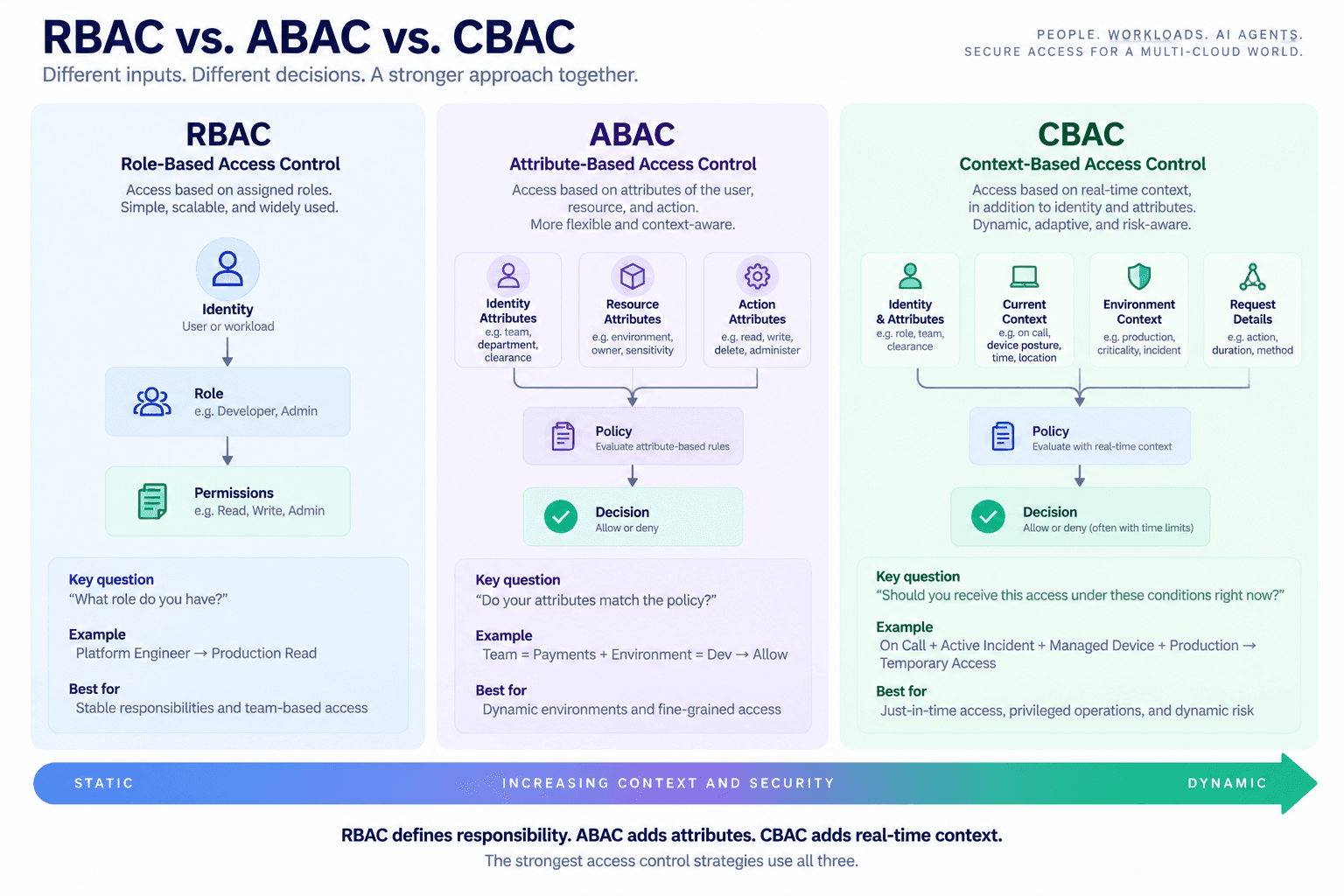
RBAC, ABAC, and CBAC Can Work Together
The progression from RBAC to ABAC to CBAC does not mean organizations need to abandon one model when adopting another.
They can complement each other.
Imagine a production access request.
RBAC establishes that the user is a Platform Engineer.
ABAC establishes that the engineer belongs to the team responsible for the requested application and that the target environment is classified as production.
CBAC evaluates whether the engineer is currently on call, whether an active incident exists, whether the device meets security requirements, and how long access should be granted.
The decision might look conceptually like:
Role + Attributes + Context → Authorization Decision
Each layer contributes useful information.
The role establishes responsibility.
Attributes establish relationships.
Context determines whether access makes sense under current conditions.
A Practical Example: Production Incident Access
Consider an engineer responding to a production incident at 2:00 AM.
With a traditional RBAC model, the engineer might already belong to a Production Administrator role.
That makes incident response easy because the permissions already exist.
It also means the engineer may possess those privileges at noon the next day, the following week, and months after the incident.
Another approach is to use the engineer's role as one input rather than the entire authorization decision.
The system can verify that:
the engineer has an appropriate operational role
the engineer owns or supports the affected application
the engineer is currently on call
an active incident exists
the device satisfies organizational security requirements
the requested environment is related to the incident
If those conditions are satisfied, access can be granted temporarily.
When the incident or authorization period ends, the access disappears.
The engineer still has a role.
What changes is whether that role should translate into privileged access right now.
Context Makes Just-in-Time Access Smarter
Just-in-time access answers an important question:
When should privileged access exist?
Instead of maintaining standing privileges, access is created when needed and removed afterward.
CBAC improves that model by helping answer:
Should this request for just-in-time access be approved under the current circumstances?
A user asking for production access at 2:00 AM while responding to an active incident may receive a different decision from the same user requesting identical access on a normal afternoon with no operational justification.
JIT controls the lifetime of access.
CBAC helps determine whether the access should be granted in the first place.
Together, they create a more dynamic alternative to standing privilege.
Context Can Come From Systems Outside the Cloud
Some of the most useful authorization signals do not originate in AWS, Azure, or Google Cloud.
An identity provider can provide authentication and MFA information.
An MDM system can provide device posture.
An EDR platform can indicate whether a device is healthy or compromised.
An ITSM system can indicate whether an incident or approved change exists.
A vulnerability platform can provide information about the security posture of the requesting workload.
An on-call system can determine whether the engineer currently has operational responsibility.
Context-based authorization can combine these signals when making a decision.
This allows cloud access to reflect the broader security and operational state of the organization rather than relying exclusively on cloud IAM configuration.
CBAC Applies to Workloads Too
Context is not only useful for human access.
Workloads increasingly need dynamic authorization.
Consider a CI/CD pipeline requesting permission to deploy infrastructure.
The identity of the pipeline matters, but additional context may matter too.
The system could evaluate:
which repository initiated the deployment
which branch triggered the pipeline
which application owns the infrastructure
which environment is being targeted
whether required approvals occurred
which process is requesting the credential
how long the credential should exist
The authorization decision becomes:
Is this workload allowed to perform this operation in this environment under these conditions?
That is much more expressive than simply giving the CI/CD platform a permanent cloud credential.
CBAC Matters Even More for AI Agents
AI agents introduce another type of dynamic identity.
An AI system may investigate infrastructure, generate code, evaluate compliance, or participate in remediation.
Giving an AI agent broad standing permissions creates obvious risk.
The better question is not:
Does this AI agent have access?
It is:
Should this AI agent be allowed to perform this specific operation, in this environment, on behalf of this identity, under these circumstances?
Useful context might include:
the human or workload that initiated the request
that identity's authorization
target environment
requested operation
whether the operation is read or write
applicable governance policy
approval state
credential lifetime
As AI systems gain more operational capability, contextual authorization becomes increasingly important.
Authorization and Credentials Are Different Things
Access control determines whether an operation should be allowed.
Credentials provide the technical mechanism used to exercise that authorization.
These concepts are related but different.
An organization might make a sophisticated CBAC decision and then issue a permanent credential.
That would preserve contextual authorization while weakening the execution model.
A stronger pattern is:
Evaluate Identity → Evaluate Attributes → Evaluate Context → Authorize → Issue Temporary Credentials → Execute → Expire
The authorization system decides whether access should exist.
The credential system ensures that the resulting access is limited in time.
This distinction becomes especially important for privileged human access, workloads, automation, and AI agents.
Explainability Matters
As authorization becomes more dynamic, users and security teams need to understand why decisions were made.
With simple RBAC, the explanation may be:
Denied because you are not a member of the Production Operator role.
With contextual authorization, the explanation might become:
Denied because you are authorized for this application, but you are not currently on call and there is no active incident associated with the requested production environment.
That explanation is valuable.
It helps users understand what condition prevented access.
It also helps security teams audit the decision later.
Dynamic authorization should not mean mysterious authorization.
Multi-Cloud Makes a Common Authorization Layer Valuable
AWS, Azure, and Google Cloud each provide powerful native identity and access systems.
They also use different terminology, policy models, credential mechanisms, and resource hierarchies.
Organizations operating across multiple providers still need consistent answers to questions such as:
Who should receive production access?
What conditions should be required?
How long should privileged access last?
Which contextual signals should influence the decision?
A common authorization layer can express organizational intent above the provider-specific mechanisms.
The final credentials and permissions can still use native AWS, Azure, or Google Cloud capabilities underneath.
The objective is not to replace cloud IAM.
It is to create a consistent decision model across it.
How Strato Cloud Approaches RBAC, ABAC, and CBAC
Strato Cloud treats roles, attributes, and context as complementary inputs to cloud authorization rather than forcing organizations to choose one model exclusively.
Roles Establish Baseline Responsibility
Existing identity and organizational structures can establish who a user or workload is and what responsibilities it normally has.
This provides the stable foundation that RBAC is good at representing.
Attributes Add Organizational Context
Strato Cloud synchronizes cloud identities and higher-level cloud environments, including AWS accounts, Azure subscriptions, and GCP projects.
Strato Cloud namespaces and cloud-agnostic labels can provide additional organizational context such as environment, ownership, business function, and criticality.
These attributes help express relationships between identities and the environments they need to access.
Context Determines Whether Access Makes Sense Now
Context-Based Access Control can then incorporate current signals when an access request occurs.
For a human, that might include on-call status, device posture, an active incident, target environment, or requested duration.
For a workload, it might include application identity, runtime, deployment process, environment, or requested operation.
For an AI-assisted operation, context can include the initiating identity, the environment being accessed, the requested capability, and the authorization associated with that user or workload.
Secure Execution Turns Authorization Into Temporary Access
Once the authorization decision is made, Strato Cloud's Secure Execution capabilities can provide temporary credentials for the approved operation.
This separates the authorization decision from the credential used to exercise it.
Instead of translating an approved role or policy into permanent privilege, the system can create access when required and allow it to expire afterward.
The resulting model is:
Identity + Role + Attributes + Context → Authorization → JIT Credentials → Cloud Activity → Expiration
This allows RBAC, ABAC, CBAC, just-in-time access, and temporary credentials to work as parts of the same access lifecycle.
Which Access Control Model Should You Use?
For most organizations, the answer is not simply RBAC, ABAC, or CBAC.
Use RBAC when permissions naturally follow stable responsibilities.
Use ABAC when access depends on relationships between identities, resources, environments, and organizational metadata.
Use CBAC when the correct decision depends on current operational or security conditions.
For sensitive cloud access, organizations may use all three.
A role can establish that someone is eligible for an operation.
Attributes can establish that the operation applies to the correct environment or resource.
Context can determine whether the access should be granted at this moment.
Temporary credentials can then ensure that the resulting privilege exists only as long as necessary.
The goal is not to choose the most complicated authorization model.
It is to use enough information to make the right access decision.
Frequently Asked Questions
What is the difference between RBAC and ABAC?
RBAC grants permissions based primarily on roles assigned to identities. ABAC evaluates attributes associated with identities, resources, actions, and other policy inputs.
What is the difference between ABAC and CBAC?
ABAC commonly evaluates attributes describing identities and resources. CBAC emphasizes the current circumstances surrounding the request, such as on-call status, device posture, active incidents, time, runtime, or requested operation.
Is CBAC a replacement for RBAC?
No. Context can complement roles. A role may establish that an identity is eligible for access while contextual signals determine whether that access should be granted now.
Can RBAC and ABAC be used together?
Yes. Roles can establish broad responsibilities while attributes refine which resources or environments those responsibilities apply to.
What is role explosion?
Role explosion occurs when organizations create increasingly specific roles to represent every combination of responsibility and access requirement, making RBAC difficult to manage.
How does CBAC relate to just-in-time access?
CBAC can determine whether a JIT access request should be approved based on current conditions. JIT then limits how long the resulting access exists.
Can CBAC apply to machine identities?
Yes. Workload runtime, application ownership, deployment pipeline, target environment, requested operation, and other signals can provide context for machine authorization.
Why is CBAC useful for AI agents?
AI agents can perform different operations on behalf of different identities. Contextual authorization can evaluate who initiated the request, what the agent wants to do, where it wants to do it, and what authorization applies before granting access.
Does CBAC replace cloud IAM?
No. AWS IAM, Azure RBAC, and Google Cloud IAM can still enforce the resulting provider-level permissions. CBAC can provide a higher-level decision model for determining when and under what circumstances those permissions should become available.