Published:
Estimated reading time:
9–10 minutes

Passing a cloud compliance audit tells you something important about your environment: at the time it was assessed, the controls examined by the audit met the required standard.
Cloud environments do not remain frozen after an assessment.
Engineers deploy resources, permissions change, applications modify infrastructure, new cloud accounts appear, and configuration drift occurs. A control that passed yesterday can fail today because of a single change.
Cloud compliance monitoring helps organizations understand whether their cloud environments continue to satisfy security, regulatory, and organizational requirements as those environments change.
Modern cloud compliance monitoring can go beyond periodically scanning configurations and producing lists of failed controls. It can combine standards-based assessments, continuous evaluation of important controls, identity visibility, operational auditability, and governed remediation to create a more complete view of compliance posture.
What Is Cloud Compliance Monitoring?
Cloud compliance monitoring is the ongoing process of evaluating cloud environments against defined security, regulatory, and organizational requirements.
Those requirements may come from industry standards, regulatory frameworks, customer commitments, or internal security policies.
A framework might require an organization to protect sensitive data from unauthorized access. In a cloud environment, satisfying that requirement could involve storage permissions, network exposure, encryption, identity controls, logging, and credential management.
Compliance monitoring connects those higher-level requirements with observable cloud configuration and activity.
The relationship often looks like:
Standard → Requirement → Technical Control → Cloud State → Compliance Result
The result tells the organization whether the environment satisfies the control and, when it does not, what needs attention.
At scale, this evaluation needs to happen repeatedly because cloud state changes continuously.
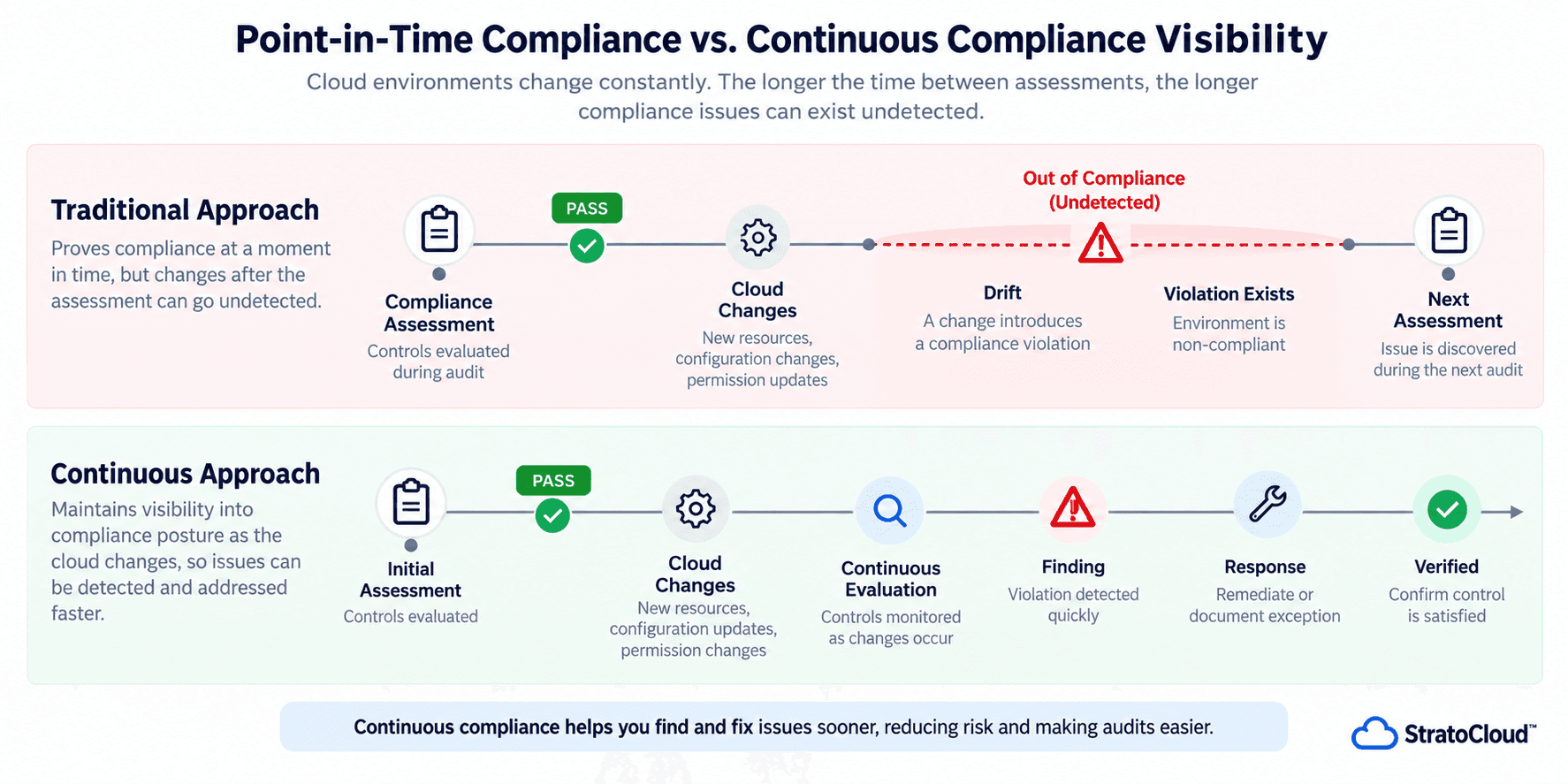
Why Point-in-Time Compliance Is Not Enough
Traditional compliance audits naturally create snapshots.
An auditor reviews evidence, tests controls, examines policies, and determines whether an organization satisfies a set of requirements during a defined assessment period.
That process remains important, but it does not prevent the environment from changing afterward.
Imagine that an organization verifies that its production storage is not publicly accessible.
The control passes.
Three weeks later, an engineer changes a storage policy while troubleshooting and accidentally exposes a resource publicly.
The previous evidence is still accurate. It proves that the environment satisfied the control when it was assessed.
It does not prove that the control is satisfied now.
Cloud compliance monitoring reduces this gap by evaluating posture more frequently and helping organizations identify when changes create new violations.
Compliance Monitoring Starts With Controls
Compliance frameworks describe expected outcomes, but those outcomes do not always translate directly into a single cloud configuration.
Consider a requirement that sensitive information must be protected from unauthorized access.
Depending on the environment, that requirement might map to technical controls involving encryption, storage permissions, IAM policies, network rules, logging, or credential management.
A useful compliance system therefore needs to connect:
Framework Requirement → Organizational Control → Technical Cloud Control → Evaluation
This translation matters because compliance standards describe what an organization must achieve, while cloud platforms expose the technical state that determines whether the requirement is being met.
The same organizational requirement may also require different technical evaluations in AWS, Azure, and Google Cloud.
Cloud Environments Drift
Infrastructure drift is one of the fundamental challenges of maintaining cloud compliance.
Even organizations that rely heavily on Infrastructure as Code experience changes from multiple sources.
Engineers may make emergency modifications. Applications may alter infrastructure through APIs. Cloud services can create supporting resources. Teams may deploy through different pipelines. New AWS accounts, Azure subscriptions, and GCP projects can appear.
A compliant state therefore cannot be assumed to remain compliant.
Suppose an organization's policy requires production databases to use encryption.
At 9:00 AM, every database satisfies the requirement.
At 2:00 PM, a new database is deployed without the required configuration.
The organization's compliance posture has changed even though the underlying requirement has not.
Compliance monitoring helps detect that change.
Continuous Evaluation Helps Detect Compliance Drift
Compliance drift occurs when an environment that previously satisfied a requirement changes and no longer meets it.
Controls that are important enough to monitor persistently can be evaluated as the environment changes.
Examples might include requirements that:
production storage cannot be publicly accessible
databases must use encryption
audit logging must remain enabled
certain network exposure is prohibited
required ownership information must exist
privileged access must follow organizational policy
Continuous evaluation can identify when a change causes one of these requirements to fail rather than waiting for the next broad compliance assessment.
This makes continuous controls particularly useful for requirements the organization already knows it wants to monitor closely.
On-Demand Standards-Based Compliance Assessments
Continuous evaluation is not the only useful model.
Organizations also need to periodically answer a broader question:
How does this environment currently perform against this compliance standard?
An on-demand compliance assessment can evaluate a selected cloud environment against a selected standard and produce a control-level view of its current posture.
The assessment might evaluate dozens or hundreds of requirements depending on the standard and the environment.
The result can identify:
controls that are compliant
controls that are non-compliant
configuration associated with failed controls
severity or importance of findings
recommended corrective actions
This provides a broader standards-based assessment while continuous controls provide ongoing visibility into requirements that need persistent evaluation.
The two approaches complement one another.
Current Cloud State Matters
The usefulness of a compliance assessment depends partly on the state being evaluated.
Cloud infrastructure changes frequently, so there is an important difference between evaluating information collected earlier and inspecting the environment when the assessment occurs.
Historical and synchronized data can be valuable for reporting, trending, and evidence.
Live cloud evaluation serves a different purpose.
When an organization initiates an assessment, querying the current cloud environment can determine how the configuration that exists now compares with the requirements being evaluated.
This is particularly valuable for on-demand assessments where the organization wants a current view of compliance posture.
AI Can Make Compliance Assessments More Actionable
Traditional compliance checks are often deterministic.
A system retrieves a particular configuration value, compares it with an expected state, and returns a pass or fail result.
That model remains useful, especially for controls that map cleanly to cloud configuration.
The challenge often comes after a control fails.
A scanner might correctly report:
Public access is enabled. Disable public access for this resource.
That tells the team the desired outcome, but it may not explain the exact configuration behind the finding or what should change in the affected environment.
An engineer may still need to investigate the resource, understand its dependencies, determine how it is managed, and translate generic remediation guidance into a specific infrastructure change.
AI can help narrow this gap.
An AI-driven assessment can examine the live configuration associated with a control, determine why the observed state does not satisfy the requirement, and produce remediation guidance based on what it found.
The distinction is subtle but important.
Instead of only saying:
This type of configuration is non-compliant and this is how this type of problem is generally fixed.
the assessment can move toward:
This control failed because of the configuration found in this environment, and this is what needs to change to satisfy it.
That makes the finding more actionable without changing the fundamental purpose of compliance monitoring.
Compliance Findings Need Context
A failed control does not exist in isolation.
The same technical finding can have very different significance depending on where it occurs.
A publicly accessible resource in a temporary development environment may carry a different level of risk than the same configuration in a production environment processing sensitive customer information.
Useful compliance monitoring therefore benefits from organizational context such as:
environment
owner
business function
criticality
cloud account, subscription, or project
applicable standard
severity
remediation status
exception status
This helps teams understand not only what failed, but where the finding exists and how urgently it should be addressed.
Multi-Cloud Compliance Requires Consistent Intent
AWS, Azure, and Google Cloud expose different resource models, identity systems, configuration APIs, and organizational hierarchies.
The compliance requirement can still be the same.
Consider:
Production storage must not be publicly accessible.
The organization wants one outcome.
Evaluating that requirement in AWS may require examining different configuration and permissions than evaluating it in Azure or Google Cloud.
Multi-cloud compliance therefore benefits from separating the control objective from its provider-specific implementation.
Common Requirement → Provider-Specific Evaluation → Consistent Compliance Result
Organizations can standardize what they expect without pretending that the underlying clouds work identically.
Organizational Context Should Cross Cloud Boundaries
Cloud-provider hierarchy does not always reflect business structure.
AWS organizes infrastructure using concepts such as accounts and Organizations. Azure uses subscriptions and management groups. Google Cloud uses projects, folders, and organizations.
Businesses think in terms of teams, products, environments, customers, applications, business units, and criticality.
A requirement might need to apply to:
Every production environment owned by the payments organization.
Those environments could span multiple AWS accounts, Azure subscriptions, and GCP projects.
Compliance monitoring becomes more useful when the organizational context determining where a control applies can cross those provider boundaries.
Compliance Includes Identity
Cloud configuration is only one part of compliance posture.
Organizations also need visibility into the identities capable of accessing their environments.
Those identities increasingly include more than employees.
Humans, workloads, service identities, CI/CD systems, automation, and AI agents may all interact with cloud APIs.
Important compliance questions can therefore include:
Who can access this environment?
What permissions do they have?
Are those permissions permanent or temporary?
When was access granted?
Under what authority?
Which identity actually interacted with the cloud?
Can the resulting activity be traced back to the person or workload that initiated it?
An environment with strong configuration controls can still present significant risk if excessive standing privileges or poorly attributable access exists.
Compliance monitoring therefore benefits from combining infrastructure posture with identity visibility.
Identity Chaining Strengthens Auditability
Modern cloud operations frequently involve intermediaries.
An engineer might use an internal platform or AI system that then interacts with the cloud on the engineer's behalf.
A simple architecture can give that intermediary its own cloud identity.
That approach can weaken attribution.
If many users perform operations through the same service identity, cloud audit logs may accurately record what that service did while making it harder to determine which human initiated each operation.
A stronger execution model preserves the initiating identity through the authorization and credential chain.
Conceptually:
User → Authorization → Temporary Credentials → Cloud Activity
The organization can then understand not only what occurred, but who caused it to occur and under whose authority.
This becomes particularly important as AI systems participate in cloud investigation and remediation.
Operational Audit Logs Are Part of Compliance Evidence
Compliance evidence should not exist only when a compliance scan runs.
Normal cloud operations continuously generate useful information.
Engineers access environments. Workloads receive credentials. Automation performs actions. Permissions are exercised. Access expires.
A governed access system can preserve evidence about those events as part of the operational workflow.
That evidence can include:
requesting identity
target environment
authorization decision
permissions granted
credential issuance
cloud activity
access expiration
This creates continuous operational auditability.
Instead of reconstructing access decisions months later from multiple systems, organizations can preserve an identity-aware record as access occurs.
Compliance posture can then include both how an environment is configured and how that environment has been accessed.
Findings Should Lead Toward Resolution
Detecting more compliance findings does not automatically improve compliance.
At scale, organizations can accumulate thousands of technically valid findings that engineering teams do not have enough time to investigate and resolve.
Generic remediation guidance helps, but there is still often a significant gap between:
Here is what is wrong
and
Here is the infrastructure change required to fix it.
More contextual assessment can reduce that gap by carrying information about the actual environment into the remediation process.
This creates a natural progression:
Finding → Understand → Remediate → Verify
Compliance monitoring should not necessarily perform every remediation automatically, but it should make it easier for findings to become actionable engineering work.
Infrastructure as Code Provides a Governed Path to Remediation
When resolving a compliance finding requires an infrastructure change, allowing an automated system to directly modify production is not always desirable.
Infrastructure as Code provides another path.
The required change can be represented as code, validated using development and IaC tooling, reviewed through source control, and deployed using the organization's normal workflow.
For AI-assisted remediation, this creates a particularly useful boundary:
Compliance Finding → Proposed IaC → Validation → Pull Request → Human Review → Deployment → Verification
The AI can help turn a specific compliance problem into a proposed solution without requiring unrestricted production access.
This also creates traceability between the original finding and the infrastructure change intended to resolve it.
Exceptions Need to Be Documented
Not every non-compliant control should necessarily result in a change.
Organizations may have compensating controls, temporary conditions, or legitimate business requirements that justify accepting a finding.
The compliance workflow should represent that decision explicitly.
A finding might therefore end in one of several states:
Compliant
Non-compliant and unresolved
Remediated
Overridden with documented justification
Documenting the reason for an override provides much stronger evidence than simply suppressing or ignoring the finding.
It tells future reviewers that the condition was identified, evaluated, and intentionally accepted.
Remediation Should End With Verification
Making a change does not prove that the compliance issue has been resolved.
The relevant control should be evaluated again.
If the environment now satisfies the requirement, the organization has evidence that the remediation achieved its intended outcome.
If the control still fails, the finding remains open.
This closes the compliance loop:
Assess → Find → Understand → Remediate or Override → Verify
Verification turns remediation from an assumption into an observable result.
Continuous Governance and Compliance Monitoring Work Together
Continuous Governance and compliance monitoring overlap, but they are not the same thing.
Continuous Governance provides a broader mechanism for expressing organizational requirements and continuously evaluating environments against them.
Some governance controls may come directly from compliance obligations.
Others may reflect internal engineering, security, cost, ownership, or architectural standards.
Compliance monitoring can use Continuous Governance to maintain visibility into important requirements between broader standards-based assessments.
This creates two complementary mechanisms:
On-demand compliance assessment provides a broad evaluation of a selected environment against a selected standard.
Continuous Governance persistently evaluates important controls as the environment changes.
Together, they help organizations understand both their broader compliance posture and whether critical requirements continue to hold over time.
What Should Cloud Compliance Monitoring Include?
A mature cloud compliance approach should provide more than a list of failed configuration checks.
Important capabilities include:
Standards-based assessment: Evaluate environments against recognized or organizational compliance requirements.
Current-state evaluation: Assess the cloud configuration relevant to the controls being tested.
Continuous control evaluation: Monitor important requirements for drift between broader assessments.
Multi-cloud support: Maintain consistent control objectives across AWS, Azure, and Google Cloud while respecting provider-specific implementation.
Organizational context: Understand environment, ownership, business function, and criticality.
Actionable findings: Explain why a control failed and provide enough context to understand what needs to change.
Identity visibility: Understand the humans and non-human identities capable of accessing cloud environments.
Identity-aware auditability: Preserve who initiated access and under whose authority cloud activity occurred.
Governed remediation: Provide a safe path from findings to infrastructure changes.
Documented exceptions: Preserve explanations when findings are intentionally accepted.
Verification: Re-evaluate controls after remediation.
Evidence and reporting: Bring the results together into a useful record of compliance posture.
How Strato Cloud Approaches Cloud Compliance Monitoring
Strato Cloud combines AI-driven standards-based compliance assessment with Continuous Governance, identity visibility, Secure Execution, and Intelligent Remediation.
The goal is to provide a broader view of compliance posture while shortening the operational distance between identifying a failed control and resolving it.
AI-Driven Compliance Scanning Against Live Cloud
A Strato Cloud compliance assessment begins with two selections:
the environment and the compliance standard.
Strato Cloud's AI then begins evaluating the live cloud environment against the requirements of that standard.
The AI inspects the cloud configuration needed to evaluate the controls without requiring an engineer to manually investigate each requirement.
The resulting assessment identifies which controls are compliant and which are non-compliant.
For failed controls, Strato Cloud also provides instructions explaining what needs to be corrected.
Because the AI has evaluated the actual live environment behind the finding, those instructions can be based on the configuration it observed rather than simply providing generic documentation about that class of control.
This helps reduce the gap between detecting a compliance issue and understanding how to resolve it.
From Finding to Fix with AI
When a finding requires an infrastructure change, the user can move it into Strato Cloud's Intelligent Remediation workflow through Fix with AI.
The context discovered during the compliance assessment can feed directly into the remediation process.
Strato Cloud's AI can generate the proposed Infrastructure as Code inside an isolated execution environment, run appropriate IaC validation and development tooling, and iterate on the proposed solution.
The resulting change can be committed to an explicitly authorized GitHub repository and delivered as a pull request.
Human reviewers remain in control of whether the proposed infrastructure change is approved and deployed through the organization's normal workflow.
This creates a governed path from:
Compliance Finding → Environment-Specific Guidance → Fix with AI → Validated IaC → Pull Request
without requiring the AI to receive unrestricted production access.
Documented Overrides
Not every finding needs to be remediated.
If the organization has a legitimate reason to accept a failed control, Strato Cloud allows the finding to be overridden with an explanation.
That explanation becomes part of the compliance record.
The assessment can therefore distinguish between controls that passed, unresolved failures, findings that were remediated, and findings that were intentionally accepted with documented justification.
Continuous Governance Between Assessments
An on-demand compliance scan evaluates an environment against a selected standard when the assessment runs.
Strato Cloud's Continuous Governance capabilities provide ongoing coverage between those assessments.
Organizations can define important requirements and continuously evaluate cloud environments for changes that cause those controls to fail.
Strato Cloud namespaces and cloud-agnostic labels provide organizational context across AWS accounts, Azure subscriptions, and GCP projects. Controls can therefore follow concepts such as environment, ownership, business function, and criticality without depending entirely on provider-specific hierarchy.
Compliance scanning and Continuous Governance remain separate but complementary capabilities.
The compliance scan provides the standards-based assessment.
Continuous Governance provides persistent evaluation of the controls the organization wants to continuously monitor.
Identity Visibility and Secure Execution
Strato Cloud also synchronizes cloud identities and provides visibility into the identities associated with cloud environments.
Secure Execution governs how authorized access is exercised.
Instead of relying on unnecessary standing privileges and permanent credentials, access can use temporary, just-in-time credentials tied to the authorized identity.
Strato Cloud also preserves identity through intermediaries.
When an authorized user initiates an AI-assisted cloud operation, the system does not need to collapse the activity of many users into one generic AI cloud identity. Secure Execution can obtain temporary credentials on behalf of the authorized user, preserving the relationship between the initiating identity and the resulting cloud activity.
Conceptually:
User → Authorization → JIT Credentials → Cloud Activity
This strengthens both access security and audit attribution.
Continuous Operational Auditability
Secure Execution continuously generates audit events as normal cloud access occurs.
These events provide a second source of compliance evidence beyond the configuration assessment itself.
When Strato Cloud generates the final compliance report, it can bring together the environment's compliance posture with recent Secure Execution access audit events for that environment.
The report can therefore show the results of the standards-based assessment, how findings were handled, and recent governed access activity associated with the environment.
This provides context around both configuration posture and operational access.
Bringing the Compliance Lifecycle Together
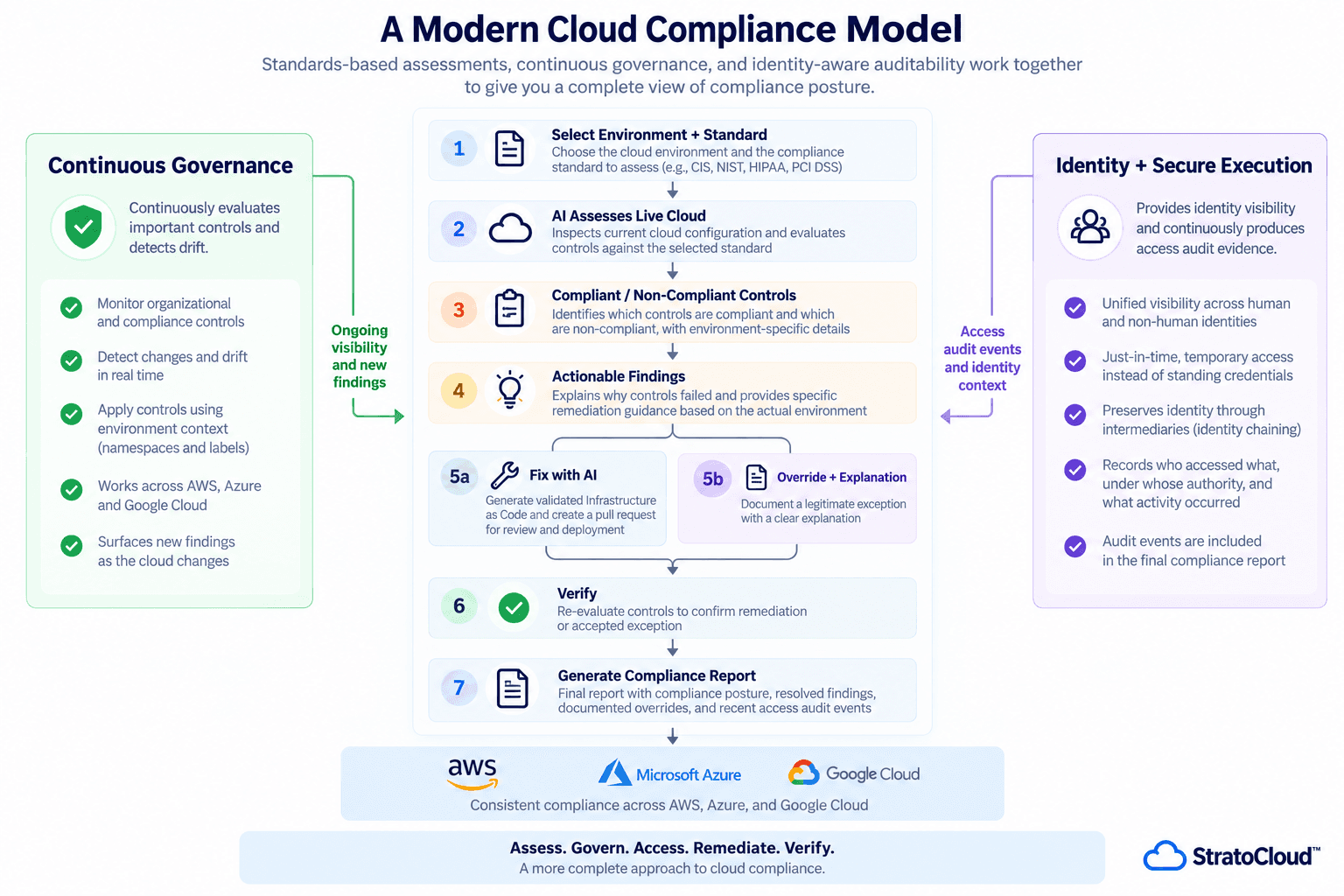
The core Strato Cloud compliance workflow is:
Select Environment + Standard → AI Evaluates Live Cloud → Compliant and Non-Compliant Controls → Environment-Specific Remediation Guidance → Fix with AI or Override → Verify → Final Report
Around that workflow, Continuous Governance provides ongoing evaluation of important controls while Secure Execution and identity visibility provide continuous evidence about how cloud environments are accessed.
Together, these capabilities connect compliance assessment with the broader operational lifecycle of the cloud.
Instead of treating compliance as a periodic scanner that produces findings for someone else to investigate, the model connects standards, current cloud state, actionable findings, governance, identities, audit evidence, remediation, exceptions, and verification.
Frequently Asked Questions
What is cloud compliance monitoring?
Cloud compliance monitoring is the ongoing process of evaluating cloud environments against security, regulatory, and organizational requirements as those environments change.
What is compliance drift?
Compliance drift occurs when an environment that previously satisfied a control changes and no longer meets the requirement.
What is the difference between a compliance scan and Continuous Governance?
A compliance scan can provide a broad assessment of an environment against a selected standard. Continuous Governance persistently evaluates important organizational controls as the environment changes.
Why is current cloud state important for compliance?
Cloud infrastructure changes frequently. Evaluating current state helps determine whether an environment satisfies a control when the assessment occurs rather than relying only on previously collected information.
How can AI improve cloud compliance monitoring?
AI can help evaluate cloud configuration in the context of a compliance control, explain why a control failed, and provide remediation guidance based on the affected environment.
Why is generic remediation guidance sometimes insufficient?
Generic guidance explains the desired compliant state but may leave engineers to determine the exact infrastructure change required in their environment. More contextual guidance can shorten that investigation.
Can AI remediate compliance findings?
AI can help generate proposed remediation, but sensitive infrastructure changes should remain governed. One approach is to generate and validate Infrastructure as Code and submit the proposed change through a pull request for human review.
Can compliance findings be overridden?
Yes. Organizations may have legitimate exceptions or compensating controls. Documenting the explanation for an accepted finding creates a stronger compliance record than simply suppressing it.
Why is identity visibility important for compliance?
Compliance includes understanding who or what can access cloud environments, what permissions they have, and how those permissions are exercised. Configuration posture alone does not provide a complete view.
Why does identity chaining matter?
When systems act on behalf of users, preserving the initiating identity makes it possible to understand who caused cloud activity and under whose authority it occurred.
Does cloud compliance monitoring replace formal audits?
No. Formal audits may still be required for regulatory, certification, contractual, or customer requirements. Continuous compliance practices can help organizations maintain stronger controls and produce better evidence between audits.