Published:
Estimated reading time:
7–9 minutes

Cloud providers give organizations many ways to organize infrastructure. AWS has accounts and Organizations. Azure has subscriptions and management groups. Google Cloud has projects, folders, and organizations.
Each model works well within its own ecosystem.
The challenge appears when an enterprise operates across several of them.
A cybersecurity team might operate infrastructure in an AWS account, an Azure subscription, and a Google Cloud project. From the organization's perspective, all three environments belong to the same team and may serve the same business function. From the cloud providers' perspectives, however, they live inside three completely different organizational models.
Cloud-agnostic labeling creates a consistent layer of organizational context across those environments regardless of which cloud provider they belong to.
Instead of forcing the organization to describe itself using the structure of AWS, Azure, or Google Cloud, teams can organize cloud environments using concepts that make sense to the business.
What Is Cloud-Agnostic Labeling?
Cloud-agnostic labeling is the practice of applying consistent organizational metadata to cloud environments without tying that metadata to the organizational model of a particular cloud provider.
For example, an organization might describe cloud environments using attributes such as:
Owner
Business unit
Environment
Application
Criticality
Cost center
Data classification
Geographic region
Compliance scope
The important part is not the individual labels.
It is that the same organizational language can be used across different cloud providers.
A production cybersecurity environment should still be identifiable as production and cybersecurity whether it exists inside an AWS account, Azure subscription, or Google Cloud project.
This creates a common organizational context above the provider-specific infrastructure.
Cloud Providers Organize Infrastructure Differently
AWS, Azure, and Google Cloud each have their own hierarchy for organizing infrastructure.
AWS commonly organizes resources around accounts within AWS Organizations. Azure uses subscriptions, management groups, and resource groups. Google Cloud uses organizations, folders, and projects.
These models were designed independently, so they do not map perfectly to one another.
An AWS account is not exactly the same thing as an Azure subscription. An Azure management group is not exactly the same thing as a Google Cloud folder. Identity and policy inheritance also work differently across providers.
Trying to force these structures into a perfect one-to-one mapping can create unnecessary complexity.
A cloud-agnostic approach takes a different path.
Instead of asking:
How do we make the AWS hierarchy look like the Azure hierarchy?
It asks:
How does our organization want to group and describe these environments?
That is a much more useful question.
Organize the Cloud Around the Business
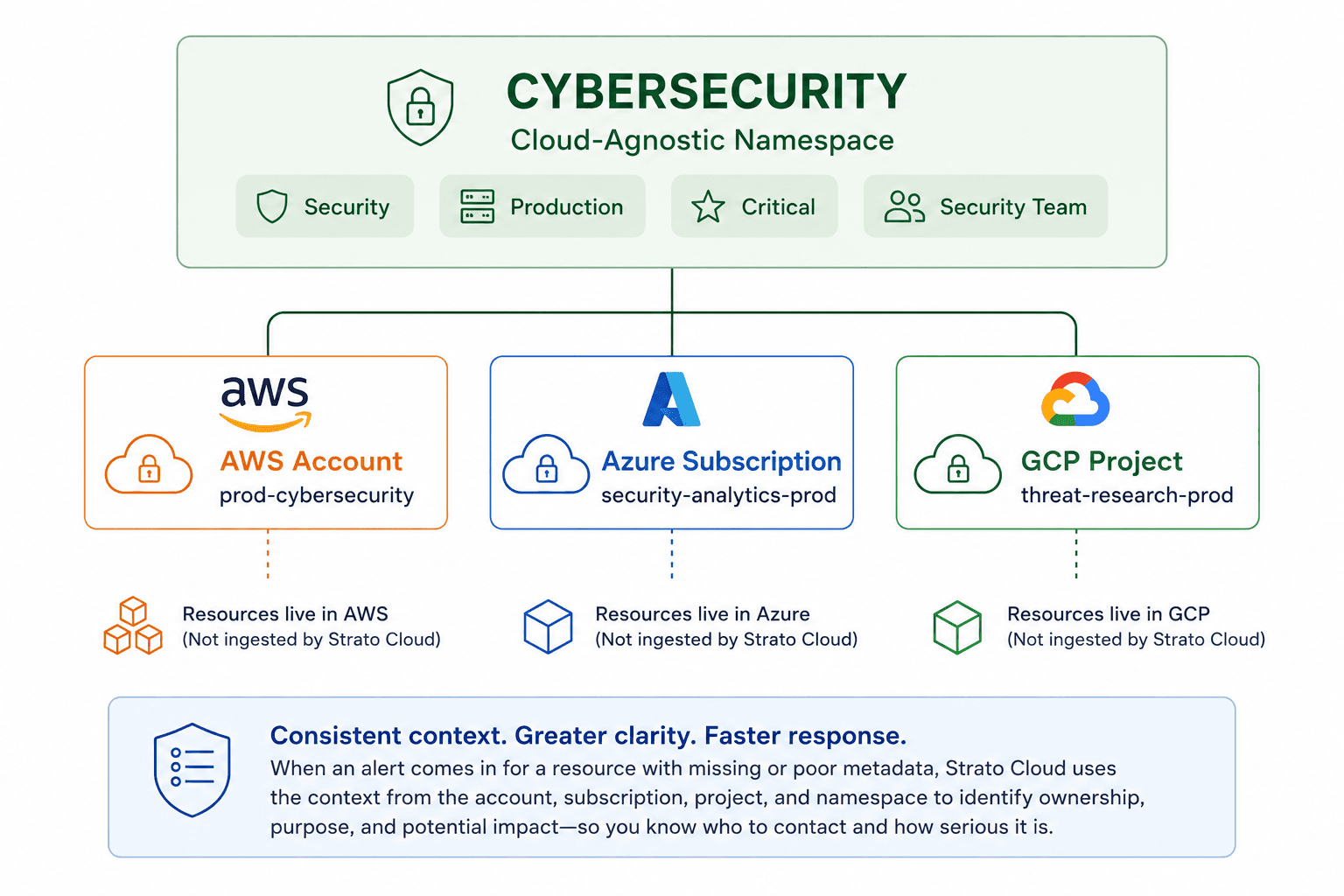
Consider a cybersecurity organization operating across all three major cloud providers.
It might have:
An AWS account running production security services
An Azure subscription running security analytics
A Google Cloud project used for threat research
The cloud providers see three different containers inside three different organizational systems.
The company sees Cybersecurity.
A cloud-agnostic organizational layer allows the company to preserve that business context without changing how the underlying providers work.
Conceptually, the organization might create:
Cybersecurity
and associate the relevant AWS accounts, Azure subscriptions, and Google Cloud projects with it.
The cloud infrastructure remains where it is. The organization simply gains a consistent way to understand how those environments relate to the business.
Namespaces Create a Cloud-Agnostic Organizational Layer
One way to implement this model is through namespaces.
A namespace is a logical grouping that exists independently of the hierarchy of any individual cloud provider.
For example, an organization could create namespaces such as:
Cybersecurity
Payments
Data & Analytics
Customer Platform
Internal IT
Research & Development
The Cybersecurity namespace could contain AWS accounts, Azure subscriptions, and Google Cloud projects.
The Payments namespace could do the same.
This means the organization's cloud structure can reflect how the company actually operates rather than how a particular cloud provider requires infrastructure to be organized.
Labels can then add additional context to the namespace itself.
For example:
Namespace: Cybersecurity
Owner: Security Engineering
Business Function: Cybersecurity
Criticality: Critical
Data Classification: Restricted
Individual accounts, subscriptions, and projects within that namespace can also carry their own labels.
This creates multiple levels of useful context.
Labels Can Exist at Multiple Levels
A cloud-agnostic labeling model becomes more useful when context can exist at the appropriate organizational level.
Consider this structure:
Namespace: Cybersecurity
Owner: Security Engineering
Criticality: Critical
Inside it:
AWS Account: Production Security
Environment: Production
Owner: Security Operations
Criticality: Critical
Azure Subscription: Security Analytics
Environment: Production
Owner: Detection Engineering
GCP Project: Threat Research
Environment: Research
Owner: Threat Intelligence
The namespace provides broad organizational context.
The individual cloud container provides more specific context.
Together, they allow teams to understand where an environment fits into the organization without requiring every piece of metadata to exist on every individual cloud resource.
What Happens When Resource Tags Are Missing?
This is where higher-level context becomes especially valuable.
Imagine it is 5:00 AM and the security operations team receives an alert.
An EC2 instance is exhibiting suspicious network behavior.
The alert identifies the instance:
i-07a94...
Unfortunately, the instance has poor metadata. Its tags do not identify an owner, application, business unit, or useful description.
This is a common operational problem.
The responder now needs to answer several questions quickly:
Who owns this?
Is it production?
What part of the company does it belong to?
How critical is the environment?
Who should be contacted?
What could be affected if the problem spreads?
Even if the resource itself provides almost no useful organizational information, one piece of context is usually available:
the cloud account containing the resource.
That can be enough to begin reconstructing the organizational context.
Following the Context Upward
Suppose the EC2 instance belongs to:
AWS Account: prod-cybersecurity
That account has cloud-agnostic metadata identifying:
Owner: Security Engineering
Environment: Production
Criticality: Critical
Business Function: Cybersecurity
The account also belongs to:
Namespace: Cybersecurity Production
The responder now has substantially more information than the EC2 instance itself provided.
They know which organization is responsible for the environment, who should be contacted, and that the affected infrastructure belongs to a critical production cybersecurity environment.
That information can dramatically change the response.
Now consider an identical alert involving an instance in:
AWS Account: dev-product-management
with:
Owner: Product Engineering
Environment: Development
Criticality: Low
Business Function: Product Management
The technical alert might initially look almost identical.
The organizational context is completely different.
One could indicate a potentially serious incident involving production security infrastructure. The other might involve an isolated development environment with a much smaller potential impact.
Cloud-agnostic context helps responders understand that difference quickly.
Context Helps Estimate Potential Impact
Technical severity alone does not always tell teams how important an event is.
A configuration problem on a development environment may be less urgent than the same configuration problem on infrastructure supporting a critical production system.
This is why concepts such as ownership, environment, business function, and criticality matter.
They help teams understand the potential blast radius of an issue.
Cloud-agnostic labels can provide this context without requiring every individual resource to contain perfect metadata.
The resource tells you where the problem occurred.
The account, subscription, or project tells you which cloud environment it belongs to.
The namespace helps tell you where that environment fits within the organization.
Together, those layers can turn an anonymous cloud resource into something operationally meaningful.
Cloud-Agnostic Labels Are Different From Resource Tags
Cloud-agnostic labels should not be confused with provider-native resource tags.
AWS tags, Azure tags, and Google Cloud labels remain useful mechanisms for attaching metadata to infrastructure within each provider.
Teams may use them to identify applications, environments, owners, cost centers, or automation requirements.
Cloud-agnostic labels solve a different problem.
They create consistent organizational context across cloud providers at higher levels of the cloud environment.
This distinction matters.
An organization does not necessarily need to copy every AWS resource tag into another system, convert it into a universal format, and maintain a duplicate inventory of every resource just to understand that an AWS account belongs to the Payments team.
Sometimes the account itself provides the right level of organizational context.
Why Not Just Standardize Cloud Tags?
Organizations have been trying to standardize cloud tagging for years.
A typical enterprise tagging policy might require fields such as:
owner
environment
application
cost-center
data-classification
The policy itself is usually reasonable.
The challenge is implementation.
Resources may be created by different teams, automation systems, Infrastructure as Code, Kubernetes controllers, managed services, or third-party tools. Some services support tags differently. Some resources are temporary. Some teams follow tagging standards carefully while others do not.
Over time, resource-level metadata often becomes inconsistent.
Higher-level cloud context does not eliminate the need for good tagging practices.
It provides another layer of information when those practices are incomplete.
If an untagged resource exists inside a clearly identified production Payments account, the organization still knows something important about it.
Cloud Identities Need Organizational Context Too
Infrastructure containers are not the only cloud objects that benefit from consistent organizational metadata.
Cloud identities also need context.
Large organizations may have thousands of users, roles, service accounts, workload identities, and other principals across multiple providers.
Knowing that an identity exists is useful.
Knowing what that identity represents is much more useful.
Cloud-agnostic labels can help describe identities using concepts such as:
Team
Application
Identity type
Environment
Business function
Criticality
Automation purpose
This becomes increasingly important as machine identities and AI agents take on larger roles in cloud operations.
A cryptic service account name tells an operator very little. Organizational context can help explain what the identity belongs to, what purpose it serves, and how important it is.
Labels Become More Powerful When Used for Governance
Labels are not only useful for search and organization.
Once organizational context exists, it can become an input into governance.
Instead of writing every policy around provider-specific account IDs or subscription identifiers, organizations can begin expressing intent using concepts that make sense to the business.
For example:
Production environments require stronger access controls.
Or:
Critical cybersecurity environments require additional approval before privileged access is granted.
Or:
Identities associated with development environments should not receive access to production environments by default.
The labels provide context that governance systems can use when evaluating what should happen.
This is one reason cloud-agnostic metadata becomes especially valuable when combined with dynamic access controls and automation.
Cloud-Agnostic Does Not Mean Cloud-Abstraction
There is an important distinction between creating cloud-agnostic organizational context and pretending every cloud provider is identical.
AWS, Azure, and Google Cloud are different platforms.
They have different services, identity systems, APIs, policy models, and architecture.
Those differences matter.
A useful cloud-agnostic layer should not hide them when they are relevant.
Instead, it should provide a common organizational language above those differences.
The organization can describe an environment as:
Production + Payments + Critical
without pretending that the AWS account and Azure subscription underneath it work the same way.
Cloud-specific details remain cloud-specific.
Organizational context becomes consistent.
Building a Cloud-Agnostic Labeling Strategy
A useful labeling strategy should start with the questions the organization needs to answer rather than with a giant list of possible metadata fields.
Common questions include:
Who owns this environment?
Is it production or development?
Which business function does it support?
How critical is it?
What type of data might it contain?
Which compliance requirements apply?
Who should be contacted if something goes wrong?
Which environments belong together?
From those questions, organizations can define a relatively small set of meaningful labels.
A good labeling model should also distinguish between metadata that belongs at the namespace level and metadata that belongs directly on an account, subscription, project, or identity.
Not every label needs to exist everywhere.
The objective is not to create more metadata.
The objective is to create useful context.
Frequently Asked Questions
What is cloud-agnostic labeling?
Cloud-agnostic labeling is a way of describing cloud environments using organizational metadata that remains consistent regardless of whether the underlying environment exists in AWS, Azure, Google Cloud, or another provider.
Are cloud-agnostic labels the same as AWS or Azure tags?
No. Provider-native tags attach metadata to objects within a particular cloud provider. Cloud-agnostic labels create a consistent organizational language that can span multiple providers.
What is a cloud namespace?
A cloud namespace is a logical grouping of cloud environments based on how an organization wants to organize them rather than according to the hierarchy of a particular cloud provider. A namespace might group AWS accounts, Azure subscriptions, and Google Cloud projects belonging to the same team, application, or business function.
Can cloud-agnostic labels replace resource tags?
No. Resource tags remain useful for resource-level metadata, automation, cost allocation, and many provider-specific workflows. Cloud-agnostic labels provide higher-level organizational context and can remain useful even when individual resource tags are missing or inconsistent.
Why are cloud-agnostic labels useful for incident response?
An alert may identify a cloud resource that has little or no useful metadata. If responders can determine the account, subscription, or project containing the resource, higher-level labels can help identify ownership, environment, criticality, business function, and the appropriate team to contact.
Can cloud identities have cloud-agnostic labels?
Yes. Applying consistent organizational metadata to cloud identities can help teams understand what identities represent, who owns them, what environments they belong to, and how they should be governed.
Key Takeaways
Cloud providers organize infrastructure differently, but businesses should not have to organize themselves around those differences.
Cloud-agnostic labeling creates a consistent organizational language across AWS accounts, Azure subscriptions, Google Cloud projects, cloud identities, and logical groupings such as namespaces.
This context becomes particularly valuable when individual cloud resources have poor or missing metadata.
A 5:00 AM alert for an anonymous EC2 instance may provide very little information about the resource itself. Knowing that the instance belongs to a critical production cybersecurity account inside the Cybersecurity namespace can immediately tell responders much more about ownership, urgency, and potential impact.
Cloud-agnostic labels do not eliminate provider-native resource tags.
They provide something different: a durable organizational context layer above the individual cloud providers.
Related Reading
Cloud Resource Ownership: Why It Matters (coming soon)
Cross-Cloud Identity Management (coming soon)
How Strato Cloud Helps
Strato Cloud creates a cloud-agnostic organizational layer across the parts of the cloud environment it manages.
Organizations can apply cloud-agnostic labels to AWS accounts, Azure subscriptions, Google Cloud projects, and cloud identities.
Strato Cloud also provides namespaces, allowing organizations to group accounts, subscriptions, and projects according to structures that make sense to the business rather than being limited by the hierarchy of a particular cloud provider.
A namespace might represent Cybersecurity, Payments, Data & Analytics, a particular application, or another organizational boundary. Labels can be applied to the namespace itself as well as directly to the accounts, subscriptions, and projects it contains.
Importantly, Strato Cloud does not require organizations to ingest every individual cloud resource into a traditional asset inventory or attach Strato Cloud labels to those resources.
Instead, Strato Cloud preserves organizational context at the higher-level cloud containers and identities it understands.
If an alert identifies an EC2 instance with no useful ownership metadata, teams can use its AWS account to understand the broader context. Strato Cloud can show information associated with that account and its namespace, helping identify who owns the environment, what it is used for, and how significant the potential impact may be.
That allows organizations to answer a critical operational question even when the individual resource cannot:
Where does this belong, who is responsible for it, and how much should we care?