Published:
Estimated reading time:
8–10 minutes

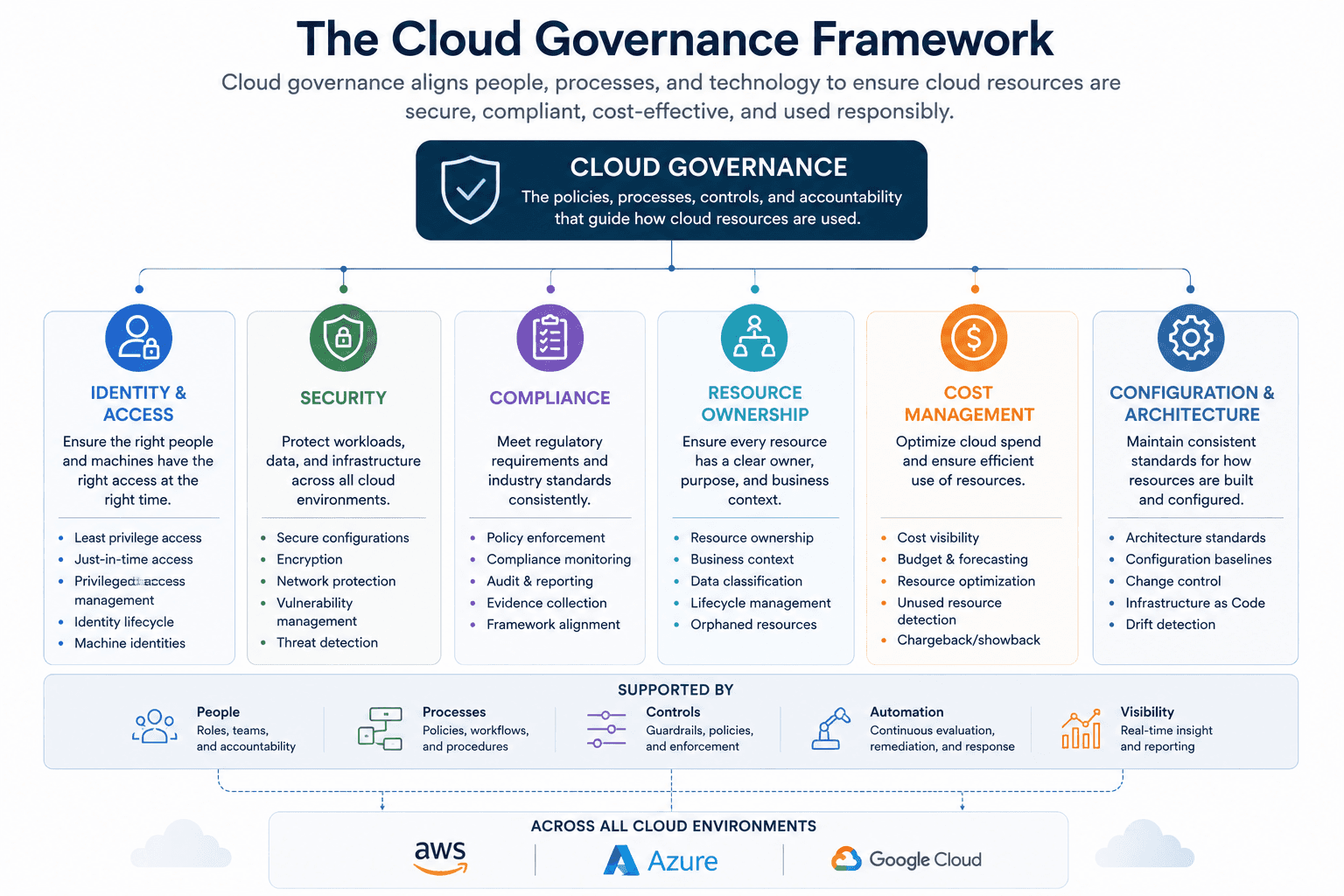
Cloud governance is the framework of policies, processes, controls, and responsibilities an organization uses to manage how cloud resources are created, accessed, configured, secured, and maintained.
As organizations expand their use of cloud services, individual teams can create infrastructure faster than traditional IT processes can govern it. That flexibility is one of the cloud's greatest strengths, but it can also lead to inconsistent security, unclear ownership, unnecessary costs, and compliance gaps.
Effective cloud governance creates guardrails that allow teams to move quickly while keeping cloud environments secure, compliant, visible, and manageable.
The goal is not to slow engineers down.
Good cloud governance makes the safe path the easy path.
Why Cloud Governance Matters
Traditional infrastructure was relatively centralized. Servers were purchased, networks were provisioned, and changes often passed through dedicated IT teams.
Cloud computing changed that model.
An engineer can create a database, expose an API, deploy a Kubernetes cluster, or provision hundreds of virtual machines in minutes. Infrastructure can also be created automatically through CI/CD pipelines, Infrastructure as Code, managed services, and increasingly AI agents.
That speed creates enormous opportunities, but it also changes how organizations must think about control.
Without effective governance, cloud environments can gradually accumulate:
Excessive permissions
Publicly exposed resources
Inconsistent configurations
Missing ownership information
Unused infrastructure
Uncontrolled costs
Compliance violations
Long-lived credentials
Resources created outside approved processes
Cloud governance provides the rules and systems needed to prevent these problems without eliminating the flexibility that makes cloud computing valuable.
Cloud Governance Is More Than Security
Cloud governance and cloud security overlap, but they are not the same thing.
Security focuses primarily on protecting systems, identities, applications, and data from unauthorized access or attack.
Governance is broader. It defines how the entire cloud environment should operate.
A governance framework might define rules such as:
Production databases must use encryption.
Internet-facing resources require additional review.
Every resource must have a known owner.
Administrative access must be temporary.
Development resources should not run indefinitely when unused.
Infrastructure must be deployed through approved automation.
Resources containing sensitive data must meet specific compliance requirements.
Security is therefore one component of cloud governance rather than the entire discipline.
The Core Areas of Cloud Governance
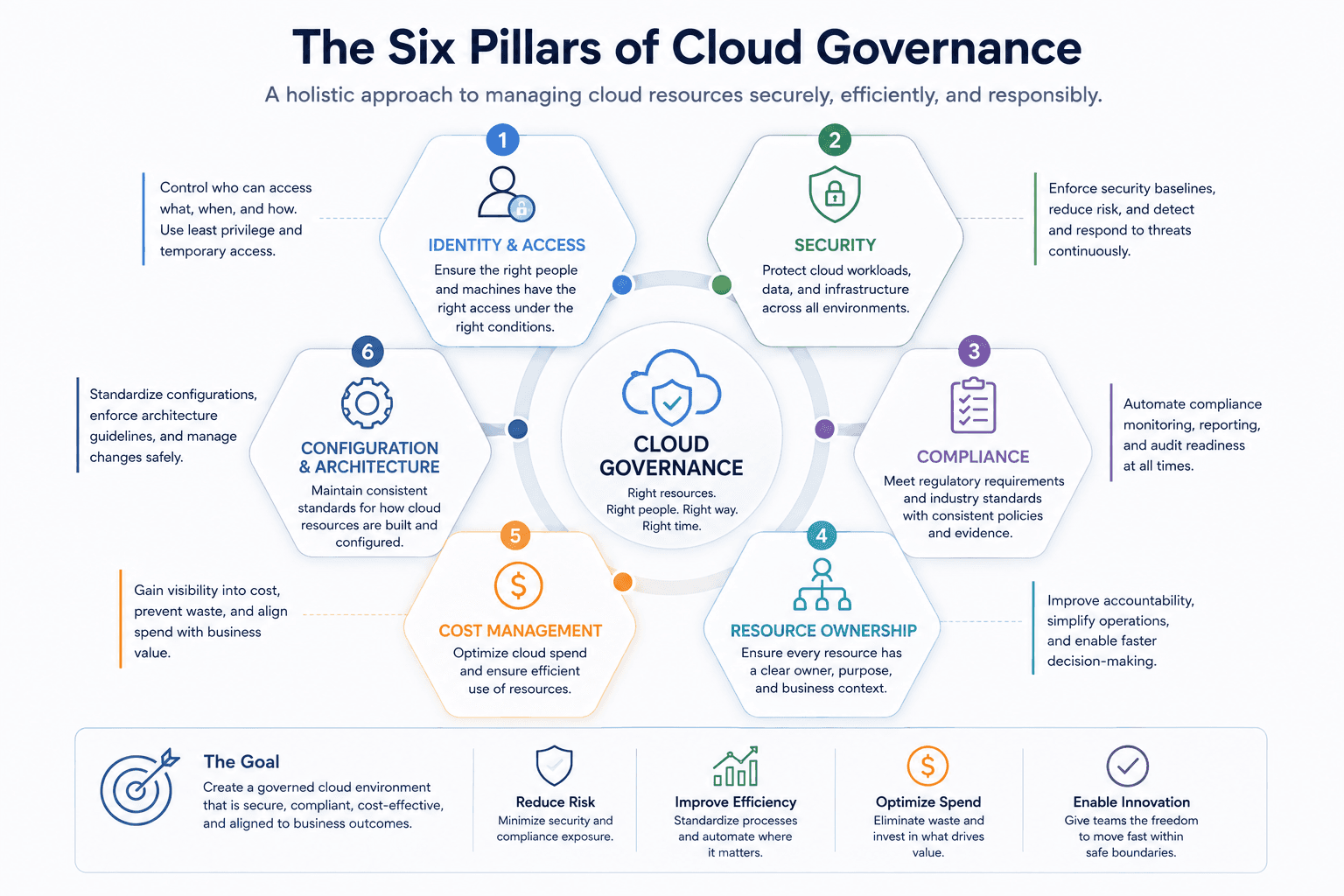
A mature governance program typically spans several areas of cloud operations.
Identity and Access
Identity governance determines who or what can access cloud resources and under what conditions.
This includes human users, service accounts, applications, workloads, automation systems, and AI agents.
Organizations need policies for privileged access, least privilege, temporary credentials, identity lifecycle management, and machine identities.
The goal is to ensure that access exists only when it is needed and only for the resources required.
Security
Security governance establishes minimum security requirements across cloud environments.
These requirements might cover encryption, network exposure, vulnerability management, logging, secrets, and resource configuration.
Rather than relying entirely on engineers to remember every security requirement, mature organizations increasingly enforce these controls automatically.
Compliance
Organizations operating under frameworks such as SOC 2, ISO 27001, PCI DSS, HIPAA, NIST, or FedRAMP need evidence that required controls are consistently applied.
Cloud governance turns those requirements into policies that can be monitored and enforced continuously.
This changes compliance from a periodic audit exercise into an ongoing operational process.
Resource Ownership
Every cloud resource should have an identifiable owner and business purpose.
That sounds simple, but ownership becomes difficult at scale. Resources may be created through automation, inherited through acquisitions, or remain long after the team that created them has moved on.
Clear ownership makes it easier to investigate security incidents, control costs, enforce policies, and determine whether resources are still necessary.
Cost Management
Cloud governance also establishes rules for how infrastructure spending is managed.
Policies may address resource sizing, approved services, budgets, unused resources, development environments, and cost allocation.
FinOps teams often work closely with cloud governance teams because resource ownership and visibility are essential for understanding cloud spending.
Configuration and Architecture
Organizations may define architectural standards for how cloud resources should be configured.
For example, a company might require production databases to use encryption, backups, private networking, and specific availability configurations.
Governance ensures those standards are consistently applied rather than treated as recommendations.
Policies, Guardrails, and Controls
Three terms appear frequently in cloud governance discussions: policies, guardrails, and controls.
A policy defines what should or should not happen.
For example:
Production storage must not be publicly accessible.
A control is the mechanism used to enforce or verify that policy.
For example, an automated system could continuously inspect storage resources and identify any production bucket that allows public access.
A guardrail helps prevent teams from violating policies in the first place.
For example, an Infrastructure as Code pipeline could reject a deployment that attempts to create a publicly accessible production bucket.
The most effective governance programs use all three.
Policies establish expectations. Controls verify them. Guardrails help engineers stay within them.
Preventive vs. Detective Governance
Cloud governance controls generally fall into two categories.
Preventive Controls
Preventive controls stop unwanted actions before they happen.
Examples include:
Blocking public storage
Rejecting noncompliant Infrastructure as Code
Preventing deployment into restricted regions
Requiring approved encryption settings
Restricting privileged access
Preventive controls can significantly reduce risk, but they must be designed carefully. Controls that are too restrictive can slow engineering teams or encourage people to find ways around them.
Detective Controls
Detective controls identify problems after a resource or configuration already exists.
Examples include:
Detecting public resources
Identifying unused infrastructure
Finding excessive permissions
Detecting missing ownership labels
Identifying configuration drift
Detective controls provide more flexibility but require effective remediation processes.
Most mature cloud governance programs use a combination of preventive and detective controls.
Cloud Governance in a Multi-Cloud Environment
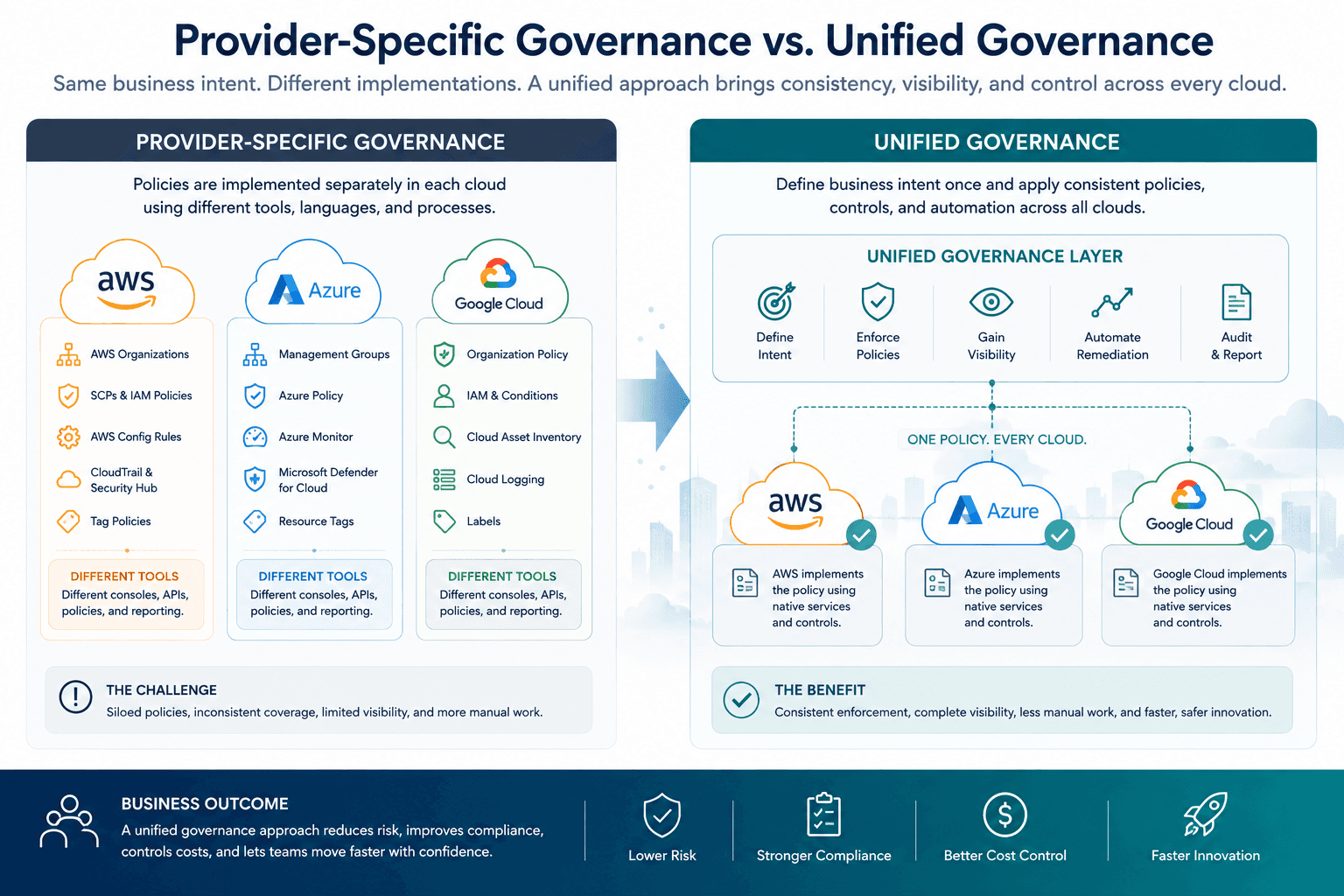
Governance becomes significantly more difficult when an organization operates across AWS, Azure, and Google Cloud.
Each provider has its own:
Identity model
Policy engine
Resource hierarchy
Tagging system
Security services
APIs
Configuration model
Compliance tooling
A policy that is straightforward to enforce in AWS may require a completely different implementation in Azure or Google Cloud.
This can result in separate governance programs for each provider.
The organization may have one set of policies implemented through AWS Organizations, another through Azure Policy, and another through Google Cloud Organization Policy.
The underlying business requirement may be identical, but the implementation is different.
Governance Should Focus on Intent
One of the most useful ways to think about modern cloud governance is to separate business intent from provider implementation.
Consider this requirement:
Production databases must be encrypted.
That is the organization's intent.
AWS, Azure, and Google Cloud may each require different services, APIs, and configuration checks to enforce it.
The governance policy should describe the desired outcome rather than forcing teams to think about every provider-specific implementation.
This becomes increasingly important as organizations operate across multiple clouds.
Governance as Code
Traditional governance often relied on documentation, approval processes, and manual reviews.
Modern cloud environments move too quickly for that approach to scale.
Governance as Code treats governance policies as software. Policies can be versioned, reviewed, tested, deployed, and monitored through automated systems.
For example, a governance rule might define that:
Production resources require an owner.
Databases must use encryption.
Administrative access must expire.
Public resources require an approved exception.
When these rules are machine-readable, organizations can evaluate thousands or millions of resources continuously.
Governance becomes part of the cloud operating model rather than a separate manual process.
Continuous Governance
Cloud environments never stop changing.
Resources are created and deleted. Permissions change. Applications are deployed. New accounts and subscriptions appear. Teams reorganize. Infrastructure drifts from its original configuration.
A compliance scan performed once a quarter provides only a snapshot.
Continuous governance evaluates the environment as it changes.
A modern governance system should be able to:
Detect changes
Evaluate policies
Identify violations
Determine ownership
Notify responsible teams
Trigger remediation
Maintain an audit trail
This allows governance to operate at cloud speed.
Governance Without Slowing Developers Down
One of the biggest concerns engineering teams have about governance is that it will create more approvals, tickets, and manual processes.
Poor governance can absolutely create those problems.
Good governance should do the opposite.
Instead of requiring engineers to understand hundreds of security and compliance rules, organizations can embed those requirements directly into platforms and workflows.
An engineer should be able to deploy infrastructure through an approved process and know that the platform automatically applies the necessary policies.
When exceptions are required, they should follow a clear and auditable process.
The goal is not more control for the sake of control. The goal is to create safe autonomy.
Teams should be able to move quickly within clearly defined boundaries.
A Real-World Example
Imagine a global company operating hundreds of cloud accounts, subscriptions, and projects across AWS, Azure, and Google Cloud.
Thousands of resources are created every day through engineering teams, CI/CD pipelines, Terraform deployments, managed services, and automation.
The security team wants to enforce a simple requirement:
Every production resource must have a known owner.
Without governance, the company might rely on engineers to manually apply tags. Over time, tags become inconsistent, teams use different naming conventions, and resources lose their connection to the people or applications responsible for them.
A governance system can instead continuously evaluate resources, associate them with organizational context, detect missing ownership information, and trigger remediation.
The policy stays simple.
The system handles the complexity.
Common Cloud Governance Mistakes
Organizations often struggle with governance because they approach it as a collection of restrictions rather than an operating model.
Common mistakes include:
Creating too many policies too quickly
Relying heavily on manual approvals
Treating every cloud provider separately
Focusing only on security
Ignoring resource ownership
Creating controls without remediation workflows
Building policies that engineers cannot understand
Measuring compliance only during audits
Successful governance programs start with clear business outcomes and automate enforcement wherever possible.
How to Build a Cloud Governance Strategy
A cloud governance program does not need hundreds of policies on day one.
Start with the questions that matter most to your organization.
1. Establish Ownership
Define who owns cloud resources, policies, security controls, and governance decisions.
2. Define Your Most Important Policies
Focus first on high-impact requirements such as privileged access, public exposure, encryption, ownership, approved regions, and sensitive data.
3. Make Policies Machine-Readable
Whenever possible, define governance rules in a format that systems can evaluate automatically.
4. Automate Detection
Continuously evaluate cloud environments rather than relying on periodic manual reviews.
5. Build Remediation Workflows
A detected problem is only useful if someone can fix it.
Define who is responsible, how they are notified, and when remediation should happen automatically.
6. Measure Outcomes
Track whether governance is reducing risk and improving operational consistency.
The goal should not be to maximize the number of policies. It should be to make the cloud environment easier to understand, secure, and operate.
Frequently Asked Questions
What is the difference between cloud governance and cloud management?
Cloud management focuses on operating cloud infrastructure. Cloud governance defines the policies and boundaries that determine how that infrastructure should be operated.
What is the difference between cloud governance and cloud security?
Cloud security focuses on protecting systems, identities, and data. Cloud governance includes security but also covers areas such as cost, ownership, compliance, architecture, and operational standards.
Who owns cloud governance?
Ownership varies by organization. Cloud governance often involves platform engineering, cloud infrastructure, security, compliance, FinOps, and application teams.
The most successful programs treat governance as a shared responsibility rather than assigning it entirely to one department.
Can cloud governance be automated?
Yes. Many governance activities can be automated, including policy evaluation, compliance monitoring, resource classification, access controls, and remediation.
Automation becomes increasingly important as cloud environments grow.
Key Takeaways
Cloud governance defines how an organization creates, accesses, configures, secures, and manages cloud resources.
Effective governance combines policies, controls, automation, ownership, and continuous monitoring. It spans security, identity, compliance, cost, configuration, and operational standards.
In multi-cloud environments, governance becomes more difficult because each provider implements these concepts differently. Organizations increasingly need a way to express common business intent while allowing provider-specific systems to handle the underlying implementation.
The goal of cloud governance is not to restrict engineering teams.
The goal is to give teams the freedom to move quickly within safe, consistent, and well-understood boundaries.
Related Reading
How Strato Cloud Helps
Cloud governance becomes increasingly difficult as organizations spread infrastructure across multiple cloud providers.
Strato Cloud provides a unified control plane for AWS, Azure, and Google Cloud that helps organizations define consistent governance policies, understand resources and ownership, manage secure access, and continuously evaluate cloud environments.
Instead of requiring teams to manage governance independently inside every provider, Strato Cloud helps translate common organizational intent into consistent controls across clouds.
This allows organizations to strengthen governance while preserving the speed and flexibility that engineering teams expect from the cloud.