Published:
Estimated reading time:
7–9 minutes

Most organizations can tell you which cloud providers they use. Far fewer can answer a more important question: What exactly is running in our cloud right now?
Answering that question becomes surprisingly difficult as cloud environments grow. Resources are created and deleted constantly. Teams deploy infrastructure through different tools. Accounts multiply. Applications depend on services owned by other teams. Permissions change, configurations drift, and infrastructure can disappear almost as quickly as it was created.
Cloud visibility is the ability to understand what exists across your cloud environments, how those resources are configured, who owns them, who can access them, how they are connected, and what is happening to them.
The important word is understand. Knowing that a resource exists is not the same as understanding what it is doing or why it matters.
Cloud Visibility Is More Than an Inventory
The simplest approach to cloud visibility is an inventory. You collect information about cloud resources, store it somewhere, and provide teams with a searchable list of what was discovered.
That is useful, but it is only the beginning.
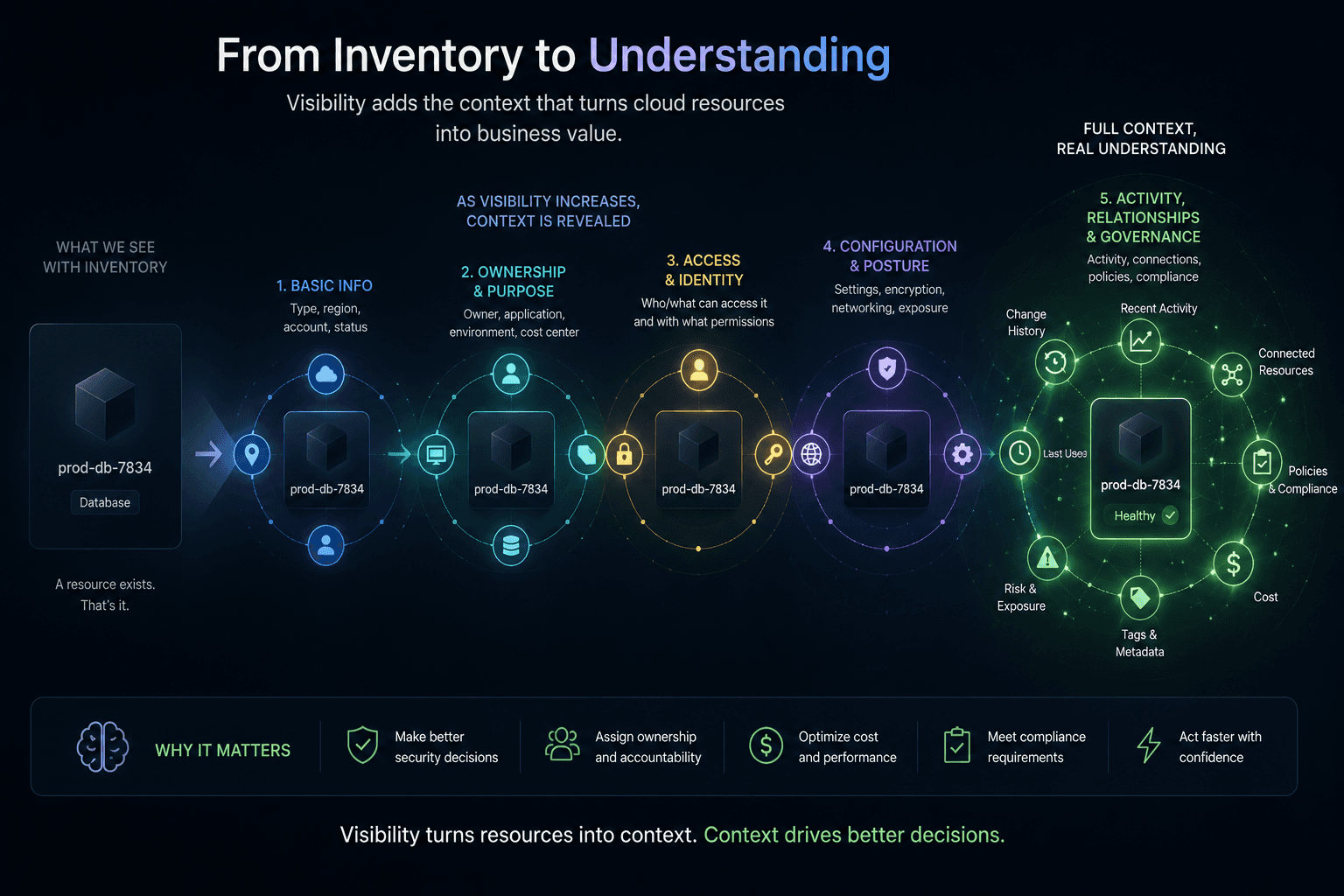
Imagine finding a database called prod-db-7834. Knowing that it exists answers one question, but it immediately creates several more:
Which application uses it?
Who owns it?
Does it contain sensitive data?
Which environment does it belong to?
Who can access it?
Is it exposed to the internet?
Is it currently being used?
What is connected to it?
Which policies apply to it?
What changed recently?
Was it created manually or through automation?
A resource list tells you what was discovered. True cloud visibility gives you the context needed to understand what is actually happening in the cloud.
Why Cloud Visibility Becomes Difficult
Cloud environments are dynamic by design. Infrastructure can be created through a console, API, CI/CD pipeline, Terraform deployment, Kubernetes controller, managed service, automation system, or AI agent.
An organization that started with a few AWS accounts managed by a central infrastructure team might eventually operate:
Hundreds of AWS accounts
Azure subscriptions owned by different business units
Google Cloud projects used by data teams
Kubernetes clusters
Serverless applications
SaaS integrations
CI/CD systems creating infrastructure
Terraform deployments
Resources inherited through acquisitions
Development environments created on demand
Machine identities and service accounts
AI agents interacting with infrastructure
At that scale, no single engineer understands the entire environment anymore. That is not necessarily a failure. It is a natural consequence of allowing teams to take advantage of cloud infrastructure at scale.
The problem appears when the organization has no reliable way to reconstruct that understanding when someone needs it.
The Five Questions Cloud Visibility Should Answer
A useful cloud visibility strategy should help teams answer five fundamental questions about their environment.
1. What Do We Have?
Organizations need to know which resources exist across accounts, subscriptions, projects, regions, and cloud providers.
That includes obvious infrastructure such as virtual machines and databases, but also identities, policies, storage, networking components, serverless functions, secrets, Kubernetes resources, and managed services.
If an organization does not know that a resource exists, it cannot secure, govern, optimize, investigate, or remove it.
2. Who Owns It?
Finding a resource is only useful if someone understands why it exists. Ownership connects infrastructure to the people, teams, applications, and business functions responsible for it.
This becomes especially important when something goes wrong. If a security team discovers a publicly accessible database at 2:00 AM, determining who is responsible for that resource should not require searching Git repositories, messaging channels, ticketing systems, and inconsistent cloud tags.
3. Who Can Access It?
Resources do not exist in isolation. Human users, applications, service accounts, workloads, automation systems, and increasingly AI agents interact with cloud infrastructure.
Visibility therefore needs to include identity. Teams should be able to understand who or what can access a resource, what permissions they have, and whether those permissions are appropriate.
This becomes particularly difficult in multi-cloud environments because every provider represents identities, roles, permissions, and relationships differently.
4. How Is It Configured?
Configuration determines how a resource behaves. A database may exist in the environment, but its security posture depends on settings such as encryption, networking, backups, authentication, and public exposure.
Configuration visibility allows organizations to understand the current state of resources and compare that state against expected standards. It can also reveal when infrastructure has changed from the state teams originally intended.
5. What Is Happening to It?
Cloud visibility also requires understanding activity. Teams need to know when resources change, what changed, and whether those changes came from an engineer, deployment pipeline, automated system, or AI agent.
This operational context turns a static list of resources into a much more useful picture of what is happening across the environment.
Context Is What Makes Visibility Useful
Consider two virtual machines with the same instance type, operating system, and region. From a basic infrastructure inventory perspective, they may look nearly identical.
One, however, might host a production payment service with strict access controls, monitoring, backups, and compliance requirements. The other could be an abandoned development machine created eight months ago that no longer serves a useful purpose.
The infrastructure alone does not explain the difference. Context is what makes the resources meaningful.
Modern cloud visibility therefore needs to connect technical resources with information about applications, environments, identities, ownership, policies, activity, and relationships.
Why Tags Alone Are Not Enough
Cloud tags and labels are commonly used to provide some of this context. A team might attach metadata such as:
owner=payments-teamenvironment=productionapplication=checkoutcost-center=commerce
Tags are useful, but they depend on people and automation applying them correctly. Naming conventions change, different teams use different taxonomies, acquired companies bring their own standards, and some cloud resources support metadata differently than others.
AWS, Azure, and Google Cloud also implement tagging and labeling differently. Over time, organizations frequently discover that metadata is incomplete, inconsistent, or outdated.
Effective visibility can use tags as one source of context, but it should not assume that tags represent the complete truth about the environment.
Visibility Requires Understanding Relationships
Cloud resources form systems rather than isolated objects. A load balancer connects to an application, the application runs on compute infrastructure, the application accesses a database, and a workload identity allows it to authenticate. Network policies control connectivity, deployment pipelines update the application, and a team is responsible for operating the service.
Looking at each resource individually hides much of the information operators actually need.
For example, a security team may want to know:
Which internet-facing applications can reach databases containing sensitive information?
Answering that question requires understanding resources, classifications, networking, identities, and relationships together. A simple inventory of cloud assets cannot provide the full answer.
The Problem With Point-in-Time Inventory
Traditional cloud inventory systems generally work by collecting information from cloud providers and storing a representation of those resources in another system.
That model is useful for reporting, historical analysis, asset management, and many other use cases. It also introduces an unavoidable question: How current is the data?
Cloud infrastructure changes constantly. A resource can be created, modified, connected to another service, or deleted between collection cycles. The system answering a question may therefore be describing the environment as it existed when the last collection occurred rather than the environment as it exists now.
The faster the cloud changes, the more important that distinction becomes.
For some use cases, a periodically refreshed inventory is perfectly adequate. For operational questions such as what is running right now, what a resource is connected to, or whether a configuration currently exists, teams may need to interrogate the live cloud environment instead.
This creates two different approaches to visibility:
Inventory-based visibility asks, “What does our collected data tell us about the environment?”
Real-time cloud visibility asks, “What does the cloud tell us about itself right now?”
Both approaches can be useful, but they solve different problems.
Multi-Cloud Makes Visibility Harder
Every major cloud provider gives customers powerful tools for understanding its own environment. AWS provides tools for AWS, Azure provides tools for Azure, and Google Cloud provides tools for Google Cloud.
The challenge appears when the organization needs to ask a question across all of them.
Imagine a security leader asking:
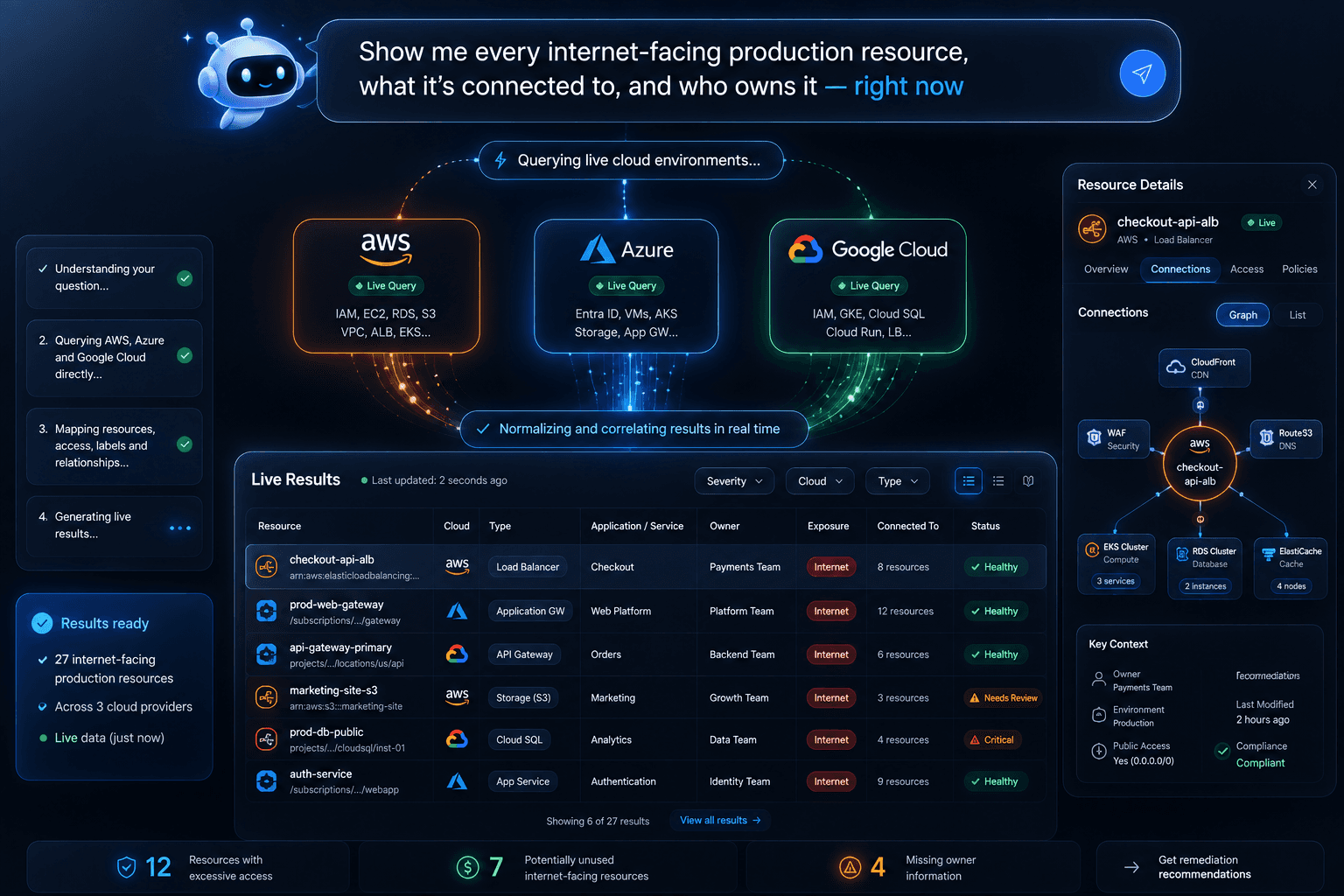
Show me every internet-facing production resource across the company.
One team could query AWS, another Azure, and another Google Cloud. The answers may be available, but each provider represents resources, identities, relationships, and configurations differently.
Multi-cloud visibility therefore requires more than knowing how to search three consoles. Organizations need a way to ask questions consistently while accounting for the differences between the underlying providers.
Visibility Is the Foundation for Governance
Governance depends on understanding the environment being governed.
If a policy states that every production resource must have a known owner, the organization first needs to determine which resources currently exist, which are production resources, and whether ownership can be established.
The same principle applies throughout cloud operations. Organizations need visibility to identify excessive access, exposed infrastructure, policy violations, configuration problems, unused resources, and unexpected changes.
This is why cloud visibility is more than another dashboard. It provides the context needed for governance, security, compliance, cost management, and automation to make informed decisions.
Visibility Should Lead to Action
Collecting more cloud data does not automatically create better visibility. A dashboard containing 500,000 resources may technically contain a tremendous amount of information while still making it difficult for an engineer to answer a simple operational question.
Useful visibility should help teams quickly answer questions such as:
Which resources violate policy?
Which resources have no identifiable owner?
Which identities have excessive access?
Which resources are publicly exposed?
Which infrastructure appears unused?
Which configurations recently changed?
What is connected to a particular application?
Which team should respond to a problem?
The objective is not to create more dashboards. It is to reduce the distance between asking a question, understanding the answer, and taking the appropriate action.
From Searching Inventory to Talking to the Cloud
Cloud visibility is beginning to evolve beyond traditional dashboards and inventory searches.
Instead of knowing which console to open, which API to call, or which inventory field to search, an engineer should be able to express the operational question they actually want answered.
For example:
Which production databases are publicly accessible right now?
Or:
What is connected to this application?
Or:
Which resources can this identity access?
Answering questions like these requires more than retrieving a stored asset record. The system needs to understand the intent of the question, determine which cloud systems can provide the answer, query the appropriate sources, understand relationships, and present the result in a useful form.
This creates a different model for cloud operations.
Instead of forcing people to learn how to navigate the cloud in order to find information, the cloud itself becomes something they can interrogate conversationally.
That model becomes even more powerful as AI becomes involved in cloud operations. Before an AI agent can safely recommend or perform an infrastructure change, it needs to understand the current environment, the resources involved, their relationships, and the policies that apply.
Real-time visibility therefore becomes part of the foundation for intelligent cloud operations.
Frequently Asked Questions
What is cloud visibility?
Cloud visibility is the ability to understand cloud resources, configurations, ownership, access, activity, relationships, and operational context across an organization's cloud environments.
Is cloud visibility the same as cloud monitoring?
No. Monitoring primarily observes system behavior and performance through signals such as metrics, logs, uptime, and application health.
Cloud visibility is broader. It helps teams understand infrastructure, identities, configuration, relationships, governance context, and activity across the cloud environment.
Is cloud asset inventory the same as cloud visibility?
No. Cloud asset inventory records information about discovered resources. Cloud visibility is the broader ability to understand resources and their operational context.
Inventory can be one way to provide visibility, but it is not the only approach.
Does cloud visibility require storing an inventory?
Not necessarily. Some systems maintain a continuously refreshed inventory of cloud resources, while other approaches can query cloud providers directly to answer questions about the current environment.
The appropriate model depends on whether the use case requires historical records, asset management, real-time operational answers, or a combination of these capabilities.
Why is multi-cloud visibility difficult?
AWS, Azure, and Google Cloud use different resource models, identity systems, APIs, metadata, and management tools. Organizations need a way to interpret those differences when answering questions across providers.
Key Takeaways
Cloud visibility begins with understanding what is running across an organization's cloud environments, but knowing that a resource exists is only the first step.
Useful visibility also requires context about ownership, identities, configuration, activity, relationships, and governance. That context allows teams to understand what resources mean rather than simply finding them in a list.
Traditional inventory systems provide one approach by collecting and storing information about cloud resources. For questions about the current operational state of rapidly changing environments, organizations can also query the live cloud directly.
As cloud environments become larger and more dynamic, the interface to cloud visibility is changing as well. Instead of navigating provider-specific consoles and inventory databases, teams can increasingly ask the questions they actually care about and allow intelligent systems to determine how to find the answer.
The future of cloud visibility may therefore be less about maintaining another inventory and more about making the cloud itself something people can simply talk to.
Related Reading
How Strato Cloud Helps
Traditional cloud inventory systems collect resource data and maintain a separate representation of the cloud environment. That model can be useful for asset management and historical reporting, but the information being queried represents what was collected rather than necessarily what exists at this moment.
Strato Cloud takes a different approach.
Instead of requiring organizations to maintain another traditional cloud inventory, Strato Cloud allows users to talk to their cloud and ask questions about the environment directly.
A user can ask what is running, how resources are configured, what they are connected to, or other operational questions. Strato Cloud interprets the request, interacts with the appropriate cloud environments, and uses the current state of those environments to produce an answer.
This approach is particularly useful in dynamic multi-cloud environments where infrastructure changes quickly and operational questions often require information from AWS, Azure, and Google Cloud.
The result is a different model for cloud visibility: instead of searching through a potentially stale representation of your cloud, you can ask the cloud what is true right now.