Published:
Estimated reading time:
8–10 minutes

Cloud tagging starts with a simple idea: attach useful metadata to cloud resources so people can understand what those resources are, who owns them, what they cost, and how they should be managed. A virtual machine might have tags such as environment=production, owner=payments-team, application=checkout, and cost-center=commerce.
When tagging works well, this metadata can support cost allocation, automation, security, governance, reporting, and incident response. The challenge is maintaining accurate, complete, and consistent metadata across thousands or millions of resources created by different teams, tools, and automation systems.
At enterprise scale, cloud tags remain extremely useful, but they are rarely reliable enough to serve as the organization’s only source of context.
What Are Cloud Tags?
Cloud tags are metadata attached to cloud objects. A tag generally consists of a key and a value, such as:
environment = productionowner = payments-teamcost-center = 4821application = checkout
Organizations use these key-value pairs to add business and operational context that does not naturally exist in the resource itself. Without metadata, an EC2 instance named i-07a94... tells an operator very little about its purpose.
With good metadata, teams can understand that the same instance belongs to the Payments application, runs in production, is owned by Payments Engineering, and should be charged to a particular cost center. That additional context is enormously valuable, which is why virtually every mature cloud organization develops some form of tagging strategy.
What Cloud Tags Are Used For
Tagging strategies usually begin with a handful of practical goals. Organizations commonly use tags to provide:
Ownership: The team, application, or individual responsible for a resource.
Environment: Whether infrastructure belongs to production, staging, development, testing, or a sandbox.
Cost allocation: The application, team, department, product, or cost center responsible for cloud spending.
Security and governance: Context that security systems can use when evaluating policies or prioritizing findings.
Automation: Information that determines which resources should be backed up, stopped after business hours, monitored differently, or included in particular workflows.
Compliance: Metadata identifying infrastructure associated with regulated workloads or particular compliance requirements.
The potential is substantial. If every resource had complete, accurate, and current metadata, tags could provide an incredibly powerful organizational map of the cloud.
The difficulty is maintaining that ideal as the environment grows.
Why Tagging Gets Harder as the Cloud Grows
Tagging a few hundred resources managed by one infrastructure team is relatively straightforward. Tagging tens of thousands of resources created by hundreds of developers across multiple cloud providers is a fundamentally different problem.
Modern cloud resources may be created by engineers using cloud consoles, Infrastructure as Code, CI/CD pipelines, Kubernetes controllers, autoscaling systems, managed cloud services, platform engineering systems, third-party applications, security automation, and increasingly AI agents. Some resources may exist for years, while others may exist for only a few minutes.
At that scale, the organization is effectively asking every infrastructure creation path to understand and continuously preserve the same metadata standard. The more teams and automation systems involved, the more opportunities there are for metadata to become incomplete or incorrect.
Problem 1: Tags Are Often Missing
The simplest tagging problem is also one of the most common. A required tag is simply not there.
An engineer might create a resource manually and forget to add the owner. A deployment pipeline could create infrastructure before tagging logic runs. A managed cloud service may create supporting resources automatically, or an acquired company may follow a completely different tagging standard.
Even organizations with strong tagging policies eventually encounter resources with incomplete metadata. This becomes a problem when other systems depend entirely on those tags for context.
If owner is missing, who should receive an alert? If environment is missing, should a security finding be treated as production? If cost-center is missing, where should the spending be allocated?
A metadata system can only use information that is actually present.
Problem 2: Tags Become Stale
A tag can exist and still be wrong. In some situations, incorrect metadata can be more problematic than missing metadata because it appears trustworthy.
Suppose a resource contains:
owner=platform-team
Six months later, responsibility for the application moves to the Payments team. The resource still exists and the tag is syntactically valid, but the organizational information it contains is no longer accurate.
This happens because organizations change while infrastructure remains. Ownership moves between teams, applications change names, cost centers are reorganized, development systems become production systems, and business units merge.
Unless something updates the metadata whenever those changes occur, tags can gradually become historical assumptions rather than reliable descriptions of the current organization.
Problem 3: Humans Are Inconsistent
Even simple concepts can quickly develop multiple representations. One team might use environment=production, another might use environment=prod, and another might shorten the key itself to env=prod.
Over time, variations such as these can accumulate:
environment=productionenvironment=prodenv=prodstage=productionEnvironment=PROD
A person can easily recognize that these probably mean the same thing. An automated governance or reporting system may treat them as completely different values.
Organizations can reduce this problem through standards, validation rules, and approved values. However, maintaining consistency becomes increasingly difficult as the number of teams, environments, acquisitions, and cloud providers grows.
Problem 4: Infrastructure Is Increasingly Created by Software
Cloud tagging was already difficult when organizations primarily needed engineers to follow tagging standards. Modern cloud environments add another layer of complexity because a significant amount of infrastructure is created or modified by software.
Kubernetes controllers, autoscaling systems, Infrastructure as Code, CI/CD pipelines, managed services, security automation, and platform engineering systems can all create cloud resources. AI agents are likely to add even more automated infrastructure activity.
The organization therefore needs more than a policy telling engineers to remember the correct tags. Every system capable of creating infrastructure must understand the organization’s metadata requirements and preserve them correctly.
Each new creation path becomes another place where the tagging standard must be implemented, tested, and maintained.
Problem 5: Cloud Providers Do Not Treat Metadata Identically
Multi-cloud makes tagging more complicated because AWS, Azure, and Google Cloud each implement resource metadata within their own platform models. Their terminology, restrictions, inheritance behavior, supported resources, and integrations are not identical.
An organization might want a common conceptual standard built around fields such as:
ownerenvironmentapplicationcriticality
The business concepts may be consistent, but implementing them across providers still requires translating organizational intent into different cloud systems. A tagging strategy that works well inside one provider therefore does not automatically become a cloud-agnostic metadata strategy.
This distinction becomes increasingly important as organizations try to build governance systems that operate consistently across AWS, Azure, and Google Cloud.
Problem 6: Not All Context Belongs on Every Resource
One of the less obvious problems with enterprise tagging is metadata duplication. Organizations often repeat the same organizational information across thousands of individual resources even when that information actually describes the broader environment containing them.
Imagine a production Payments environment containing thousands of resources. Many of those resources might repeat:
business-unit=commerceapplication=paymentscriticality=criticalowner=payments-engineering
If ownership changes, the organization may theoretically need to update that information across thousands of resources. The more duplicated metadata exists, the more opportunities there are for different resources to contain conflicting versions of the same organizational information.
Some information genuinely belongs at the resource level. Other information is better understood as context about the environment containing those resources. Recognizing that distinction can make a cloud metadata strategy much more resilient.
The 5:00 AM Test
A useful way to evaluate a tagging strategy is to imagine the worst possible time to depend on it. At 5:00 AM, a security system generates an alert for an EC2 instance identified only as i-07a94... because it is exhibiting suspicious network behavior.
The responder checks the resource metadata and finds no owner, application, business unit, or useful description. Perhaps the instance was created by automation, someone forgot the required tags, or the metadata was lost during a migration. The reason matters less than the immediate problem: someone still needs to determine what this resource is and how urgently the organization should respond.
The responder needs answers to questions such as:
Who should be contacted?
Is this production?
Which part of the business is affected?
How critical is the environment?
What might the blast radius be?
A tagging strategy that depends entirely on perfect resource metadata has reached a dead end. Fortunately, the resource still exists inside a broader cloud environment.
An EC2 instance belongs to an AWS account. Azure resources exist within subscriptions, and Google Cloud resources exist within projects and a broader resource hierarchy. That higher-level context provides another path to understanding what an otherwise anonymous resource represents.
Context Does Not Have to Live on Every Resource
Suppose the poorly tagged EC2 instance belongs to an AWS account identified as Production Cybersecurity. The organization knows that the account is owned by Security Engineering, supports production systems, has critical business importance, and is associated with cybersecurity infrastructure.
The individual EC2 instance still has poor metadata, but the responder now has useful information about the environment surrounding it. That context can help determine who should be contacted and how seriously the alert should be treated.
Now consider the same technical alert occurring inside an AWS account identified as Product Management Development. That environment is owned by Product Engineering, used for development and experimentation, and classified as relatively low criticality.
The technical findings may initially look identical, but the likely organizational impact is very different. This is why cloud context should exist at more than one level.
Think in Layers of Context
A more resilient metadata strategy recognizes that different information belongs at different levels of the organization and cloud environment.
At a simplified level, that structure might look like:
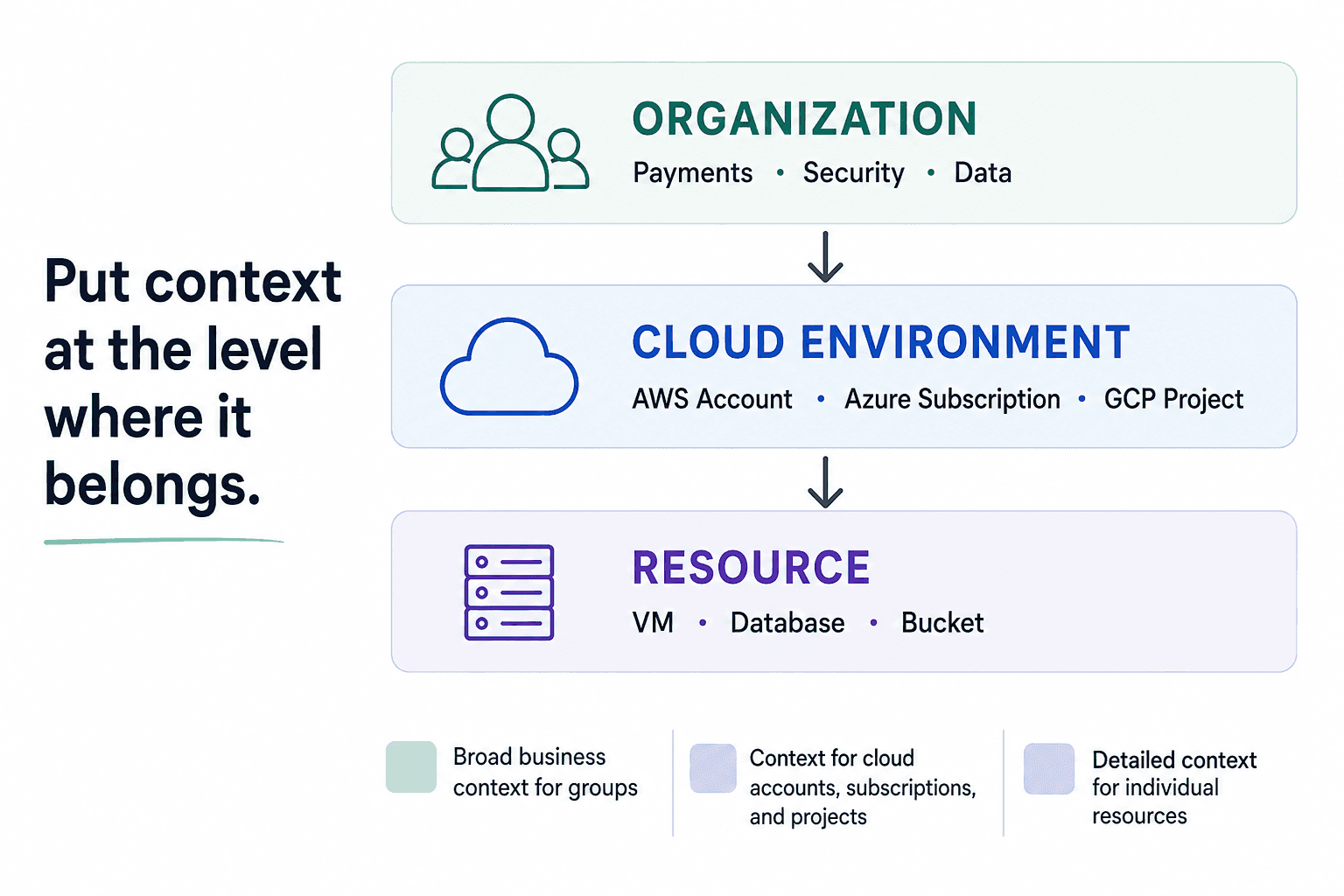
Some context describes the organizational grouping. Other information describes a particular cloud account, subscription, or project. More granular information may genuinely belong to the individual resource.
For example, ownership of a business function may make sense higher in the hierarchy, while whether a particular storage bucket contains sensitive information may need to exist directly on the resource.
The objective should not be to put every possible label everywhere. It should be to put the right context at the right level.
Enforcement Helps, but It Does Not Solve Everything
Organizations can improve tagging quality significantly through automation. Required metadata in Infrastructure as Code, CI/CD validation, cloud-provider policies, approved tag dictionaries, automated remediation, and reporting on missing tags can all make tagging programs considerably more reliable.
These controls are worth implementing. Strong governance can prevent many of the inconsistencies that appear when tagging is entirely voluntary.
Enforcement does not eliminate every challenge, however. Managed services can create infrastructure indirectly, legacy environments may predate the standard, acquired environments may follow different conventions, and organizational information can change long after infrastructure has been created.
Strong enforcement can make tags much better. It cannot make resource-level tags a perfect source of all organizational truth.
When Tags Work Best
Cloud tags are most effective when they describe information that genuinely belongs to the object being tagged and when that information can be maintained reliably.
Resource-specific cost allocation, backup requirements, data classification, lifecycle rules, automation behavior, and application identifiers can all be excellent uses for tags. Tags are also extremely valuable as inputs into cloud-native automation because the metadata exists close to the resource itself.
The lesson is not to stop tagging. Organizations should continue improving tagging standards and enforcement where tags provide useful resource-level information.
The lesson is to avoid expecting resource tags to solve every organizational metadata problem.
Tags and Cloud-Agnostic Labels Solve Different Problems
Provider-native resource tags and cloud-agnostic labels can complement each other because they provide context at different levels.
Resource tags provide detailed metadata close to individual infrastructure. Cloud-agnostic labels can provide consistent organizational context around higher-level structures such as AWS accounts, Azure subscriptions, Google Cloud projects, cloud identities, and cross-cloud organizational groupings.
This creates a more resilient metadata model. When a resource has excellent tags, those tags can provide detailed information. When its metadata is incomplete, higher-level context can still help explain where the resource belongs and what the surrounding environment represents.
The organization is no longer asking a single metadata layer to answer every question.
The Goal Is Context, Not Perfect Tagging
Organizations sometimes treat tagging coverage as the objective and measure success using metrics such as the percentage of resources containing every required tag. Those metrics can be useful for understanding the health of a tagging program, but they should not become the ultimate goal.
The real objective is helping people and systems understand the cloud. Security teams need to determine who owns an affected environment. Finance teams need to allocate spending. Engineers need to distinguish production from development. Governance systems need to understand which policies should apply, and automation needs enough context to determine how infrastructure should be treated.
If those questions can be answered reliably, the metadata strategy is working. Tags are one mechanism for creating that context, but they do not have to be the only one.
Frequently Asked Questions
Why do cloud tagging strategies fail?
Cloud tagging strategies often struggle because resources are created by many teams and automation systems, metadata becomes stale, naming conventions drift, and different cloud providers implement tagging differently. These problems become more difficult to control as environments grow.
Are cloud tags still useful?
Absolutely. Tags remain extremely useful for cost allocation, automation, security, governance, reporting, and resource-specific metadata. Problems arise when organizations expect resource tags to become the only source of organizational context.
Can cloud tagging be enforced?
Yes. Organizations can use Infrastructure as Code validation, cloud policies, CI/CD controls, automated remediation, and other mechanisms to improve tagging consistency. Enforcement can substantially improve tag quality, although it does not eliminate every metadata challenge.
What happens when a cloud resource has no owner tag?
Teams can often reconstruct useful context from higher levels of the environment. Knowing the AWS account, Azure subscription, or Google Cloud project containing the resource can help identify ownership, environment, business function, and criticality.
Should every piece of metadata be applied to every cloud resource?
No. Some metadata belongs directly on a resource, while other information describes the broader account, subscription, project, application, team, or organizational environment. A good metadata strategy places context at the level where it makes the most sense.
What is the difference between cloud tags and cloud-agnostic labels?
Cloud tags are provider-native metadata attached to cloud objects. Cloud-agnostic labels provide a consistent organizational vocabulary across cloud providers and can describe higher-level environments, identities, or organizational groupings without depending on a particular provider’s tagging model.
Key Takeaways
Cloud tags are one of the most useful mechanisms available for adding context to cloud infrastructure, but they become difficult to maintain perfectly at enterprise scale. Resources are created by humans and automation, ownership changes, metadata becomes stale, naming conventions drift, and cloud providers implement tagging differently.
The answer is not to abandon tagging. It is to stop expecting resource tags to carry the entire burden of explaining the cloud.
A resilient cloud metadata strategy uses multiple layers of context. Resource tags provide detailed information where appropriate, while accounts, subscriptions, projects, identities, and organizational groupings can provide broader context.
This means a poorly tagged resource does not have to become an anonymous resource. Even during a 5:00 AM incident, teams should still have a path to understanding where something belongs, who owns the surrounding environment, and how significant the potential impact may be.
Related Reading
Cloud Resource Ownership: Why It Matters (coming soon)
Building a Cross-Cloud Resource Taxonomy (coming soon)
How Strato Cloud Helps
Strato Cloud does not attempt to solve inconsistent resource tagging by ingesting every individual cloud resource into another inventory and attaching a second set of labels to it.
Instead, Strato Cloud maintains context around the higher-level cloud objects it manages. Organizations can apply cloud-agnostic labels to AWS accounts, Azure subscriptions, Google Cloud projects, cloud identities, and Strato Cloud namespaces.
Namespaces provide a way to group accounts, subscriptions, and projects according to organizational boundaries that make sense across cloud providers. Labels at these levels can preserve information about ownership, environment, business function, criticality, and other organizational context without requiring that information to be duplicated across every individual resource.
This becomes useful when resource-level metadata is incomplete. If an alert arrives for a poorly tagged EC2 instance, its AWS account provides a path back to organizational information in Strato Cloud. Teams can determine who owns the account, what labels apply to it, which namespace it belongs to, and what that environment represents.
A resource in a critical production cybersecurity environment can therefore be understood differently from a resource in a low-risk development environment even when neither resource has perfect tags.
Strato Cloud does not replace cloud tags. It provides another layer of context so organizations do not have to depend on perfect resource tagging to understand where something belongs.