Published:
Estimated reading time:
8–9 minutes

Organizations create policies for almost every part of their cloud environment. Production databases must be encrypted, storage containing sensitive information cannot be public, resources may need to remain in approved regions, infrastructure needs an identifiable owner, and privileged access should follow defined security requirements.
The challenge is that a policy written in a security document does not automatically prevent or detect anything. Someone still has to translate the requirement into something that can be evaluated against actual infrastructure.
Policy as Code makes that translation explicit. Instead of expressing important technical requirements only in documents, tickets, or human review processes, organizations represent them as machine-readable rules that software can evaluate automatically.
This allows policies to become part of how infrastructure is built, deployed, monitored, and governed.
What Is Policy as Code?
Policy as Code is the practice of defining organizational policies in a structured, machine-readable form so they can be automatically evaluated and, where appropriate, enforced.
Consider a requirement such as:
Production storage must not allow public access.
Software can evaluate infrastructure against that requirement and determine whether the policy is satisfied. Conceptually, the process connects a business or security requirement to a machine-readable policy, infrastructure evaluation, and ultimately a decision or finding.
The policy becomes executable logic rather than guidance that depends entirely on someone remembering to check it. This approach can be applied to security, compliance, infrastructure standards, deployment rules, identity, cost controls, and many other forms of technical governance.
Why Put Policy Into Code?
Traditional policy documents are designed for people. They explain expectations, responsibilities, and requirements, and they remain an important part of organizational governance.
Problems emerge when those requirements need to be applied consistently across thousands of infrastructure changes.
Imagine a security policy stating that all production databases must use encryption at rest. If enforcement depends entirely on engineers reading the policy and remembering to configure encryption correctly, mistakes are inevitable. A security reviewer could inspect every deployment, but that quickly becomes a manual bottleneck.
Policy as Code allows the requirement to be evaluated automatically. When infrastructure is proposed or an existing environment is examined, software can determine whether the database configuration satisfies the policy.
The organization has effectively transformed a human expectation into a repeatable technical control.
Policy as Code Does Not Replace Human Policy
Not every organizational policy can or should become code. Some requirements involve judgment, process, legal interpretation, or organizational responsibility that cannot be reduced to a simple technical condition.
Even technical policies usually originate from a broader human requirement. For example, an organization may establish that customer data must be appropriately protected. That objective could translate into several technical controls involving encryption, public exposure, identity permissions, network access, logging, credential management, and data retention.
Policy as Code implements the portions of those requirements that can be evaluated technically. The written policy explains what the organization expects and why, while Policy as Code helps determine whether the technical environment satisfies that expectation.
What Can Policy as Code Evaluate?
Policy as Code can operate across many parts of cloud engineering.
For infrastructure configuration, policies can evaluate whether cloud resources satisfy architectural or security requirements. An organization might require databases to use encryption, prohibit public storage, require logging, restrict production workloads to approved configurations, or define acceptable network exposure.
Policies can also evaluate Infrastructure as Code such as Terraform, CloudFormation, or Pulumi before deployment. A proposed infrastructure change that violates an organizational requirement can be identified before it reaches the cloud.
The same concept can extend into CI/CD pipelines, where policy evaluation becomes part of build and deployment workflows. Pipelines can test proposed infrastructure and prevent deployment when required controls fail.
Policy as Code can also influence identity and access, including whether an identity should receive a particular capability or whether privileged access satisfies organizational requirements. Compliance frameworks can similarly be translated into technical controls that software evaluates against cloud environments.
Organizations can even use policies for cost and operational governance, including approved regions, resource types, ownership requirements, lifecycle standards, and other engineering conventions.
Policy as Code is therefore not limited to security. It is a general mechanism for making technical requirements machine-evaluable.
Policy as Code Can Be Preventive or Detective
One of the most important distinctions in Policy as Code is when the policy is evaluated.
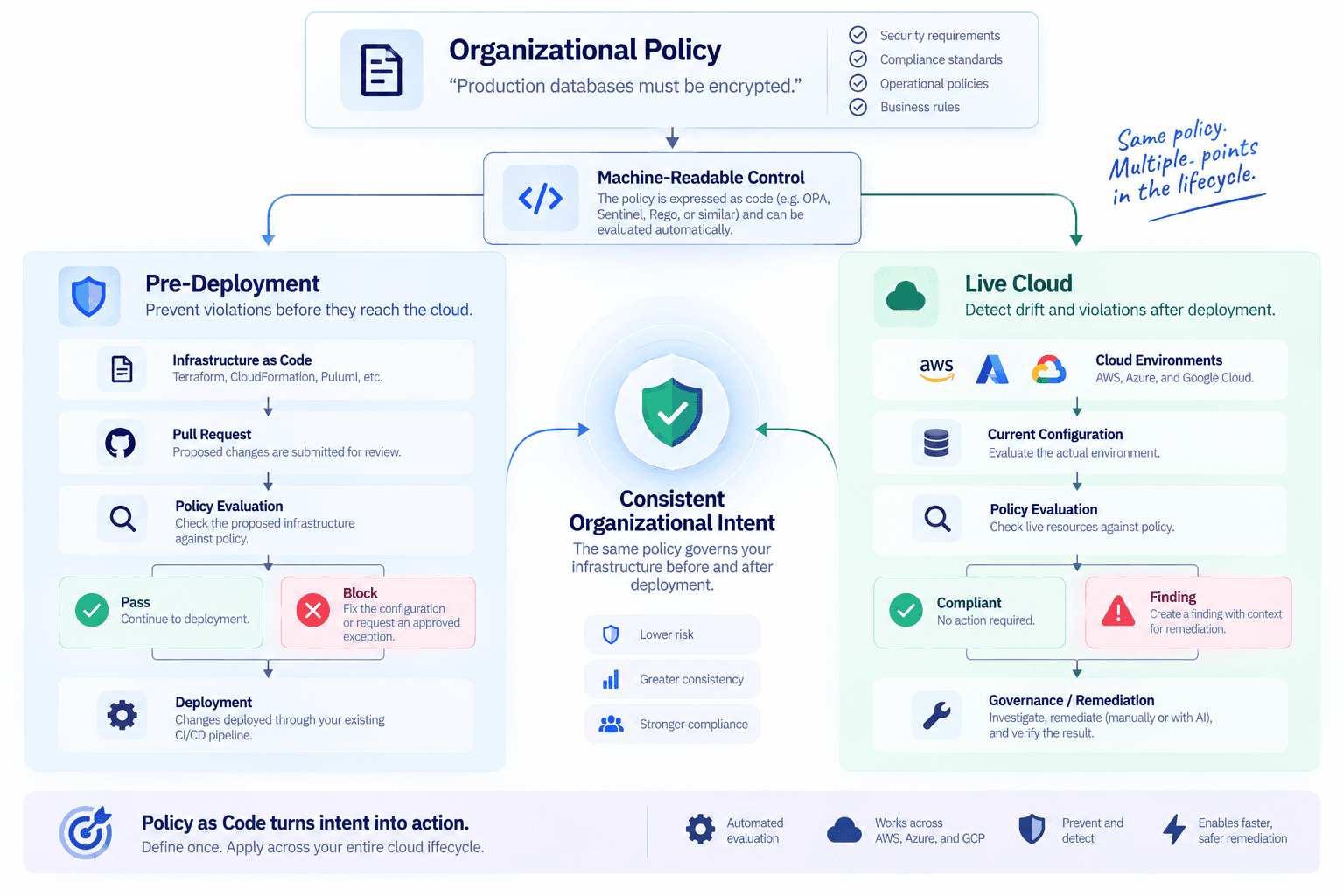
A preventive policy evaluates a proposed change before it reaches the environment. Imagine an engineer opening a pull request containing Terraform that creates an unencrypted production database. The CI pipeline evaluates the proposed infrastructure, the encryption policy fails, and the change cannot proceed until the configuration is corrected or an approved exception is applied.
A detective policy evaluates infrastructure that already exists. If someone later changes the database manually and disables the required configuration, a policy evaluating the live environment can detect that the actual cloud state no longer satisfies the requirement.
The same organizational intent can therefore operate at multiple points in the infrastructure lifecycle. Before deployment, policy can help prevent violations. After deployment, it can detect drift and configurations that no longer satisfy organizational requirements.
Mature governance strategies often need both.
Infrastructure as Code Is Not the Same as Policy as Code
The names are similar, but Infrastructure as Code and Policy as Code solve different problems.
Infrastructure as Code describes what infrastructure should exist. A Terraform configuration might specify a database, network, or IAM policy and define how that infrastructure should be configured.
Policy as Code describes which conditions that infrastructure must satisfy. A policy might require every production database to use encryption regardless of which Terraform module or cloud provider created it.
The two become particularly powerful when used together. An organization can define infrastructure as code, evaluate the proposed code against policy before deployment, and then evaluate the resulting live environment afterward to ensure that actual state continues to satisfy the same organizational intent.
Policy as Code Can Shift Governance Earlier
One advantage of Policy as Code is that it can move some governance decisions earlier in the engineering lifecycle.
Consider a Terraform pull request. Instead of waiting until infrastructure reaches production and then scanning it for violations, the workflow can evaluate the proposed configuration before deployment:
Developer → Pull Request → IaC Validation → Policy Evaluation → Review → Deployment
If the proposed infrastructure violates an important requirement, the developer receives feedback while the change is still being developed. Correcting a configuration at this stage is usually easier than discovering the same problem after infrastructure has already been deployed and applications depend on it.
This approach is commonly described as shifting governance left, but pre-deployment policy is only part of the solution.
Why Shift-Left Policy Is Not Enough
A cloud environment can become non-compliant even if every Infrastructure as Code pull request passes its policy checks.
Not every change necessarily comes through the same pipeline. Someone may make a manual cloud modification, an application may create infrastructure dynamically, or a managed cloud service may introduce supporting resources. Policies themselves can also change after infrastructure has already been deployed, leaving previously acceptable resources outside the new standard.
There is also an important difference between intended and actual state. The IaC repository describes what the organization expects infrastructure to look like, while the cloud environment represents what actually exists.
Governance therefore benefits from evaluating the same organizational requirement at multiple stages. Pre-deployment checks can evaluate proposed infrastructure, while detective controls can evaluate the live cloud after deployment.
Policy as Code provides the rule. Where and when that rule is evaluated determines how it contributes to the broader governance lifecycle.
Policy as Code Needs Context
A rule without context can easily become too broad.
Consider a policy stating that only approved instance types may run in production. Before evaluating the technical configuration, the system needs to know which environments are production. Similarly, a requirement that critical applications receive additional logging depends on knowing which applications the organization considers critical.
Useful policy evaluation can therefore depend on organizational context such as environment, owner, business function, application, criticality, cloud provider, account, subscription, project, or data classification.
Without that context, organizations may need to hard-code provider-specific identifiers into policies or create large numbers of nearly identical rules. Context allows the policy to describe organizational intent more naturally while the governance system determines where that intent applies.
Cloud Tags Can Help, but They Are Not the Whole Answer
Cloud tags are often used to provide this context. A policy might evaluate resources tagged with Environment = Production, for example.
This can work well when tagging is complete and consistent, but maintaining that consistency becomes difficult at scale. AWS, Azure, and Google Cloud have different metadata conventions, teams may use different keys and values, and tags can be missing, outdated, or applied inconsistently.
Organizations can also maintain useful context above the individual resource level. An AWS account, Azure subscription, or GCP project may already represent a production environment. If the organization knows that an entire environment is production, every policy does not necessarily need to infer that fact independently from each resource's tags.
The broader governance model can determine where the policy applies, while the policy itself evaluates the technical requirement.
Multi-Cloud Policy Needs a Common Intent
AWS, Azure, and Google Cloud implement infrastructure differently, but organizational requirements frequently remain the same.
A requirement that production storage must not be publicly accessible has one business meaning. Evaluating that requirement requires different technical logic in each provider because AWS storage permissions differ from Azure and Google Cloud.
A multi-cloud governance system can separate organizational intent from provider-specific evaluation. One common policy objective can map to AWS-specific, Azure-specific, and GCP-specific evaluation underneath.
This allows the organization to reason about what it expects from its cloud environments without forcing the governance strategy to mirror every provider's terminology and implementation details.
Policy as Code and Compliance
Policy as Code can also help translate compliance requirements into technical controls.
A framework may require an organization to restrict access to sensitive systems. That higher-level requirement could translate into multiple machine-evaluable controls involving identity permissions, public exposure, network access, MFA, privileged access, logging, or credential lifetime.
Representing those controls as code makes them repeatable and testable, but compliance remains broader than policy evaluation. Compliance programs also involve evidence, documentation, exceptions, organizational processes, auditability, and formal assessment.
Policy as Code should therefore be viewed as an important building block for compliance rather than a replacement for the compliance process itself.
Policies Need Exceptions
Real organizations occasionally need to violate a technical policy intentionally. A legacy application may require a configuration that does not meet a newer standard, a temporary operational condition may justify an exception, or a compensating control may reduce the risk another way.
The wrong response is often to weaken the policy globally because one legitimate exception exists.
A stronger governance model keeps the policy intact while documenting the exception. The exception can identify the affected environment or resource, the policy being overridden, the reason, the approving party, an expiration date, and any compensating controls.
This preserves both flexibility and accountability. Policy as Code becomes much more practical when exception handling is treated as part of the governance system rather than as a reason to avoid strong policies.
A Failed Policy Should Produce an Actionable Finding
Detecting that a policy failed is useful, but the quality of the resulting finding matters.
A finding that simply says “Encryption policy failed” leaves substantial investigation to the engineering team. A more useful result identifies which requirement failed, which environment is affected, what configuration caused the failure, why the observed state violates the policy, and what needs to change.
This becomes particularly important when policies evaluate live cloud infrastructure. The finding can carry technical and organizational context into the remediation workflow rather than forcing another team to rediscover it.
The governance lifecycle can then move beyond simple detection toward evaluation, understanding, remediation, and verification.
Policy as Code Is Not Continuous Governance
Policy as Code and Continuous Governance are closely related, but they are not synonyms.
Policy as Code is the mechanism for representing requirements as machine-evaluable rules. Continuous Governance is the broader operating model for applying organizational requirements across changing cloud environments.
That broader model needs to determine where policies apply, when they should be evaluated, which environments are in scope, what organizational context matters, how findings are prioritized, how exceptions are handled, and how remediation occurs.
It also needs to determine whether the environment returns to the desired state after a problem is addressed.
A useful way to think about the relationship is that Policy as Code defines the rule, while Continuous Governance operates that rule across the cloud lifecycle.
Policy as Code and Intelligent Remediation
Once a policy produces an actionable finding, the next question is what happens to it.
Traditionally, the finding may become a ticket. An engineer investigates the problem, determines the correct configuration, writes the infrastructure change, tests it, and submits it for review.
AI-assisted remediation can shorten that process. The policy finding provides a clear description of the desired state, while information about the affected environment provides the technical context required to understand what needs to change.
An AI system can use that information to generate a proposed Infrastructure as Code remediation. The proposed change can then be validated and delivered through a pull request for review and deployment through the organization's normal workflow.
The resulting lifecycle becomes:
Policy → Finding → Environment Context → AI-Generated IaC → Validation → Pull Request → Review → Deployment → Re-evaluation
Policy remains the source of governance intent. AI reduces the engineering work required to restore the desired state.
Policy as Code and AI Agents
AI agents themselves also need policy boundaries.
An organization may allow an AI system to investigate infrastructure while prohibiting direct production modification. Another agent may be allowed to generate Infrastructure as Code but only inside an isolated environment and only for an authorized repository. A remediation workflow may require human approval before anything reaches production.
These are governance decisions that can also be expressed through policy.
As AI becomes part of cloud operations, policies may increasingly govern which environments an agent can access, which tools it can use, which operations it can perform, which repositories it can modify, what approvals it requires, and how long its credentials can exist.
AI does not reduce the need for policy. It introduces new identities and operations that governance systems need to control.
How Strato Cloud Approaches Policy as Code
Strato Cloud treats policy as part of a broader Continuous Governance lifecycle across AWS, Azure, and Google Cloud.
The objective is not simply to store machine-readable rules. It is to connect organizational intent with the cloud environments where those requirements should apply, evaluate whether those environments satisfy them, and provide a path for addressing findings when they do not.
Policies Can Follow Organizational Context
Strato Cloud organizes AWS accounts, Azure subscriptions, and GCP projects using namespaces and cloud-agnostic labels. These provide organizational context such as environment, ownership, business function, and criticality independently of provider-specific hierarchy.
That context can determine where governance requirements apply. Instead of defining a rule against a long list of provider-specific account identifiers, an organization can express its intent around concepts such as production, payments, or critical infrastructure.
The governance system can then determine which environments match that context. This separates what the organization wants from how each cloud provider happens to organize infrastructure.
Controls Can Be Evaluated Against Live Cloud State
For detective governance, the important question is whether the actual environment satisfies the requirement.
Strato Cloud can evaluate controls against live cloud environments rather than depending entirely on a synchronized inventory of individual resources. This allows governance findings to reflect the current cloud configuration when the evaluation occurs.
The policy provides the requirement, while the live environment provides the state against which that requirement is evaluated.
Policies Can Support Multi-Cloud Governance
The same organizational objective may require different implementation logic in AWS, Azure, and Google Cloud.
Strato Cloud can maintain common governance intent while using cloud-specific mechanisms to evaluate the underlying environments. This allows organizations to express a requirement such as “production storage must not be public” without designing the entire governance strategy around provider-specific terminology.
Findings Can Connect to Intelligent Remediation
When a control fails, the resulting finding can become input to Strato Cloud's Intelligent Remediation workflow.
The finding provides the requirement that was violated and identifies the environment where the violation exists. Strato Cloud's AI can use that context to generate a proposed Infrastructure as Code solution inside an isolated execution environment.
The AI can run validation and development tools, iterate on the proposed code, and deliver the remediation through an authorized GitHub repository as a pull request. The organization retains its normal review and deployment process.
This connects policy detection to remediation without requiring the governance system or AI to make uncontrolled production changes.
Secure Execution Can Apply Policy to Access
Governance is not limited to infrastructure configuration.
Strato Cloud's Secure Execution capabilities can apply identity, organizational context, and current conditions when determining whether humans, workloads, or AI systems should receive cloud access.
Once access is authorized, temporary credentials can be used instead of unnecessary permanent standing access. Policy can therefore influence both how cloud infrastructure should be configured and how identities should be allowed to interact with it.
Continuous Governance Operates the Lifecycle
Policy as Code becomes most valuable when it participates in an ongoing governance process.
The broader Strato Cloud model connects definition, targeting, evaluation, detection, understanding, remediation, and re-evaluation.
Policies express the requirements. Namespaces and labels help determine where they apply. Live cloud evaluation determines whether environments satisfy them. Findings identify gaps, Intelligent Remediation can help prepare corrective infrastructure changes, and Secure Execution governs how privileged operations occur.
Re-evaluation then determines whether the environment has returned to the desired state.
That is the distinction between simply having policies and continuously governing cloud environments with them.
What Makes a Good Policy as Code Strategy?
A useful Policy as Code program should start with organizational intent rather than individual tools.
Policies should remain understandable enough that engineering and security teams know which requirement they represent. Business intent should be separated from provider-specific implementation wherever practical, particularly in multi-cloud environments.
Organizations should also consider where each policy needs to operate. Preventive evaluation can catch problems before deployment, while live-cloud evaluation can detect drift and changes that bypass the development workflow.
Reliable organizational context is equally important because policies are only as accurate as the identity, environment, ownership, and classification information they depend on.
When policies fail, findings should provide enough information to become actionable engineering work. Legitimate exceptions should be documented explicitly, findings should connect to a practical remediation process, and controls should be evaluated again after changes are deployed.
Policy as Code is most effective when it becomes part of the engineering and governance lifecycle rather than another isolated security tool.
Frequently Asked Questions
What is Policy as Code?
Policy as Code is the practice of expressing organizational requirements as machine-readable rules that software can automatically evaluate against infrastructure, identities, deployments, or other technical systems.
Is Policy as Code the same as Infrastructure as Code?
No. Infrastructure as Code describes the infrastructure that should exist, while Policy as Code defines conditions that infrastructure must satisfy.
What is an example of Policy as Code?
An organization might define a rule requiring every production database to use encryption. Software can evaluate proposed or existing database configurations against that requirement and determine whether they comply.
Can Policy as Code prevent cloud misconfigurations?
Yes. Policies can be evaluated against Infrastructure as Code before deployment to identify or block configurations that violate organizational requirements.
Can Policy as Code detect cloud drift?
Yes. Policies can also be evaluated against live cloud environments to identify existing infrastructure that no longer satisfies the desired requirement.
Is Policy as Code only for security?
No. It can be used for security, compliance, infrastructure standards, identity, cost controls, operational requirements, and other forms of technical governance.
How does Policy as Code work across multiple clouds?
Organizations can maintain a common policy objective while implementing provider-specific evaluation logic for AWS, Azure, and Google Cloud.
How does Policy as Code relate to Continuous Governance?
Policy as Code defines machine-evaluable requirements. Continuous Governance is the broader lifecycle that determines where those requirements apply, evaluates them as environments change, handles findings and exceptions, connects them to remediation, and verifies the resulting state.
Can AI help remediate Policy as Code findings?
Yes. AI can use the policy finding and environment context to generate a proposed Infrastructure as Code remediation, which can then be validated and reviewed through existing engineering workflows.
Does Policy as Code eliminate manual governance?
No. Some requirements require human judgment, and organizations still need processes for policy design, exceptions, review, approvals, and risk decisions.