Published:
Estimated reading time:
6–8 minutes

Cloud governance and cloud compliance are closely related, but they are not the same thing.
Cloud governance defines how an organization wants its cloud environments to operate. Cloud compliance demonstrates that the organization meets specific internal, regulatory, or industry requirements.
The distinction matters because an organization can pass an audit and still have poorly governed cloud infrastructure. It can also have strong internal governance practices that extend far beyond what any compliance framework requires.
Understanding how governance and compliance work together helps organizations move beyond periodic audits toward cloud environments that remain secure, consistent, and compliant as they change.
Cloud Governance vs. Compliance at a Glance
Cloud Governance | Cloud Compliance | |
|---|---|---|
Primary purpose | Define how cloud environments should operate | Demonstrate adherence to required standards |
Scope | Broad organizational policies and operating standards | Specific regulatory, industry, contractual, or internal requirements |
Examples | Access, ownership, cost, security, architecture, configuration | SOC 2, ISO 27001, PCI DSS, HIPAA, NIST, FedRAMP |
Who is involved | Engineering, platform, security, FinOps, compliance, leadership | Security, compliance, risk, auditors, legal |
How it is measured | Policy adherence and operational outcomes | Evidence that required controls are satisfied |
Frequency | Continuous | Traditionally periodic, increasingly continuous |
Primary question | "Are we operating the cloud the way we intend?" | "Can we prove that we meet the required controls?" |
The easiest way to remember the difference is:
Governance establishes the rules of the road. Compliance proves that required rules are being followed.
What Is Cloud Governance?
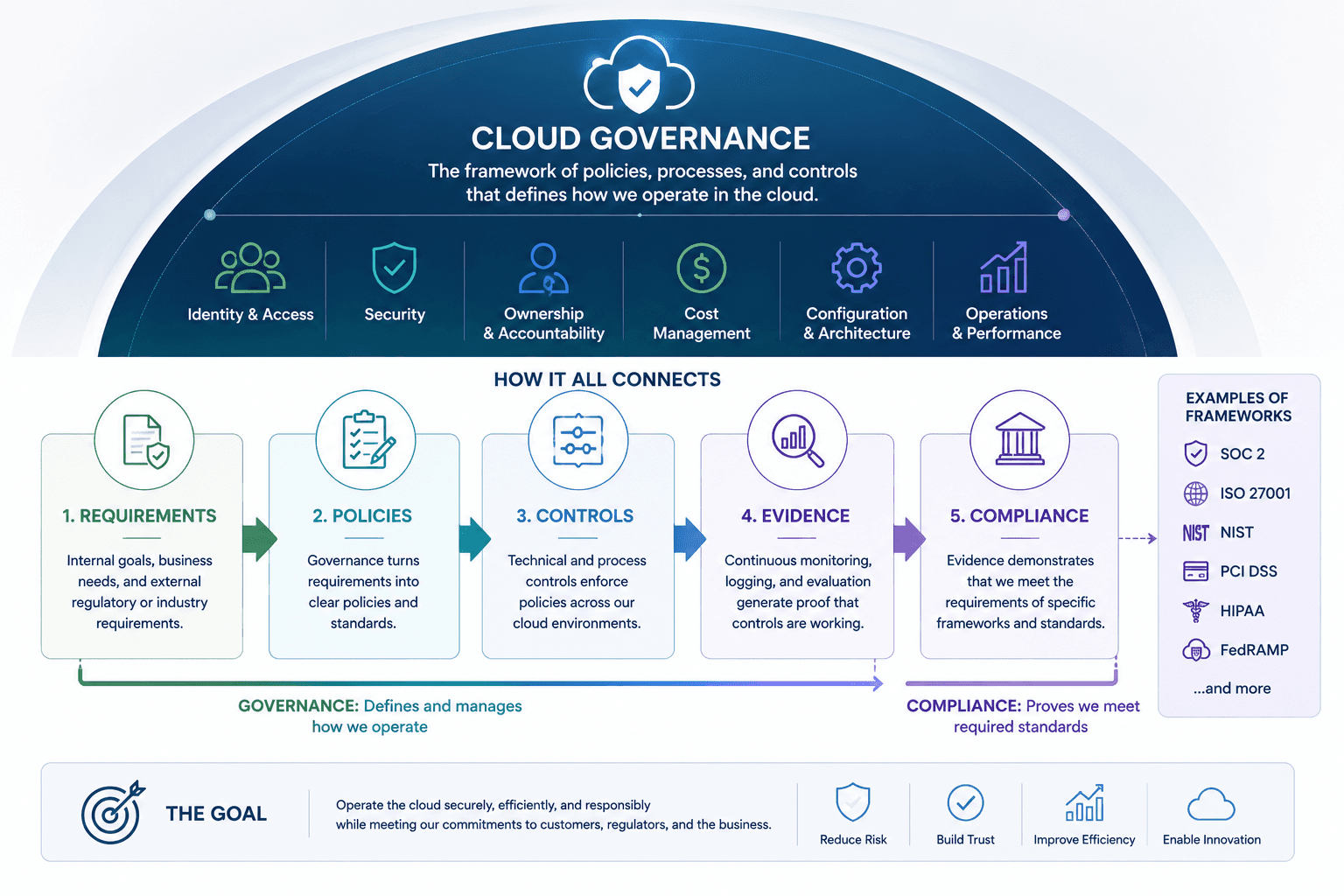
Cloud governance defines the policies, processes, controls, and responsibilities that determine how an organization uses cloud infrastructure.
Governance answers questions such as:
Who is allowed to create cloud resources?
Who owns each resource?
When should administrative access be granted?
Which regions can teams deploy into?
What security configurations are required?
How should cloud costs be allocated?
Which resources may be exposed to the internet?
What happens when infrastructure violates policy?
Some governance policies exist because of regulatory requirements. Others exist because they simply represent good operational practice.
For example, an organization might require every production resource to have a known owner even if no compliance framework explicitly requires that exact implementation.
Governance therefore reflects how the organization believes its cloud should operate.
For a deeper explanation, see What Is Cloud Governance?
What Is Cloud Compliance?
Cloud compliance focuses on satisfying specific requirements.
Those requirements may come from laws, regulations, industry standards, contractual obligations, or internal policies.
Common examples include:
SOC 2
ISO 27001
PCI DSS
HIPAA
NIST frameworks
FedRAMP
Each framework defines requirements or controls that an organization must implement and, in many cases, demonstrate through evidence.
For example, a compliance requirement may state that access to sensitive systems must be restricted to authorized individuals.
The organization must then implement controls that satisfy that requirement and produce evidence showing that those controls are working.
This is where compliance becomes closely connected to governance.
Governance Turns Requirements Into Operating Policies
Consider a company preparing for a SOC 2 audit.
SOC 2 may require the organization to demonstrate appropriate controls around access to production systems.
That requirement is fairly broad.
The company's governance program translates it into operational policies such as:
Production access requires authentication through the corporate identity provider.
Administrative privileges must follow least-privilege principles.
Privileged access must be approved.
Temporary administrative access expires automatically.
Access activity must be logged.
Former employees must lose access promptly.
Compliance provides the requirement.
Governance determines how the organization will satisfy it in day-to-day operations.
The technical systems then enforce those policies.
A Simple Example: Public Cloud Storage
Imagine an organization has a governance policy stating:
Production storage containing sensitive information must not be publicly accessible.
There may be several reasons for this policy.
The security team wants to reduce the risk of a data breach. The compliance team may need the policy to satisfy requirements related to protecting sensitive information. Engineering leadership may simply consider public production storage an unacceptable architectural practice.
One policy can therefore support several business objectives at once.
The organization can enforce that policy through preventive controls that block public storage, detective controls that identify existing exposure, or automated remediation that corrects violations.
Compliance teams can then use evidence from those systems to demonstrate that the control exists and is operating effectively.
This creates an important chain:
Requirement → Policy → Control → Enforcement → Evidence
That chain connects compliance requirements to everyday cloud operations.
Why Passing an Audit Does Not Mean You Have Good Governance
A successful audit demonstrates that an organization satisfied the requirements being evaluated during a particular period.
It does not necessarily mean the entire cloud environment is well governed.
Imagine a company that passes its annual compliance audit but still has:
Thousands of resources without known owners
Excessive administrative permissions
Unused infrastructure generating costs
Inconsistent configurations between teams
Long-lived service account credentials
Different security standards across cloud providers
The organization may technically satisfy the controls included in its audit while still operating an environment that is difficult to secure and manage.
Good governance addresses the broader operational health of the cloud.
Compliance represents one important outcome of that governance.
Compliance Is Becoming Continuous
Historically, compliance was often treated as a periodic activity.
Teams collected screenshots, exported reports, interviewed system owners, and assembled evidence before an audit.
The problem is that cloud environments change constantly.
A resource that was compliant when evidence was collected in January might be misconfigured in February.
A new account might appear in March. Permissions might change in April. A developer could create an exposed resource in May.
Periodic evidence collection cannot fully represent a constantly changing environment.
This is why cloud compliance is increasingly moving toward continuous compliance.
Instead of asking whether the environment was compliant when someone collected evidence, organizations can continuously evaluate whether resources satisfy required controls.
When something changes, the organization can detect the violation immediately.
One Control Can Satisfy Multiple Frameworks
Another challenge is that organizations often need to comply with several frameworks at once.
A company might maintain SOC 2 certification while also following ISO 27001 and NIST recommendations. A particular business unit may additionally need PCI DSS or HIPAA controls.
These frameworks frequently contain overlapping requirements.
For example, several frameworks may require some form of:
Access control
Audit logging
Encryption
Change management
Vulnerability management
Incident response
Asset inventory
Implementing completely separate technical controls for every framework creates unnecessary complexity.
A better approach is to define organizational governance policies first and then map those policies to multiple compliance requirements.
One well-designed access control can potentially provide evidence for several frameworks.
This shifts the model from:
Framework → Separate Controls
to:
Organizational Policy → Shared Controls → Multiple Frameworks
That approach becomes significantly easier to operate at scale.
Multi-Cloud Makes the Relationship More Complicated
Compliance requirements generally describe outcomes, not specific cloud implementations.
For example:
Sensitive data must be encrypted.
The requirement is straightforward.
The implementation may not be.
AWS, Microsoft Azure, and Google Cloud each expose different services, APIs, policy systems, resource models, and encryption configurations.
A company operating across all three providers could end up implementing the same compliance requirement three different ways.
This creates a challenge.
The organization's governance intent should remain consistent even when the underlying implementation changes.
The policy might simply be:
Sensitive production data must be encrypted at rest.
AWS, Azure, and Google Cloud can then satisfy that policy using their native capabilities.
Separating governance intent from provider-specific implementation makes it easier to maintain consistent controls across a multi-cloud environment.
Where Security Fits
Security, governance, and compliance are often discussed together, which can make their roles confusing.
A useful way to think about them is:
Governance defines how the organization intends to operate.
Security protects systems, identities, workloads, and data.
Compliance demonstrates that required controls and standards are being satisfied.
They overlap heavily, but none completely replaces the others.
A security control may exist because it reduces risk even when no compliance framework requires it.
A governance policy may exist because it improves cost management or ownership rather than security.
A compliance requirement may require evidence that certain security controls are operating correctly.
Strong cloud programs connect all three instead of treating them as separate initiatives.
From Audit Readiness to Continuous Governance
The most mature organizations do not build cloud controls solely to prepare for audits.
They build systems that continuously understand what exists, evaluate policies, identify violations, and maintain evidence.
The same operational system can support engineering, security, governance, and compliance.
For example, when a cloud resource changes, an automated system could:
Detect the change.
Determine who owns the resource.
Evaluate applicable governance policies.
Identify any violations.
Trigger remediation or an approval workflow.
Record what happened.
Preserve evidence for future audits.
Compliance evidence becomes a natural output of good cloud operations instead of something teams scramble to assemble before an audit.
Governance and Compliance Should Reinforce Each Other
Governance without compliance awareness can overlook important regulatory requirements.
Compliance without broader governance can become a checkbox exercise.
The strongest approach connects them.
Compliance frameworks help organizations identify important controls.
Governance translates those requirements into practical policies.
Automation continuously evaluates and enforces those policies.
Evidence demonstrates that the controls are working.
The result is an environment that is not simply compliant during an audit.
It is designed to remain compliant as it changes.
Frequently Asked Questions
Is cloud governance the same as cloud compliance?
No. Cloud governance defines the policies and operating standards for cloud environments. Cloud compliance focuses on satisfying and demonstrating adherence to specific requirements.
Is compliance part of cloud governance?
Yes. Compliance is generally one component of a broader cloud governance strategy. Governance also includes areas such as identity, security, resource ownership, cost management, configuration, and architecture.
Can an organization be compliant but poorly governed?
Yes. An organization may satisfy the specific controls required by an audit while still having problems with ownership, permissions, cost, configuration consistency, or other areas outside the audit's scope.
Does good governance make compliance easier?
Yes. When policies are clearly defined, controls are automated, resources have known owners, and activity is continuously recorded, producing compliance evidence becomes much easier.
What is continuous compliance?
Continuous compliance is the practice of evaluating cloud environments against compliance requirements as infrastructure changes rather than relying primarily on periodic manual assessments.
Key Takeaways
Cloud governance and cloud compliance solve related but different problems.
Governance defines how your organization wants the cloud to operate. Compliance proves that required standards are being met.
Compliance requirements can inform governance policies, while governance provides the operating model needed to enforce those requirements consistently.
As cloud environments become more dynamic and spread across multiple providers, organizations are moving away from periodic compliance checks toward continuous governance and continuous compliance.
The long-term goal is not simply to pass the next audit.
It is to build cloud environments that remain secure, governed, and audit-ready every day.
Related Reading
SOC 2 Cloud Compliance Guide (coming soon)
ISO 27001 Cloud Compliance Guide (coming soon)
How Strato Cloud Helps
Maintaining governance and compliance becomes more difficult as infrastructure spreads across AWS, Azure, and Google Cloud.
Strato Cloud helps organizations apply consistent governance across cloud environments by providing unified visibility, policy evaluation, resource context, secure access, and automated workflows.
Instead of treating compliance as a separate periodic exercise, organizations can continuously evaluate their cloud environments against governance policies and maintain the operational evidence needed to support compliance programs.
This helps teams move from preparing for compliance to operating continuously governed cloud environments.