Published:
Estimated reading time:
8–9 minutes

Cloud environments accumulate infrastructure quickly. Applications are deployed, environments are rebuilt, storage is replaced, databases are migrated, IP addresses are reserved, snapshots are created, and temporary resources become permanent almost by accident.
Most of this infrastructure begins with a legitimate purpose. The problem appears when that purpose disappears but the resource does not.
An application may be decommissioned while one of its storage volumes remains. A test environment may be deleted while snapshots and IP addresses survive. A load balancer may remain after the service behind it has moved elsewhere. A database created for a short-lived project may continue running months after the project ends.
These are examples of orphaned cloud resources, and they create more than unnecessary cloud spend. They can increase security exposure, complicate operations, create compliance questions, and make cloud environments harder to understand.
Detecting them sounds straightforward, but the difficult question is rarely whether a resource exists. It is whether the resource still has a reason to exist.
What Is an Orphaned Cloud Resource?
An orphaned cloud resource is a resource that remains in a cloud environment after losing the workload, owner, deployment, dependency, or operational purpose that originally justified its existence.
The exact definition varies by resource type. An unattached block-storage volume may be orphaned because the virtual machine that used it no longer exists. An old snapshot might be orphaned because the system it protected was retired and the snapshot is no longer required by a retention policy.
Other cases are less obvious. A database can still be running and technically healthy while no active application uses it. A load balancer may still have configuration attached to it while receiving no meaningful traffic. A resource may even appear active because automated monitoring or background processes continue interacting with it.
This is why orphaned and unused are not synonyms. Low utilization can be an important signal, but determining whether something is truly orphaned usually requires additional context.
How Cloud Resources Become Orphaned
Orphaned infrastructure is usually a natural consequence of the speed and complexity of cloud operations rather than a single operational mistake.
Development and test environments are created and destroyed frequently. Infrastructure as Code deployments may replace resources rather than modifying them in place. Migrations can leave old infrastructure behind while applications move to new systems. Teams may create temporary resources during incidents, experiments, or troubleshooting and forget to remove them later.
Organizational change also contributes to the problem. Projects end, employees leave, teams reorganize, and applications move between owners. The cloud resource can survive all of those changes even when the organizational context that once explained it has disappeared.
Multi-cloud environments add another layer of complexity because cleanup processes may differ across AWS, Azure, and Google Cloud. Teams that have strong lifecycle controls in one provider may have much weaker processes in another.
The result is gradual accumulation rather than one obvious cleanup event.
Common Types of Orphaned Cloud Resources
Some resource types are particularly prone to becoming disconnected from their original purpose.
Unattached storage volumes are a common example. A virtual machine may be terminated while its persistent disk remains, continuing to generate storage charges.
Old snapshots and machine images can accumulate when automated backup or image-building processes create new versions without removing older ones. Some may be intentionally retained, while others no longer serve a recovery or compliance purpose.
Reserved or unattached IP addresses can survive after the workloads using them disappear. Depending on the provider and configuration, they may continue generating charges or consume limited address space.
Load balancers and networking components can remain after applications migrate or environments are dismantled. They may still contain listeners, rules, target groups, firewall configuration, or DNS relationships even when the underlying service is gone.
Databases and data stores are potentially more expensive and more sensitive. A forgotten database may continue consuming compute and storage while also retaining data that the organization no longer needs.
Development and test infrastructure can become orphaned when experiments end without a complete teardown. Entire collections of compute, storage, networking, and managed services may remain after the engineer who created them has moved on.
These examples share a common characteristic: the resource survived longer than the relationship that originally justified it.
Why Orphaned Resources Matter
Cost is usually the most visible consequence. A single unattached disk may be inexpensive, but thousands of abandoned resources spread across accounts, subscriptions, projects, and regions can become meaningful cloud spend.
Security can be more important.
An orphaned resource may still have network exposure, credentials, IAM relationships, stored data, software vulnerabilities, or connections to other systems. Because nobody believes they own it, the resource may also receive less operational attention than active infrastructure.
This creates an uncomfortable combination: infrastructure that still exists but may no longer have anyone actively responsible for it.
Compliance and data governance introduce additional concerns. Old snapshots, databases, storage buckets, or disks may contain information that should have been deleted under retention policies. Forgotten infrastructure can therefore become a data-lifecycle problem as well as an infrastructure problem.
Operationally, orphaned resources also add noise. Engineers investigating incidents or architecture may spend time understanding infrastructure that no longer contributes to anything meaningful.
Detection Starts With Signals, Not Conclusions
One of the biggest mistakes in orphan detection is treating a single signal as proof.
A disk being unattached is a strong signal, but it may have been deliberately preserved before a migration. A virtual machine with low CPU usage may be an abandoned server, or it may be an important service that spends most of its time waiting for infrequent requests.
A database with few connections may be forgotten, or it may support a monthly financial process. A snapshot may be old because nobody needs it, or because a retention policy specifically requires it to remain.
Effective orphan detection therefore combines multiple signals to build confidence.
Those signals generally fall into several categories:
Relationship signals: Is the resource attached to or referenced by active infrastructure?
Activity signals: Has the resource been used recently?
Ownership signals: Is there an identifiable team or person responsible for it?
Deployment signals: Is the resource represented in an active IaC stack, repository, or deployment?
Business context: Does the surrounding account, subscription, project, or environment still have an active purpose?
Lifecycle signals: Is the resource expected to exist temporarily or indefinitely?
Policy signals: Do retention, compliance, backup, or recovery requirements explain why it remains?
The more signals that point toward abandonment, the stronger the orphan hypothesis becomes.
Dependency Context Is Critical
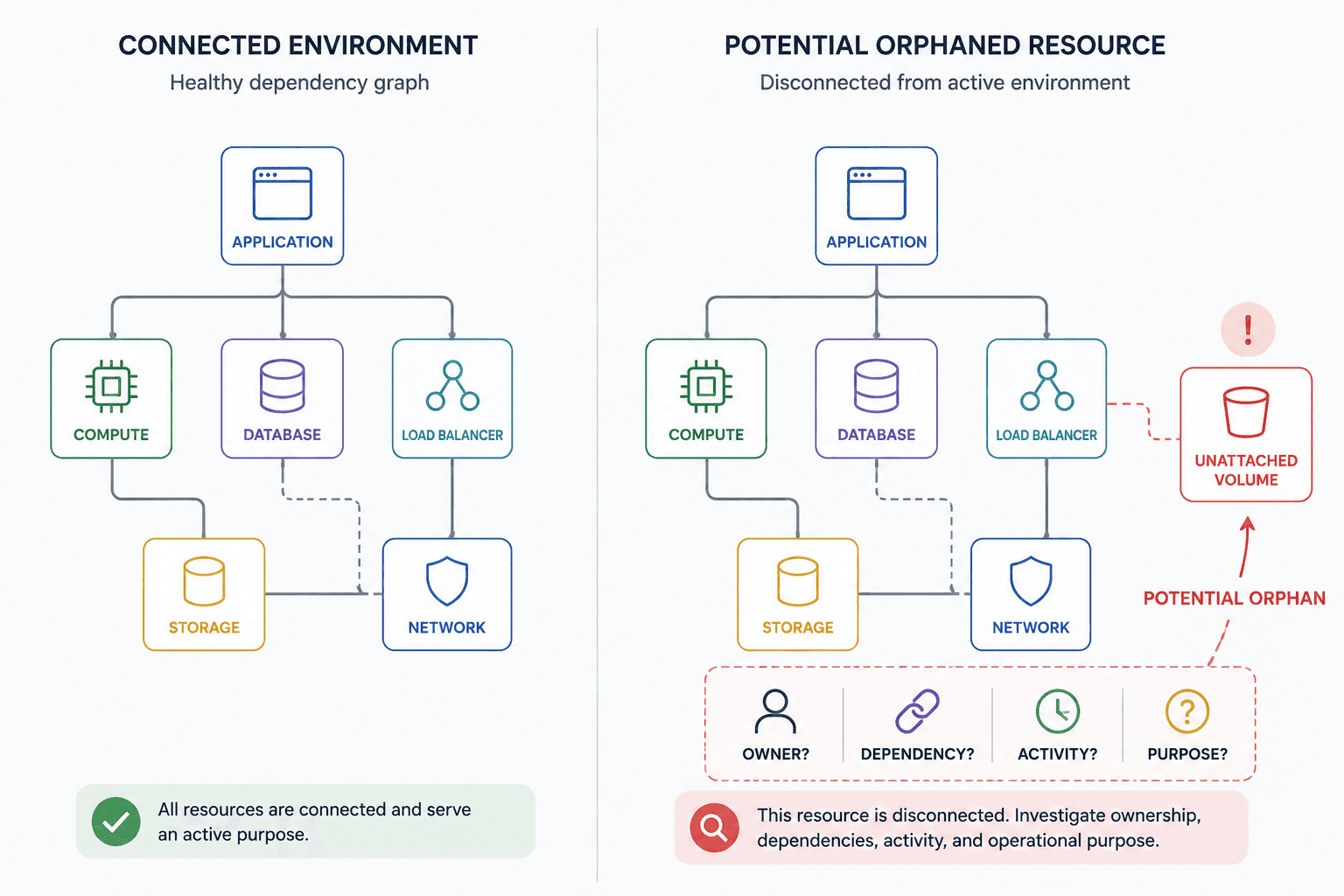
Cloud infrastructure rarely exists in isolation. Resources depend on one another through attachments, references, network paths, identity relationships, configuration, DNS, application dependencies, and data flows.
This makes dependency analysis particularly important when identifying orphaned infrastructure.
Consider an unattached storage volume. The provider can easily report that it is not currently attached to a virtual machine, but that does not automatically mean it should be deleted. It may be awaiting attachment to a replacement instance, retained during an incident investigation, or preserved because of a recovery requirement.
Similarly, an apparently idle load balancer may still be referenced by DNS. A database with low utilization may still receive occasional requests from a critical application.
The question is therefore not simply "What is this resource connected to right now?" It is also "What systems, processes, or organizational requirements still depend on it?"
Ownership Is One of the Strongest Signals
Technical signals become much more useful when combined with ownership information.
Imagine finding a database that has received almost no application traffic for 60 days. If the database belongs to an active production environment with a clearly identified owner, the next step is straightforward: ask the responsible team whether it is still required.
If the same database exists in an old development environment with no known owner and no corresponding application, the evidence of orphaning becomes much stronger.
This is why cloud governance and resource cleanup are closely related. Ownership information gives technical findings organizational meaning.
Unfortunately, ownership is often encoded primarily through resource tags, and those tags may be incomplete or unreliable. An individual resource might have no useful metadata even when the surrounding AWS account, Azure subscription, or GCP project has a clear organizational purpose.
In those cases, higher-level context can still narrow the investigation. Knowing that an untagged resource belongs to a production cybersecurity environment is far more useful than seeing only an opaque cloud identifier.
Cloud Tags Help, but They Cannot Be the Only Signal
Tagging strategies frequently include fields such as owner, application, environment, cost center, or expiration date. When those tags are accurate, they can be extremely useful for detecting and investigating abandoned infrastructure.
The problem is that the resources most likely to become orphaned are often the same resources whose metadata has deteriorated.
A temporary resource may have been created manually without the normal tags. The owner value may reference a team that no longer exists. An expiration tag may never have been added. Different providers or teams may also use inconsistent naming conventions.
This means an orphan-detection strategy that depends entirely on perfect tagging will systematically struggle with some of the resources most in need of investigation.
Tags should therefore be treated as one source of evidence rather than the entire source of truth.
Infrastructure as Code Provides Another Clue
Infrastructure as Code can provide valuable lifecycle context because it describes infrastructure that an organization intentionally manages.
If a resource exists in the cloud but cannot be associated with an active Terraform configuration, CloudFormation stack, deployment pipeline, or other managed infrastructure definition, that may be a useful orphan signal.
Again, it is not proof. Organizations frequently operate legitimate manually managed resources, imported infrastructure, or systems that predate their current IaC practices.
The stronger pattern appears when multiple indicators agree. A resource that is absent from active IaC, has no identifiable owner, shows no meaningful activity, and appears disconnected from active workloads deserves significantly more attention than one that triggers only a single condition.
Detecting Orphans Across AWS, Azure, and Google Cloud
The fundamental problem is similar across cloud providers, but the resources and APIs involved differ.
AWS environments may accumulate unattached EBS volumes, unused Elastic IP addresses, old snapshots, idle load balancers, abandoned RDS instances, or infrastructure left in forgotten accounts and regions.
Azure environments can contain unattached managed disks, unused public IP addresses, old snapshots, abandoned databases, networking resources, or infrastructure remaining in subscriptions and resource groups that no longer have active workloads.
Google Cloud environments may include persistent disks, static external IP addresses, snapshots, load balancing components, databases, or resources remaining in old projects.
Native provider tools can help identify individual conditions, but enterprises operating across clouds face an additional challenge: determining what those provider-specific signals mean within a consistent organizational model.
The technical query changes by provider. The investigation questions remain remarkably similar: Who owns this? What depends on it? Is it active? Why does it still exist?
Live Cloud Investigation Matters
Cloud environments change too quickly for orphan investigation to depend entirely on stale representations of infrastructure.
An engineer investigating a suspected orphan needs to understand what is true now. Is the volume still unattached? Does the database currently have connections? Is the IP address associated with anything? Does the load balancer have healthy targets? What other infrastructure references the resource?
This makes live cloud investigation particularly useful.
Rather than relying only on a previously collected snapshot of the environment, teams can query the current cloud state as part of the investigation. Natural-language interfaces can make this process easier by allowing operators to ask questions such as:
Which unattached storage volumes in our development environments have had no activity for the last 60 days?
or:
Show me resources in this account that appear to have no active workload or identifiable owner.
The value is not simply the natural-language interface. It is the ability to combine an operational question with current cloud information and organizational context.
Be Careful With Automatic Deletion
Once orphan detection becomes reliable, automatic deletion can appear to be the obvious next step.
That is where organizations need to be careful.
The cost of leaving an unnecessary disk running for another week is usually small compared with deleting a disk that contained important data. Similar risk exists with databases, snapshots, IP addresses, and networking components.
A mature cleanup workflow should therefore distinguish between detection, confidence, approval, and remediation.
High-confidence, low-risk resources may eventually support greater automation. Other resources may need owner confirmation, a quarantine period, a backup, a pull request, or explicit approval before deletion.
Automation should reflect the consequences of being wrong.
From Orphan Detection to Intelligent Remediation
Orphan detection is another example of why cloud findings need a path toward resolution.
Once a resource has been identified as a likely orphan and the organization has sufficient confidence that it can be removed, the remediation should ideally be reproducible and auditable.
If the infrastructure is managed through IaC, cleanup may involve modifying the corresponding configuration rather than simply deleting the resource through a console. In other cases, a controlled operational workflow may be more appropriate.
AI can help analyze the evidence, identify relevant configuration, propose the required change, and prepare remediation. For IaC-managed infrastructure, that remediation can move through a Git pull request so engineers can review exactly what will change before deployment.
This preserves an important principle: detecting an orphan should not automatically grant a system permission to delete it.
How Strato Cloud Helps Investigate Orphaned Resources
Strato Cloud approaches cloud visibility differently from systems that depend on maintaining a traditional inventory of every individual cloud resource.
Instead of requiring every resource to be continuously ingested into a separate inventory, Strato Cloud enables teams to query their live AWS, Azure, and Google Cloud environments and investigate current cloud state.
Strato Cloud does maintain organizational context around higher-level environments and identities. AWS accounts, Azure subscriptions, GCP projects, and synchronized cloud identities can be organized using cloud-agnostic namespaces and labels that represent concepts such as ownership, environment, business function, or criticality.
That context becomes valuable during orphan investigation.
An individual resource may have poor or missing native tags, but the account, subscription, project, or namespace around it can still provide clues about who owns the environment and how important it is. Teams can combine that organizational context with live cloud queries to investigate whether suspicious resources remain connected to active workloads or continue serving an operational purpose.
Continuous Governance can identify conditions that deserve attention, while Intelligent Remediation can help move confirmed problems toward controlled resolution.
The goal is not simply to create a longer list of cloud resources. It is to help teams answer the more useful question: What exists in our cloud right now that may no longer need to be there, and what should we do about it?
Frequently Asked Questions
What is an orphaned cloud resource?
An orphaned cloud resource is infrastructure that remains after losing the workload, owner, deployment, dependency, or operational purpose that originally justified its existence.
Are orphaned resources the same as unused resources?
No. Low or zero utilization can indicate that a resource may be orphaned, but some legitimate resources are rarely used. Orphan detection should also consider dependencies, ownership, deployment state, business context, and lifecycle requirements.
What are common examples of orphaned cloud resources?
Common examples include unattached storage volumes, unused IP addresses, old snapshots, abandoned databases, obsolete load balancers, networking components, and resources left behind by development or test environments.
Why are orphaned cloud resources a security risk?
They may still contain data, expose network services, retain IAM relationships, run vulnerable software, or connect to other systems while receiving little operational attention because nobody actively owns them.
Can cloud tags identify orphaned resources?
Tags can help identify ownership, environment, expiration, and purpose, but they should not be the only signal. Orphaned resources frequently have missing, outdated, or inconsistent metadata.
Should orphaned cloud resources be automatically deleted?
Not necessarily. Organizations should consider the confidence of the detection and the consequences of deletion. Sensitive resources may require owner confirmation, backup, quarantine, human review, or other safeguards before removal.
How can Infrastructure as Code help detect orphaned resources?
A resource that exists in the cloud but is absent from the organization's active IaC may deserve investigation. This signal becomes stronger when combined with low activity, missing ownership, and lack of active dependencies.
How do you detect orphaned resources in a multi-cloud environment?
Provider-specific APIs and signals can identify potentially abandoned infrastructure in AWS, Azure, and Google Cloud. Organizations should then combine those technical signals with common questions around ownership, dependencies, activity, business purpose, and lifecycle.