Published:
Estimated reading time:
7–9 minutes

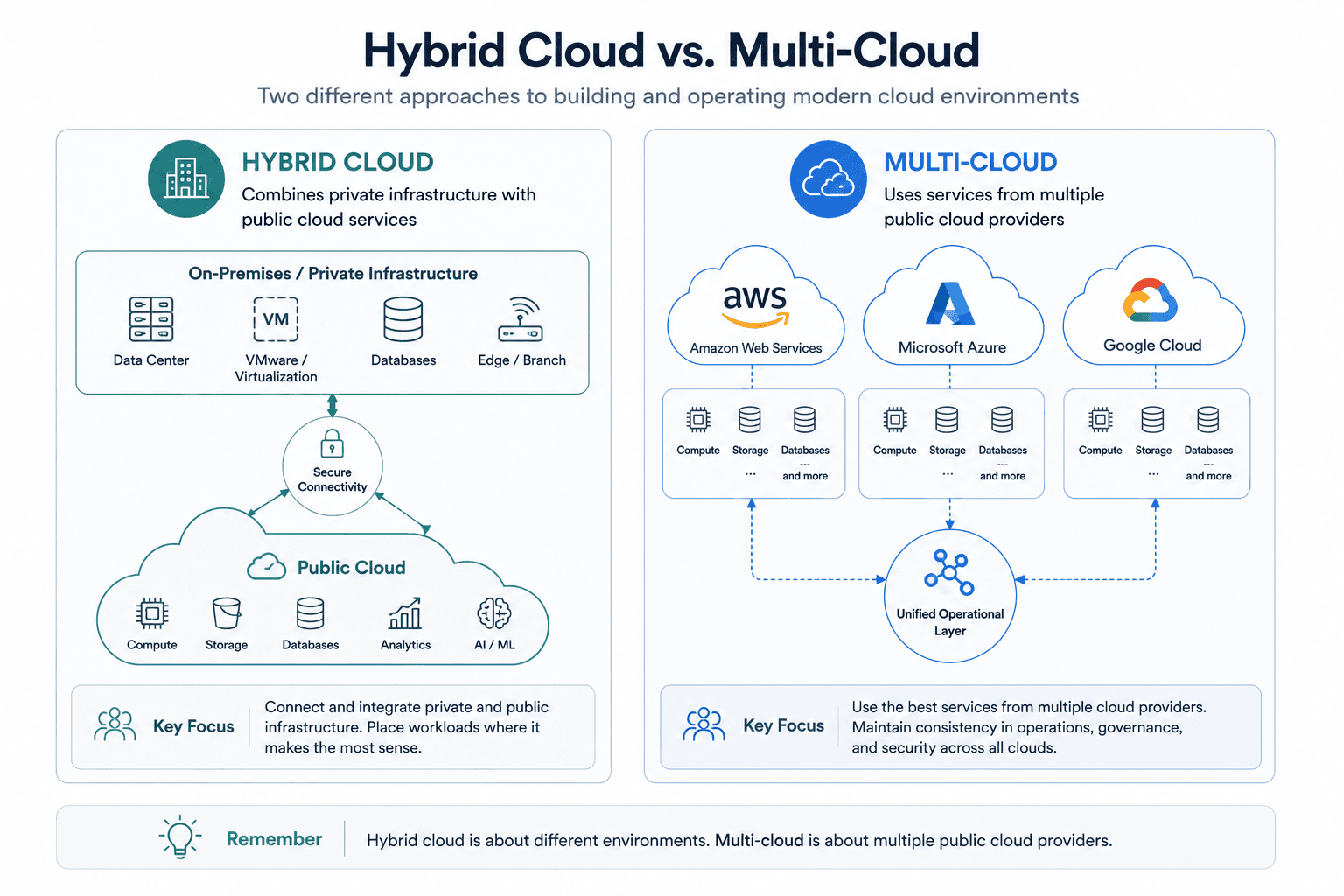
If you've spent any time researching cloud architecture, you've probably seen the terms multi-cloud and hybrid cloud used interchangeably. While they are closely related, they describe different approaches to building and operating modern IT environments.
Understanding the difference is important because each approach solves a different business problem. Hybrid cloud focuses on connecting private infrastructure with public cloud services. Multi-cloud focuses on using services from multiple public cloud providers. Many organizations eventually become both.
This guide explains how the two models differ, why organizations adopt them, and how to decide which approach best fits your environment.
What Is Hybrid Cloud?
A hybrid cloud combines private infrastructure with public cloud services. Private infrastructure can include traditional data centers, VMware environments, edge locations, or private cloud platforms.
The goal is to allow applications, data, and services to operate across both environments. Some workloads remain on private infrastructure while others run in the public cloud. Organizations can move workloads between environments as business and technical requirements change.
Hybrid cloud became popular as companies modernized existing infrastructure instead of replacing everything at once. Today, it remains common because many organizations continue to operate systems that are difficult, expensive, or unnecessary to move entirely into the cloud.
Examples include:
Manufacturing systems
Healthcare applications
Financial platforms
Industrial control systems
Legacy ERP applications
Edge computing workloads
For many organizations, hybrid cloud is simply the most practical way to modernize while continuing to support existing investments.
What Is Multi-Cloud?
Multi-cloud is the practice of using services from two or more public cloud providers.
The most common providers are Amazon Web Services (AWS), Microsoft Azure, and Google Cloud Platform (GCP). An organization may use one provider for application hosting, another for analytics, and another for artificial intelligence or machine learning.
Unlike hybrid cloud, multi-cloud is not about connecting public cloud with private infrastructure. It is about operating across multiple public cloud ecosystems.
Organizations often become multi-cloud gradually. Acquisitions, independent engineering teams, regulatory requirements, and choosing the best platform for specific workloads all contribute to a multi-cloud environment.
The Difference at a Glance
The simplest way to remember the difference is this:
Hybrid cloud connects different infrastructure environments.
Multi-cloud uses multiple public cloud providers.
Although the definitions are simple, the operational challenges are very different.
Hybrid Cloud | Multi-Cloud | |
|---|---|---|
Primary goal | Connect private and public infrastructure | Use multiple public cloud providers |
On-premises infrastructure | Yes | Optional |
Public cloud providers | One or more | Two or more |
Primary challenge | Infrastructure integration | Operational consistency |
Identity complexity | Moderate | High |
Governance complexity | Moderate | High |
Common in large enterprises | Yes | Yes |
Most Enterprises Use Both
One of the biggest misconceptions is that organizations must choose between hybrid cloud and multi-cloud. In reality, most large enterprises operate both.
Imagine a global retailer with stores, warehouses, and online services around the world. Customer-facing applications run in AWS. Internal collaboration tools and Microsoft workloads run in Azure. Data scientists use Google Cloud for analytics and machine learning. Meanwhile, warehouse systems and older ERP applications continue to operate in private data centers.
This organization is both hybrid cloud and multi-cloud. Its biggest challenge is no longer deciding where workloads run. The challenge is managing all of those environments consistently.
Different Architectures Create Different Challenges
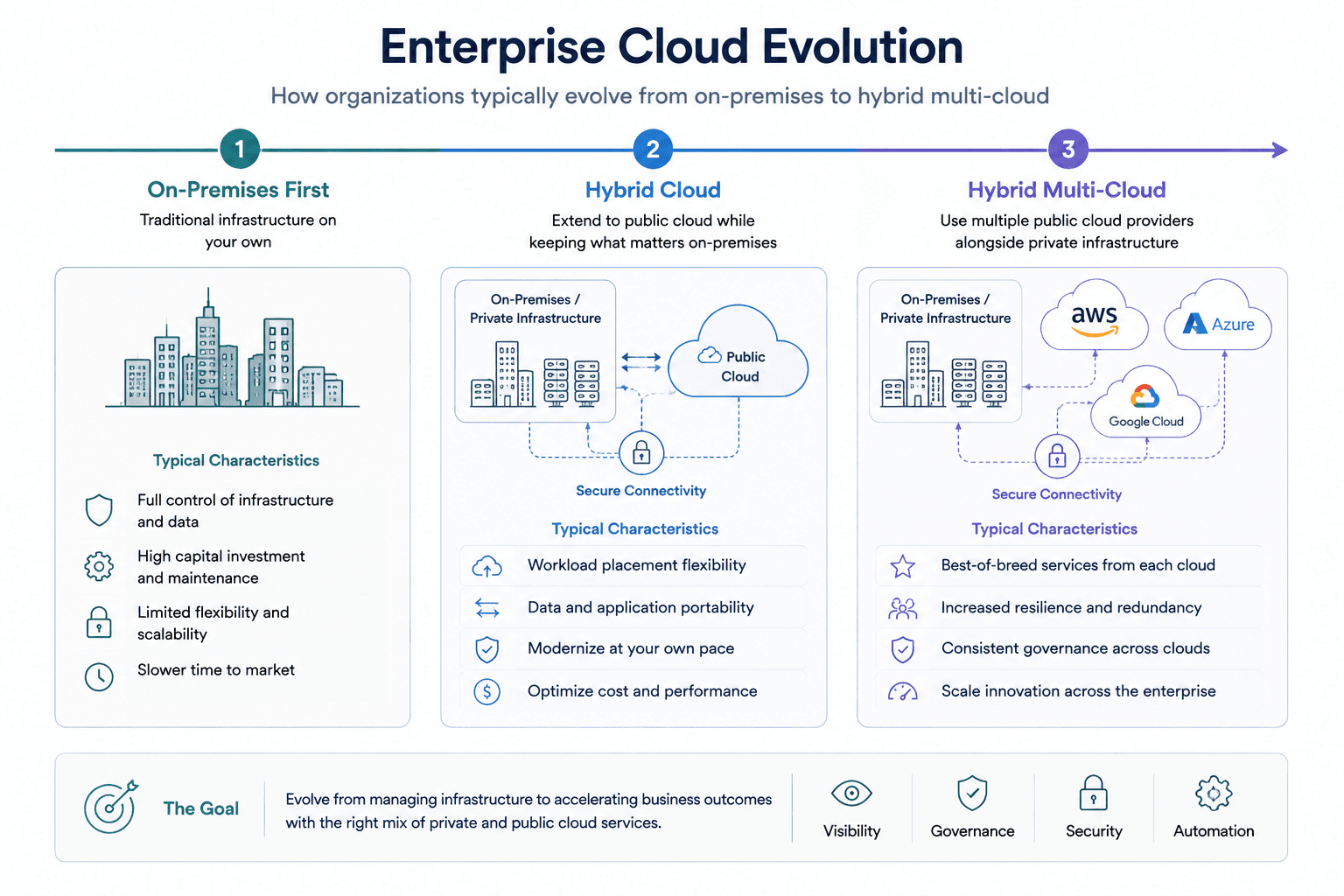
Hybrid cloud and multi-cloud require different operational priorities because they solve different problems.
A hybrid cloud strategy focuses on connecting environments. Organizations spend time designing networks, synchronizing data, planning disaster recovery, and deciding where workloads should run.
A multi-cloud strategy focuses on operating consistently across providers. Engineering and security teams must manage different identity systems, resource models, policy engines, APIs, and management tools.
As organizations grow, those operational differences become more significant than the infrastructure itself.
Why Multi-Cloud Is Often More Complex
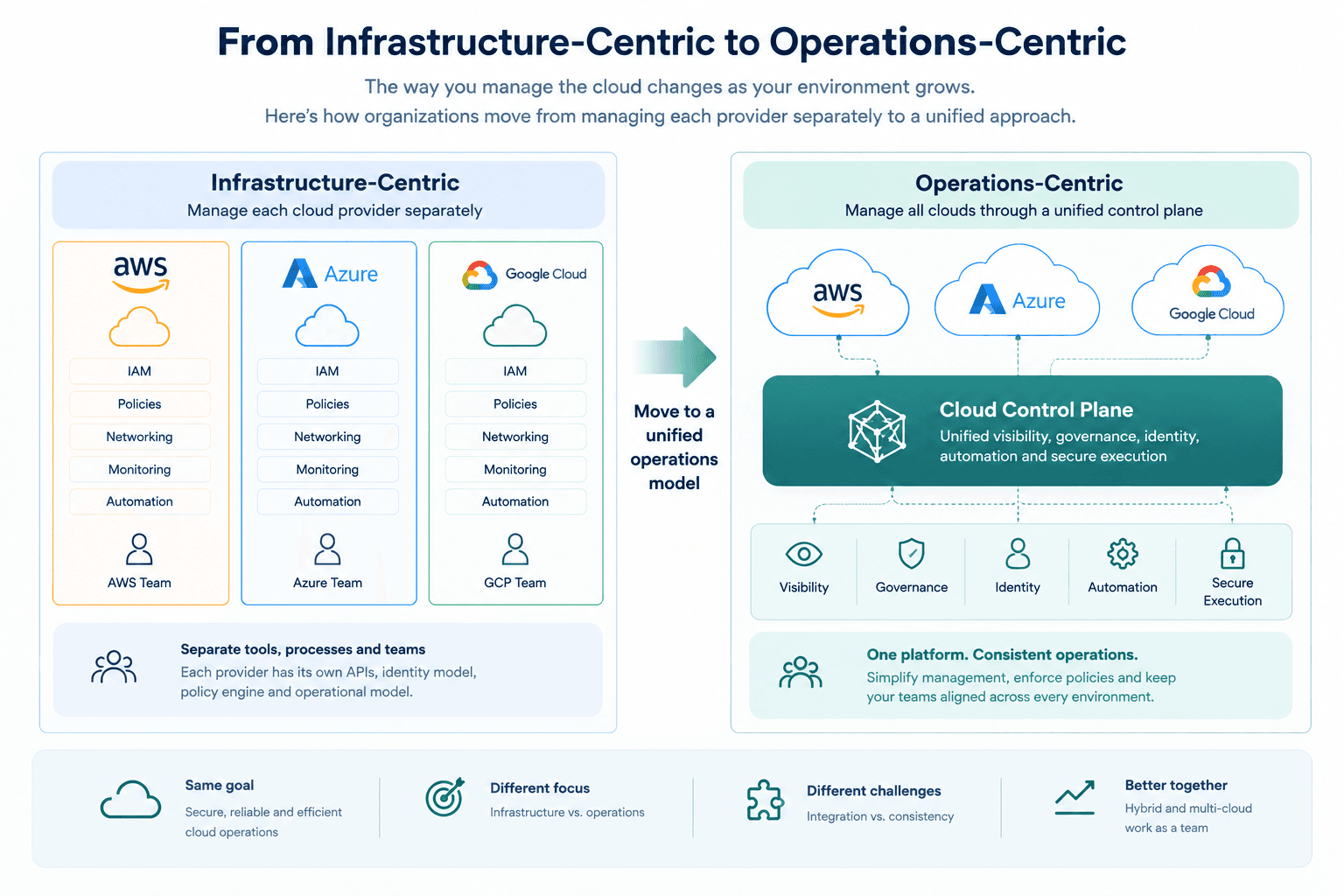
Every public cloud provider has its own way of organizing resources, managing identities, enforcing policies, and exposing APIs. Engineers who are comfortable in AWS must learn different concepts when working in Azure or Google Cloud.
As a result, common operational questions become harder to answer.
Who owns this resource?
Which identities have administrative access?
Which resources contain sensitive data?
Which policies apply to this workload?
What changed yesterday?
Answering these questions across multiple providers often requires several dashboards, different APIs, and separate operational processes.
This is why many organizations discover that managing multiple clouds is not primarily an infrastructure problem. It is an operational one.
A Shift in Perspective
As organizations mature, they stop thinking about managing individual cloud providers and start thinking about managing the business as a whole.
Instead of asking, "How do we manage AWS?" they begin asking, "How do we consistently manage AWS, Azure, and Google Cloud together?"
That shift changes the conversation from infrastructure to operations. It also explains why many organizations adopt a cloud control plane that provides consistent visibility, governance, identity management, automation, and secure execution across providers.
Which Approach Is Right for Your Organization?
There is no universal answer because every organization has different business requirements.
A hybrid cloud strategy makes sense when private infrastructure continues to play an important role. This is common for organizations with regulatory requirements, specialized hardware, or long-lived applications that are not practical to migrate.
A multi-cloud strategy becomes relevant when workloads span multiple public cloud providers. This often happens naturally as organizations grow, acquire new companies, or adopt specialized cloud services.
Many enterprises eventually find themselves operating both architectures at the same time. At that point, the focus shifts from building infrastructure to simplifying operations.
Frequently Asked Questions
Can you have hybrid cloud without multi-cloud?
Yes. An organization that connects a private data center to AWS is operating a hybrid cloud, but it is not multi-cloud because it uses only one public cloud provider.
Can you have multi-cloud without hybrid cloud?
Yes. An organization that runs workloads entirely in AWS, Azure, and Google Cloud without any private infrastructure is multi-cloud but not hybrid cloud.
Is hybrid cloud becoming less common?
No. Many organizations continue to operate critical systems in private infrastructure for business, technical, or regulatory reasons. Hybrid cloud remains an important architecture across many industries.
Why do so many enterprises become multi-cloud?
The most common reasons include acquisitions, independent engineering teams, regulatory requirements, and choosing the best cloud provider for specific workloads. Few organizations become multi-cloud because they planned to from the beginning.
Key Takeaways
Hybrid cloud and multi-cloud are complementary architectures that solve different problems.
Hybrid cloud focuses on connecting private infrastructure with public cloud services. Multi-cloud focuses on operating across multiple public cloud providers.
Most large organizations eventually become both. As that complexity grows, success depends less on the infrastructure itself and more on maintaining consistent visibility, governance, identity management, and automation across every environment.
Related Reading
How Strato Cloud Helps
Whether your organization is hybrid cloud, multi-cloud, or both, the operational challenge is creating consistency across every environment.
Strato Cloud provides a unified control plane for AWS, Azure, and Google Cloud that helps organizations improve visibility, simplify governance, secure access, and automate cloud operations. This allows engineering teams to spend less time managing provider-specific differences and more time delivering secure, reliable infrastructure.