Published:
Estimated reading time:
8–9 minutes

Cloud platforms contain an enormous amount of information.
The problem is getting to it.
An engineer investigating a production issue might move between a cloud console, monitoring system, IAM configuration, load balancer settings, networking rules, logs, command-line tools, and internal documentation before understanding what is happening.
Each system may contain part of the answer.
Now imagine beginning with the question instead:
What is exposed to the internet in production?
Then:
What is behind that load balancer?
Then:
Which security groups allow traffic to those resources?
Then:
Who owns that environment?
This is the idea behind Talk to Your Cloud.
It is not simply putting a chatbot next to a cloud dashboard. It is creating an interface where people can express operational intent in natural language while an AI system determines how to investigate the cloud, gathers current information, preserves context between questions, and returns an answer that reflects both cloud state and organizational context.
Done well, the conversation becomes an interface to the cloud itself.
What Does It Mean to Talk to Your Cloud?
Talking to your cloud means being able to ask questions about cloud environments in natural language and have an AI system investigate those environments to determine the answer.
The user does not need to begin by knowing which cloud service, console page, API, or command contains the information.
They begin with the question.
For example:
Which production environments do I have?
Which of them have resources exposed to the internet?
What is behind this application load balancer?
Which databases are connected to this application?
Who owns the account where this resource is running?
Each question may require different cloud APIs and different types of reasoning.
A useful conversational cloud system translates the user's operational intent into the technical investigation required to answer it.
That changes the interface from:
Know the cloud API → retrieve data → interpret it
to:
Ask the operational question → investigate → understand
Natural language is the interface, but the investigation behind it is what makes the experience valuable.
A Chatbot Is Not the Same as Talking to Your Cloud
It is easy to describe any AI interface attached to a cloud product as conversational cloud management.
But a chatbot can only be as useful as the information and capabilities behind it.
Imagine connecting a large language model to documentation about AWS.
You could ask:
How do I determine whether an EC2 instance is publicly accessible?
The model could explain security groups, public IP addresses, route tables, load balancers, and other relevant concepts.
That is useful cloud knowledge.
Now ask:
Which of my production workloads are publicly accessible right now?
That is a completely different question.
The answer requires access to the organization's cloud environments.
The system needs to determine which environments are production, inspect their current configuration, understand the relationships between resources, and evaluate what is actually exposed.
The difference is between knowing about the cloud and knowing what is happening in your cloud.
Talking to your cloud requires the second.
Live Cloud State Changes the Conversation
Many cloud management systems maintain an inventory of resources.
They periodically collect information from cloud providers, normalize it, store it, and allow users or applications to query that representation.
This architecture is useful for many purposes, including historical analysis, reporting, search, and correlation.
But it introduces an important distinction.
The system may be answering questions about what it previously observed, not necessarily what exists in the cloud when the question is asked.
For some questions, that distinction does not matter.
For operational investigation, it can matter a great deal.
Suppose an engineer asks:
Why is this application unreachable?
The answer might depend on a security group changed five minutes ago, a load balancer target that just became unhealthy, or a DNS configuration modified during a deployment.
A synchronized inventory may not yet reflect those changes.
An AI system capable of querying live cloud APIs can investigate the environment as it exists during the conversation.
That changes the meaning of the answer.
It is no longer simply:
According to the data we collected earlier...
It can become:
Here is what the cloud is reporting now.
The AI Needs Tools, Not Just Knowledge
A language model cannot understand a live cloud environment simply because it knows how AWS, Azure, or Google Cloud work.
It needs tools.
Those tools might allow it to inspect:
cloud accounts, subscriptions, and projects
compute resources
networking configuration
load balancers
storage
databases
identity and permissions
logging and monitoring
managed services
resource relationships
The AI can then reason about which tools are required for a particular investigation.
If the user asks:
What is exposed to the internet?
the system may need to inspect public endpoints, load balancers, network rules, public IP addresses, and the resources behind those entry points.
If the next question is:
What databases can those applications reach?
the investigation changes.
The AI may need to follow relationships from the exposed application into compute, networking, configuration, and database services.
The conversation remains simple for the user even though the investigation behind it may involve many provider APIs.
Conversation Preserves the Investigation
Cloud troubleshooting rarely consists of one question.
Engineers investigate incrementally.
They discover something, ask a narrower question, follow a dependency, test a hypothesis, and continue until they understand the system.
Consider:
Which production environments have internet-facing applications?
The answer identifies three environments.
The engineer continues:
Show me what is exposed in the payments environment.
Then:
What is behind that load balancer?
Then:
Does that application have access to any databases?
Then:
Who owns this environment?
The meaning of phrases such as "that load balancer," "that application," and "this environment" depends on the preceding conversation.
A useful Talk to Your Cloud system preserves this investigative context.
Instead of forcing the engineer to restart every query with complete resource identifiers and account information, the conversation becomes the working context for the investigation.
This makes conversational interaction particularly well suited to exploratory cloud operations.
Organizational Context Matters as Much as Cloud State
Cloud APIs can tell you a great deal about infrastructure.
They cannot always tell you what that infrastructure means to the business.
An AWS account ID does not necessarily tell you which team owns it.
An Azure subscription may not explain whether it supports production or development.
A GCP project name may not communicate how critical the workload is.
Organizations need another layer of context.
Useful information might include:
environment
owner
business function
application
criticality
organizational namespace
cloud account, subscription, or project
relevant identities
Now consider an operational question:
Which internet-facing environments should I be most concerned about?
Cloud configuration can identify exposure.
Organizational context can help distinguish a critical production cybersecurity environment from a development environment owned by an internal product team.
The infrastructure provides technical context.
The organization provides business context.
Useful cloud reasoning needs both.
Multi-Cloud Makes Conversation More Valuable
AWS, Azure, and Google Cloud expose different APIs, resource models, identity systems, networking concepts, and terminology.
Engineers working across all three need to understand those differences.
The business question may still be simple:
Which production environments are publicly exposed?
Without a higher-level interface, answering that question may require different tools and queries for every provider.
A conversational system can preserve the common intent while translating the investigation into provider-specific operations underneath.
The user asks one organizational question.
The system determines how to investigate AWS, Azure, and Google Cloud.
This does not make the cloud providers identical.
It creates a common interface above their differences.
The Hard Part Is Authorization
Giving AI tools capable of inspecting cloud infrastructure introduces an immediate security question:
What should the AI be allowed to see?
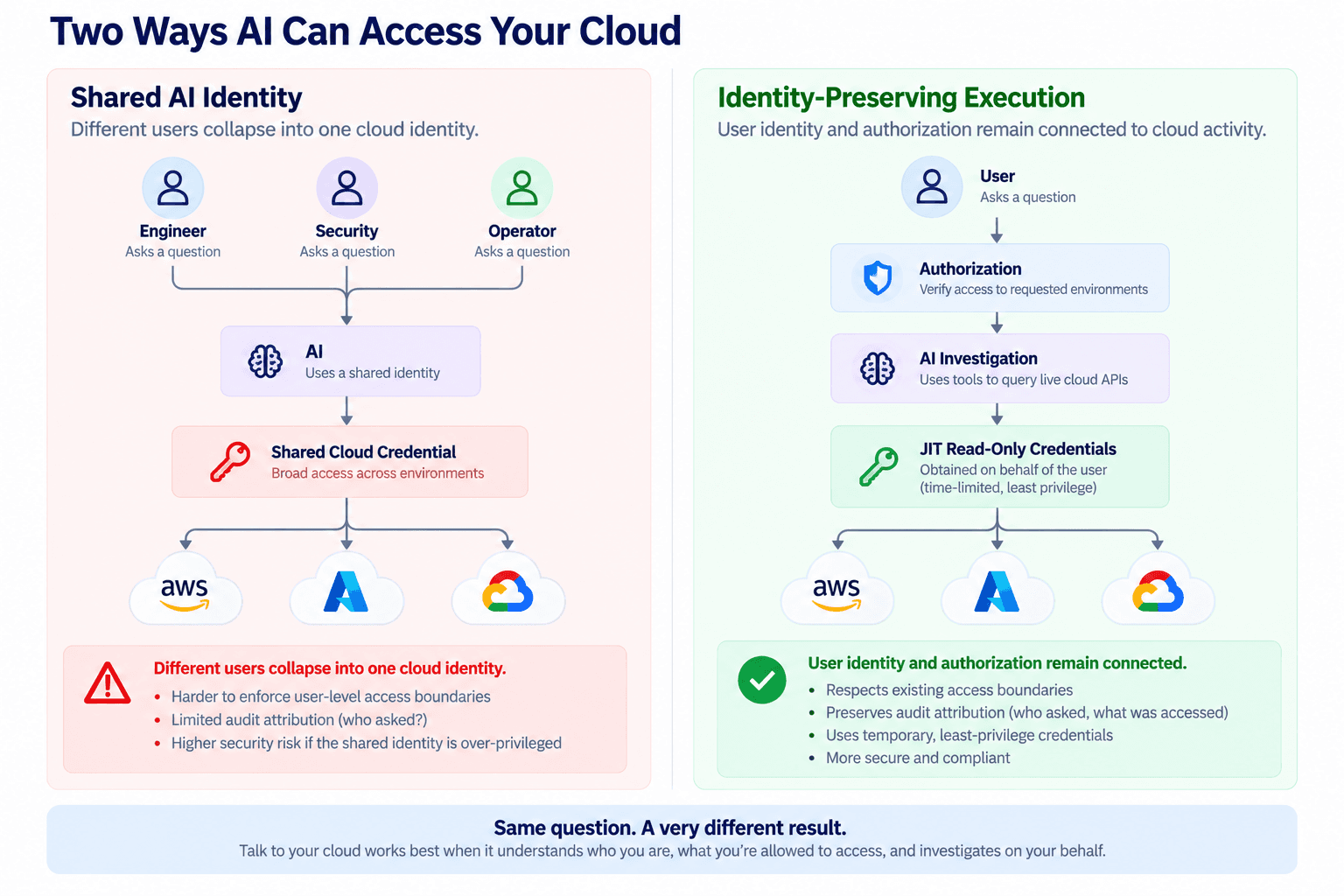
One simple architecture is to create a service account for the AI and give it read access to every cloud environment.
Users ask questions, and the AI performs every investigation using that shared identity.
That is convenient.
It also creates problems.
A user who is not authorized to inspect a production environment could potentially ask the AI questions about it unless the application independently recreates every relevant access boundary.
The AI service identity may also have broader access than any individual user should possess.
Conversational cloud access should not become a shortcut around cloud authorization.
The user's ability to ask a question should remain constrained by what they are actually authorized to access.
The Identity Behind the Question Matters
Authorization is only half of the identity problem.
Auditability matters too.
Suppose 100 engineers use the same AI service identity to investigate cloud environments.
The cloud provider's audit logs may accurately record thousands of API calls from the AI identity.
But those logs no longer directly represent the humans whose questions caused those calls.
Many different users have collapsed into one intermediary identity.
For operational and security investigations, organizations increasingly need to answer:
Who asked the AI to perform this investigation?
Was that person authorized to access the environment?
Under whose authority were the cloud API calls performed?
What credentials were used?
What did the investigation access?
A stronger architecture preserves the identity of the person initiating the investigation through the execution chain.
Conceptually:
User → Authorization → Temporary Credentials → Cloud APIs
The AI becomes an execution intermediary without becoming an identity replacement.
Temporary Credentials Reduce the Trust Given to AI
An AI system investigating infrastructure does not necessarily need permanent cloud credentials.
Credentials can instead be obtained when an authorized investigation begins and expire afterward.
For read-only investigation, those credentials can also be limited to the permissions required to inspect the environment.
This creates a more constrained model:
verify the user → authorize the environment → issue temporary access → investigate → expire access
The AI receives the capability it needs for the investigation without requiring a permanently privileged identity.
This becomes increasingly important as AI systems gain more tools and participate in more cloud operations.
Investigation and Execution Should Be Separate Trust Decisions
Talking to your cloud naturally leads to another question:
Can I ask it to fix something?
Eventually, conversational cloud interfaces will move beyond answering questions.
A user might ask:
Why is this resource non-compliant?
and then:
Fix it.
But understanding an environment and modifying it are different trust decisions.
Read-only investigation can often happen safely with constrained temporary access.
Infrastructure changes require stronger controls.
An AI system should not automatically receive unrestricted write access simply because it can understand the user's request.
A safer model separates investigation from execution.
The AI can identify the problem, understand the desired outcome, and propose a change. The actual modification can then move through an authorized remediation workflow with validation, traceability, and human review where appropriate.
Conversation becomes the interface to the intent without removing the controls surrounding execution.
From Cloud Conversation to Cloud Control Plane
Once conversational interaction can combine live cloud state, organizational context, authorization, identity, and governed actions, it begins to look like something larger than a chatbot.
It becomes an interface to a cloud control plane.
The conversation can help users move through several stages:
Ask → Investigate → Understand → Decide → Act
The AI interprets intent.
Cloud APIs provide current technical state.
Organizational metadata provides business context.
Identity determines what the user is authorized to access.
Secure execution provides constrained credentials.
Governance and remediation systems determine how actions can proceed.
This is the deeper meaning of talking to your cloud.
Natural language is simply the surface.
The architecture behind the conversation determines whether the system is useful, trustworthy, and safe.
How Strato Cloud Approaches Talk to Your Cloud
Strato Cloud's Talk to Your Cloud capability is designed around this model.
Users can ask operational questions across AWS, Azure, and Google Cloud without first determining which provider console, API, or command they need to use.
Live Cloud Investigation
Strato Cloud does not need to maintain a synchronized inventory of every individual cloud resource in order to answer operational questions.
When an investigation requires current resource information, the system can query the live cloud environment.
This allows the AI to reason about the environment based on current cloud state and follow the investigation across services as the conversation develops.
Organizational Context
Strato Cloud does maintain context about the higher-level structures surrounding those resources.
AWS accounts, Azure subscriptions, GCP projects, Strato Cloud namespaces, synced cloud identities, and cloud-agnostic labels provide information about how environments relate to the organization.
Labels can describe concepts such as ownership, environment, business function, or criticality.
This allows an investigation to combine what the cloud reports with what the infrastructure means to the business.
Authorization Before Investigation
Before an AI investigation accesses a cloud environment, Strato Cloud verifies that the requesting user is authorized to access that environment.
The ability to ask the AI a question does not grant access to infrastructure the user could not otherwise inspect.
This keeps conversational cloud investigation inside the organization's access boundaries.
Secure Execution on Behalf of the User
Once the user is authorized, Strato Cloud's Secure Execution capabilities can obtain temporary, just-in-time, read-only cloud credentials on behalf of that user.
The AI uses those credentials to perform the investigation.
This is different from giving one shared AI identity broad read access to every environment.
The execution chain remains associated with the human whose request initiated the investigation:
User → Talk to Your Cloud → Authorization → Secure Execution → JIT Read-Only Credentials on Behalf of User → Cloud APIs
The AI can investigate the cloud without becoming an identity middleman that obscures who caused the activity.
From Understanding to Governed Action
The conversation can also connect to the broader Strato Cloud control plane.
Continuous Governance can identify requirements and findings.
Compliance assessments can evaluate environments against standards.
Intelligent Remediation can turn selected findings into proposed Infrastructure as Code changes that are validated and delivered through pull requests.
Secure Execution governs how humans, workloads, and AI systems receive cloud access.
Talk to Your Cloud provides a conversational interface for understanding the environment around those workflows.
The important distinction is that conversation does not replace governance, identity, or engineering controls.
It makes those systems easier to interact with.
What Should You Expect From a Talk to Your Cloud System?
A useful conversational cloud system should do more than generate plausible answers about cloud technology.
It should be able to:
investigate current cloud state
reason across multiple cloud services
preserve context across follow-up questions
understand organizational context
operate across multiple cloud providers
respect the requesting user's authorization
preserve identity through cloud execution
use constrained, temporary credentials
maintain an auditable execution chain
separate investigation from privileged action
Without these capabilities, a conversational interface risks becoming either a chatbot that knows cloud documentation or an overly privileged AI service account.
Neither fully delivers the idea.
The Future Cloud Interface May Begin With a Question
Cloud consoles are not going away.
Dashboards remain useful for monitoring known metrics. Resource browsers remain useful when engineers already know what they are looking for. CLI tools and APIs remain essential for automation and precise operations.
Conversation solves a different problem.
It is particularly powerful when the engineer knows what they want to understand but not necessarily where the answer lives.
Instead of navigating the structure of the cloud provider, the user can begin with intent.
What is exposed?
Why is this application unhealthy?
What is behind this endpoint?
Who owns this environment?
What changed?
The AI can translate those questions into cloud investigations while preserving the context, identity, and controls required to perform them safely.
That is what it really means to talk to your cloud.
Frequently Asked Questions
What does “Talk to Your Cloud” mean?
Talk to Your Cloud describes using natural language to investigate and interact with cloud environments. The AI translates operational questions into the cloud API calls and reasoning required to answer them.
Is Talk to Your Cloud just a chatbot?
No. A chatbot can answer general questions about cloud technology. Talking to your cloud requires access to the organization's actual cloud environments, tools for investigating them, current cloud state, organizational context, and appropriate authorization.
Does conversational cloud management require a cloud resource inventory?
Not necessarily. A system can query live cloud APIs when resource information is needed. Inventories can still be useful for other purposes, including historical analysis and reporting.
Why is live cloud state important?
Operational environments change frequently. Querying current cloud APIs can help an investigation reflect what exists when the question is asked rather than relying only on information collected earlier.
Can Talk to Your Cloud work across AWS, Azure, and Google Cloud?
Yes. Natural language can provide a common interface while the system translates the investigation into provider-specific APIs and operations underneath.
Should an AI agent have its own cloud credentials?
Not necessarily. A more constrained model can authorize the requesting user and issue temporary credentials for the investigation rather than maintaining a broadly privileged permanent AI identity.
Why does user identity matter for AI cloud investigations?
Preserving user identity helps maintain access boundaries and provides stronger audit attribution. Organizations can understand who initiated the investigation and under whose authority the resulting cloud activity occurred.
Can conversational AI modify cloud infrastructure?
It can participate in workflows that lead to infrastructure changes, but investigation and modification should be treated as separate trust decisions. Sensitive changes can move through governed remediation workflows with validation and human review.